The Table Tennis Racket Inspection Rule, Explained (Since 1983)
Before a match, a player has to show the racket to the opponent and the umpire. That step is a written rule in the ITTF Laws of Table Tennis, not just sporting courtesy.
This page covers what the rule requires, how it differs from formal racket control testing, and which racket standards the Laws and Regulations set.
Short answer: Under Law 2.4.8 of the ITTF Laws of Table Tennis (ITTF Statutes 2026), a player must show their opponent and the umpire the racket they are about to use before the match starts and whenever they change racket during a match, and must allow them to examine it.
Table of Contents
Where the Two-Colour Requirement Came From
The ITTF’s own account of the racket colour rule (ITTF news item, 30 September 2021) gives the background. Before 1983, the regulation stated that both sides of the racket had to be the same colour. When long pimpled and anti-spin coverings appeared on the market, it became difficult for an opponent to detect which side of the racket had made contact. In 1983 the regulation was changed to two distinct colours, and in 1985 the requirement that one side be black and the other red was agreed.
Law 2.4.8 requires the player to show the racket to the opponent and the umpire before the match and to allow them to examine it. The Laws do not state a purpose for that step, so this page does not attribute one.
What the Laws Require of the Racket
Law 2.4.8 only requires the racket to be shown and examined. It does not list a checklist, so the standards come from other parts of the Laws and Regulations. Any rubber covering must be currently authorised by the ITTF (Regulation 3.2.1.3). One side must be black and the other a bright colour clearly distinguishable from black and from the colour of the ball (Law 2.4.6). The ITTF announced on 30 September 2021 that pink, purple, green and blue became officially authorised colours for racket coverings from 1 October 2021, and may be used instead of red, with one side still black.
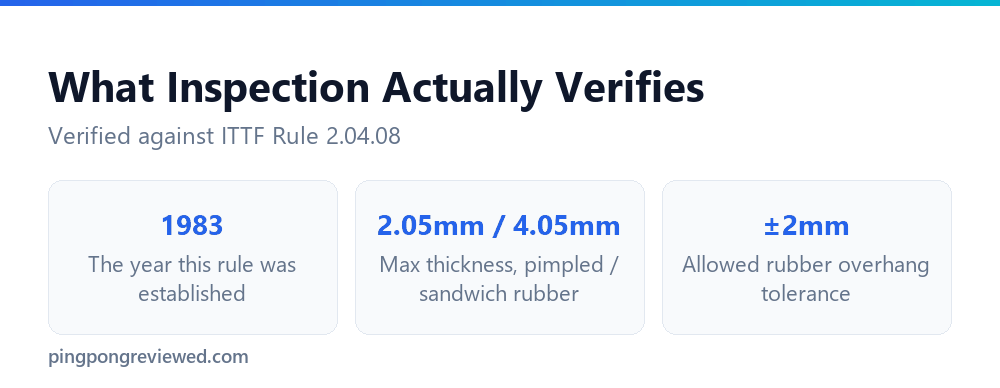
Thickness is limited by Law 2.4.3: ordinary pimpled rubber must have a total thickness including adhesive of less than 2.05mm, and sandwich rubber less than 4.05mm, subject to any margin of tolerance specified in the relevant technical equipment document. The ITTF Technical Leaflet T9 (2024 version) says racket control applies those limits plus a measurement tolerance of 0.05mm. Under Regulation 3.2.1.3 the ITTF logo, the ITTF number (when present), and the supplier and brand names must be clearly visible nearest the handle. Under Law 2.4.5 the covering material must extend up to but not beyond the limits of the blade, except for the part nearest the handle that is gripped by the fingers.
When Inspection Happens: More Often Than Just the Start
The most obvious inspection point is before the match begins, but the rule extends further than that single moment. Any time a player changes rackets mid-match, the replacement has to go through the same show-and-examine process with both the opponent and umpire again, a mid-match swap doesn’t get a pass just because the original racket already cleared inspection.
Regulation 3.4.2.5 adds that, unless the umpire authorises otherwise, players shall leave their rackets on the table during intervals. If the racket is strapped to the hand, the umpire shall allow the player to keep it strapped to the hand during intervals.
⚠️ Watch out: Regulation 3.4.2.4 says a racket shall not be replaced during an individual match unless it is accidentally damaged so badly that it cannot be used. The Laws and the Regulations for International Competitions are presumed to apply unless variations are agreed in advance or made clear in the published rules of the competition (Regulation 3.1.2.6), so a club or league may set its own rules. This isn’t a rule that lets a player freely switch rackets mid-match for tactical reasons.
Why Both the Opponent AND the Umpire Inspect
It’s worth noting the rule specifically names both parties, not just the umpire alone. Law 2.4.8 says the player shall show the racket to the opponent and the umpire and allow them to examine it. The Laws do not describe a separate role for each, so this page does not assign one.
What Happens if a Racket Fails Inspection
The Statutes cover this for formal racket control testing. Regulation 3.2.4.2.3 says rackets that do not pass the racket control test before the match cannot be used, but may be replaced by a second racket, which may be tested immediately if time permits and otherwise after the match. If a racket does not pass a random racket control test after the match, the offending player is liable to penalties. A racket control centre is established at all ITTF World Title, Olympic and Paralympic competitions and at a select number of other ITTF competitions, and may be established at Continental and Regional competitions (Regulation 3.2.4.2). The simple show-and-examine step in Law 2.4.8 does not itself set a penalty.
💡 Pro tip: If you’re a competitive player, check your own racket’s compliance, including rubber authorisation, thickness, colour and covering extent, well before match day. Regulation 3.2.4.2.4 entitles all players to have their rackets tested voluntarily, without penalties, before the match.
- ✓Show your racket to both the opponent and umpire before every match
- ✓Re-inspect any replacement racket the same way if you need to change mid-match
- ✓Keep your racket on the table during game breaks unless the umpire permits removal
- ✓Verify your own racket’s compliance well ahead of match day
- ✕Assume a racket that passed inspection once needs no further checks after a mid-match swap
- ✕Expect to freely change rackets mid-match for tactical reasons alone
- ✕Remove your racket during a break without first getting umpire permission
- ✕Wait until the pre-match inspection to discover a compliance issue
How This Applies in Recreational Play
Casual and club play without a dedicated umpire obviously can’t replicate the full formal inspection procedure, but the underlying transparency principle remains useful advice for any level of play: agreeing to show your racket to an opponent before a casual match, especially if you’re using a two-different-rubber setup that isn’t immediately obvious by looking at it, helps avoid confusion and mid-match disputes.
This is a low-cost, low-friction habit worth adopting even outside formal competition, a five-second racket show-and-tell before starting a casual match costs nothing and removes any ambiguity about what each side of the paddle actually is, benefiting both players regardless of skill level or stakes.
A Related Check: Verifying Your Own Setup Before Buying
A practical buying point follows from the Laws: a buyer assembling a custom setup with separately purchased blade and rubber sheets should verify each component’s own ITTF-approval status and thickness specifications before assuming the finished combination will pass inspection at a sanctioned event. A blade and rubber can each individually be legitimate, approved products while still combining into a setup that fails a specific thickness or overhang check if assembled incorrectly, worth confirming directly rather than assuming compliance from component reputation alone.
The Short Version, Restated
Under Law 2.4.8, every match starts with the player showing the racket to the opponent and the umpire, and every mid-match racket change triggers the same step. Under Regulation 3.4.2.5, rackets stay on the table during intervals unless the umpire says otherwise.
Racket standards can change, as the colour change effective 1 October 2021 shows, so it is worth confirming current standards rather than relying on what you remember from years ago.
The Colour Requirement’s 2021 Change
According to the ITTF news item of 30 September 2021, the rule that one side must be black and the other red was agreed in 1985, and pink, purple, green and blue became officially authorised colours for racket coverings as of 1 October 2021. They may be used instead of red, and one side must still be black. The expanded palette applies now, not the older red-only standard that some older pages still describe.
The colour list is the part of this topic most likely to be out of date on older pages, so check the current Laws and the ITTF equipment documents for the competition you are entering.
Where the Logo Has to Be
Regulation 3.2.1.3 requires any ordinary pimpled or sandwich rubber covering to be currently authorised by the ITTF and attached to the blade so that the ITTF logo, the ITTF number (when present), and the supplier and brand names are clearly visible nearest the handle. The ITTF Technical Leaflet T9 (2024 version) adds that, for racket control, the rubber must be on the current List of Authorised Racket Coverings and carry the supplier’s name, brand name and the ITTF logo.
Racket Control Tests Before and After a Match
Formal racket control is separate from the show-the-racket step in Law 2.4.8. The ITTF Technical Leaflet T9 (2024 version) describes the tests, which include checks of the regularity of the blade and coverings, the authorisation of the covering, flatness and covering thickness. It says that, in certain circumstances, a post-match racket control test may include dismantling the racket, meaning the rubber is removed from the blade.
T9 lists reasons for dismantling a racket after the match, including a thickness result that does not look reasonable to the racket tester, a measured thickness above 4.05mm that needs double-checking, and signs of preparation on visible parts of the blade. It says dismantling is done by trained racket testing staff in the racket control room.
⚠️ Watch out: T9 says that if a player fails a post-match test, the referee decides on any additional sanction, and the options it lists include a censure, reprimand or warning, a fine of up to CHF10,000, disqualification of results, and a suspension of up to 12 months. Under Regulation 3.2.4.3 of the Statutes, four accumulated failures on any aspect of racket testing in four years lead to a 12-month suspension after the player completes the event.
The practical point for competitive players is that passing a pre-match check does not rule out a later test: Regulation 3.2.4.2.3 allows after-match testing, and a player whose racket fails a random after-match racket control test is liable to penalties.
Common Questions
Why does an opponent get to inspect my racket before a match?
Law 2.4.8 requires a player to show the opponent and the umpire the racket they are about to use, before the match and whenever they change racket, and to allow them to examine it.
Do I need to show my racket again if I change it mid-match?
Yes, any racket change during a match requires showing the replacement to both the opponent and umpire again.
Can I freely switch rackets during a match for tactical reasons?
No, under ITTF Regulation 3.4.2.4 a racket shall not be replaced during an individual match unless it is accidentally damaged so badly that it cannot be used.
What specifically gets checked during a racket inspection?
Law 2.4.8 only requires the racket to be shown and examined. The racket itself must meet the Laws: an ITTF-authorised rubber with the logo and brand names visible nearest the handle, one black side and one bright side, covering thickness under 2.05mm (pimpled) or 4.05mm (sandwich), and covering that does not extend beyond the blade.
Can I remove my racket during a break between games?
Players shall leave their rackets on the table during intervals unless the umpire authorises otherwise (Regulation 3.4.2.5).
What bright colors are currently authorized alongside black?
Red, pink, purple, green, or blue, since a 1 October 2021 ITTF update expanded the palette beyond the older red-only requirement.
Should I inspect a custom blade-and-rubber setup before an event?
Yes, verify each component’s own approval status and thickness, since a compliant blade and compliant rubber can still combine into a setup that fails inspection if assembled incorrectly.
The Short Version
- →Law 2.4.8 requires showing your racket to both opponent and umpire before a match.
- →The two-colour racket requirement dates to a 1983 regulation; black and red was agreed in 1985.
- →Any mid-match racket change requires a fresh inspection of the replacement.
- →Mid-match changes are restricted to accidental damage under the ITTF Regulations for International Competitions.
- →Rackets stay on the table during breaks unless the umpire permits removal.
- →The racket must meet the Laws on rubber authorisation, colour, thickness, logo placement and covering extent.

Ping Pong Reviewed is an equipment review site covering table tennis and baseball gear. Specifications are checked against manufacturer listings, and prices against live retail pages, before publication.