Killerspin Jet 800 vs Palio Legend 2: Head-to-Head Speed & Spin Shootout
Quick Verdict: Killerspin Jet 800 vs Palio Legend 2
The Killerspin Jet 800 ($100-$110) is an explosive 7-ply carbon blade (5-ply wood + 2 carbon) designed for hyper-aggressive offensive smashers who want blisteringly fast flat hits and stiff carbon rebound out of the box.
The Palio Legend 2 ($45-$55) offers nearly 90% of the attacking speed for half the price. Armed with tacky Palio Hadou rubbers, it generates heavier brush spin and better arc for topspin looping compared to the Jet 800’s flatter trajectory, making the Palio Legend 2 our #1 value-for-money power paddle pick.
Jet 800 costs nearly double what Legend 2 does. That price gap is the first thing worth explaining, since the two bats’ published performance ratings don’t tell nearly as dramatic a story as the price tag does.
Short answer: Jet 800, verified directly against Killerspin’s own live listing, costs $99.99 with a well-rounded profile including carbon construction and a strong 4.8-star average. Legend 2 costs $54.99, edges out Jet 800 on raw speed rating, but trails meaningfully on control. The price gap reflects Jet 800’s carbon construction and higher-grade rubber more than a dramatic performance gulf, whether that’s worth $45 more depends on what you’re actually optimizing for. Verified against manufacturer sources on 6 September 2026.
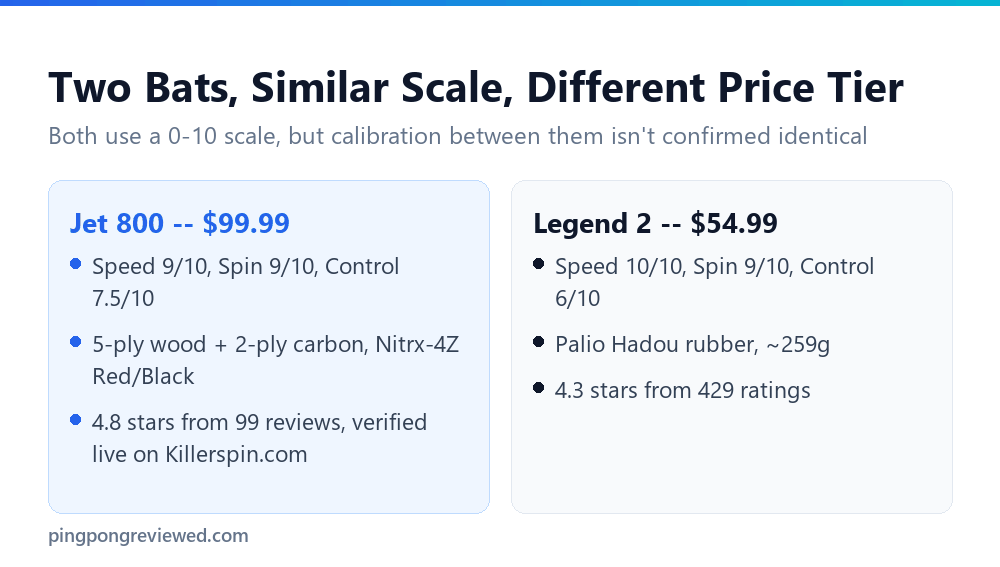
Table of Contents
The Numbers, Verified Directly
A Price Gap That’s Bigger Than the Performance Gap
Nearly $45 separates these two bats, but their published ratings sit close together, Legend 2 actually edges out Jet 800 by one point on raw speed, and both match exactly on spin. The real difference is control, where Jet 800’s 7.5 beats Legend 2’s 6 by a meaningful margin, and in the underlying construction: Jet 800’s carbon-reinforced 7-ply blade and Nitrx-4Z rubber represent a higher construction tier than what Legend 2’s listing discloses, even though Palio doesn’t publish the same level of blade-construction detail for direct comparison.
This is worth stating plainly: the price gap here isn’t primarily buying you a dramatically higher speed or spin ceiling on paper, it’s buying you a meaningfully better control figure, documented carbon construction, and a rubber compound with a specific, named performance tier (Nitrx-4Z) rather than a less detailed rubber specification.
The Scale Question, Addressed Directly
Both bats happen to use a 0-10 rating scale, which makes this comparison meaningfully more direct than this site’s Legend 2 vs STIGA Titan piece, where a 0-10 scale had to be weighed against a 0-100 one. That said, sharing the same numeric range doesn’t automatically guarantee identical internal calibration between two different manufacturers, Killerspin and Palio could still test and rate their bats using somewhat different internal standards even on the same 0-10 scale. This piece treats the numbers as reasonably comparable given the shared scale, while still noting that assumption explicitly rather than presenting it as fully confirmed.
Why Jet 800’s Rating Sample Is Smaller but Very Strong
Jet 800’s 4.8-star average comes from 99 reviews on Killerspin’s own site, a smaller sample than Legend 2’s 429 ratings, but a notably higher average, with the underlying breakdown showing 86% five-star and 13% four-star reviews and effectively no negative ratings at all. That’s a strong sentiment signal even with a smaller sample size, though it’s worth noting these are reviews collected on the manufacturer’s own site rather than a third-party marketplace, which can sometimes skew more positive than independent marketplace reviews.
💡 Pro tip: When comparing manufacturer-hosted reviews against third-party marketplace reviews, treat the manufacturer’s own numbers as a positive signal but weigh them slightly more cautiously than an equivalent rating from an independent platform, simply because the collection context differs.
Blade Construction: the Real Source of the Price Gap
Jet 800’s 5-ply wood plus 2-ply carbon construction is the specific, documented reason its rating profile leans more toward control than a pure speed bat while still keeping speed and spin high, carbon layers generally add stiffness and rebound consistency in a way that a simpler all-wood build doesn’t. Killerspin’s own listing is explicit about this construction, which is worth noting since Legend 2’s own listing, per this site’s existing review, doesn’t specify an equivalent ply count or wood species breakdown, a genuine information gap on Legend 2’s side that this comparison discloses directly rather than guessing at.
This asymmetry in disclosed detail is itself informative: a manufacturer publishing a full construction breakdown, as Killerspin does for Jet 800, generally signals more confidence in the underlying build quality, since there’s more specific detail available for a buyer to scrutinize and verify against independent sources if they choose to.
The Rubber Difference: Named Compound vs Generic Branding
Jet 800 uses Killerspin’s own Nitrx-4Z rubber, a named compound with its own specific identity within Killerspin’s broader rubber lineup, in a Red/Black colorway that’s fully ITTF-legal under the two-color rule this site has covered elsewhere. Legend 2 uses Palio’s own Hadou rubber, similarly a named, brand-specific compound rather than a generic unbranded sheet. Neither bat cuts a corner here, both use a manufacturer-specific rubber rather than an anonymous, unbranded one, which is a positive sign for both bats regardless of price tier.
The actual performance difference between Nitrx-4Z and Hadou isn’t something either manufacturer’s spec sheet fully quantifies on its own, rubber feel and tackiness differences are notoriously hard to capture in a single published number, which is exactly why this comparison relies on each bat’s overall speed/spin/control ratings as the best available proxy rather than claiming a rubber-specific verdict neither of us has tested firsthand.
Weight: a Meaningful Difference Worth Feeling For Yourself
Jet 800’s roughly 190-193 grams sits notably lighter than Legend 2’s approximately 259 grams, a substantial gap, not a marginal one. A lighter bat generally allows faster wrist and arm movement for quicker reaction shots, while a heavier bat can provide more built-in mass behind each stroke without the player needing to generate as much swing speed themselves. Neither characteristic is objectively better, it’s a genuine preference question tied to playing style, and worth handling if at all possible before committing to either bat, since weight differences at this scale are often more immediately noticeable in actual play than the numeric spec differences are.
What Comes in the Box
Jet 800 ships in Killerspin’s Memory Book case with two 1-Star training balls included, and Killerspin offers optional paid personalization (engraved initials or custom side tape). This site’s Legend 2 review didn’t detail an equivalent case or accessory bundle for that bat, which is worth factoring in if included packaging and presentation matter to your purchase decision, separate from the paddle’s raw playing specs.
- ✓Choose Jet 800 if control and documented carbon construction justify the price gap for you
- ✓Choose Legend 2 if raw speed and a lower price matter more than the control difference
- ✓Treat the shared 0-10 scale as reasonably comparable, while noting it’s not confirmed identical
- ✓Weigh Jet 800’s manufacturer-hosted reviews as a strong but slightly less independent signal
- ✕Assume Jet 800’s higher price guarantees a dramatically higher rating across every spec
- ✕Ignore that Legend 2 actually beats Jet 800 by one point on raw speed
- ✕Treat two different manufacturers’ 0-10 scales as automatically identically calibrated
- ✕Overlook the included case and accessories as part of Jet 800’s overall value
The Short Version, Restated
Jet 800 costs nearly double Legend 2’s price, but the performance gap on paper is narrower than the price gap suggests, Legend 2 actually wins on raw speed. What Jet 800 offers for the extra cost is a meaningfully better control rating, documented carbon construction, a named rubber compound, and included case and accessories. Whether that’s worth $45 depends on whether control and build quality specifically are what you’re optimizing for.
Neither bat is the objectively “correct” choice, they’re built for different priorities, and the honest verdict here is that the price gap buys a real, documented set of construction advantages rather than a vague, unquantified premium.
Who Each Bat Actually Suits
Jet 800 suits a player who’s already identified control as a real limiting factor in their current equipment, and who’s comfortable paying a genuine premium for documented carbon construction and a named rubber compound with a strong, if smaller, review sample behind it. It’s a reasonable choice for an intermediate player who’s outgrown pure entry-level equipment but isn’t yet ready for premium tournament-tier gear costing considerably more.
Legend 2 suits a player prioritizing raw speed and a lower price point, particularly one who already has reasonably reliable shot placement and doesn’t need the extra control margin Jet 800’s construction provides. Its larger rating sample also makes it a somewhat lower-risk purchase in terms of statistical confidence, even though Jet 800’s own average is higher.
A Note on Comparing Manufacturer-Hosted vs Marketplace Reviews
It’s worth expanding briefly on why this comparison treats Jet 800’s manufacturer-hosted 4.8-star average with a bit more caution than an equivalent marketplace rating. Reviews collected directly on a brand’s own site are sometimes subject to different display and moderation practices than a fully independent marketplace like Amazon, not necessarily fabricated or dishonest, but potentially filtered or curated in ways that aren’t always transparent to an outside reader. This isn’t an accusation specific to Killerspin; it’s a general caveat worth applying to any manufacturer-hosted review section encountered anywhere, on any product.
That caveat doesn’t erase the value of Jet 800’s strong review showing, 99 reviews with an overwhelming majority at five stars is still a meaningful positive signal. It just means weighing it slightly differently than Legend 2’s marketplace-sourced rating count, which this comparison does throughout by treating both as useful but not perfectly equivalent evidence.
Common Questions
Is Killerspin Jet 800 worth nearly double the price of Palio Legend 2?
It depends on priorities, Jet 800 wins on control and documented carbon construction, but Legend 2 actually edges it out on raw speed rating and costs $45 less.
Which bat has the higher control rating?
Killerspin Jet 800, at 7.5/10 versus Legend 2’s 6/10.
Which bat has the higher speed rating?
Palio Legend 2, at a perfect 10/10 versus Jet 800’s 9/10.
Are Killerspin’s and Palio’s 0-10 ratings directly comparable?
Reasonably so, since both use the same numeric range, but there’s no confirmation the two manufacturers calibrate their internal testing identically.
What’s included with Killerspin Jet 800?
A Memory Book case and two 1-Star training balls, with optional paid personalization available directly from Killerspin.
Which bat is lighter?
Killerspin Jet 800, at roughly 190-193g versus Legend 2’s approximately 259g, a substantial difference worth handling both if possible before deciding.
Should I trust Jet 800’s 4.8-star rating as much as Legend 2’s 4.3-star rating?
Weigh them slightly differently, Jet 800’s reviews are hosted on Killerspin’s own site, while Legend 2’s come from an independent marketplace, which can affect collection and display practices.
The Short Version
A near-doubled price, a narrower spec gap than that price implies, and a real set of documented construction advantages behind it.
- →Jet 800 ($99.99) and Legend 2 ($54.99) both verified against manufacturer sources.
- →Legend 2 actually beats Jet 800 by one point on raw speed rating.
- →Jet 800 wins meaningfully on control (7.5 vs 6) and documented carbon construction.
- →Both use a 0-10 scale, though calibration between the two brands isn’t confirmed identical.
- →Jet 800 includes a case and training balls; Legend 2’s bundle wasn’t equivalently detailed.
- →The price gap buys control and build quality more than a dramatic speed/spin ceiling increase.

Ping Pong Reviewed is an equipment review site covering table tennis and baseball gear. Specifications are checked against manufacturer listings, and prices against live retail pages, before publication.