Can I Catch the Ball When Serving? Two Sources Disagree
This is one of the few rules questions in table tennis where two credible sources give a different answer, and rather than pick one to sound more authoritative, both are reported here directly.
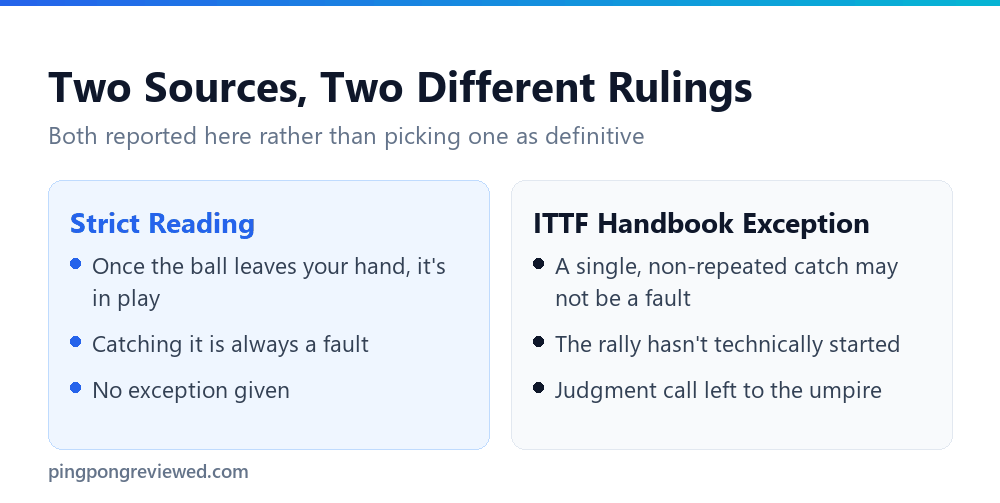
Short answer: Under the strict, commonly-taught reading of the rule, once you toss the ball for a serve it’s in play, and catching it instead of hitting it is a fault. A separate provision in the ITTF Handbook for Match Officials allows a single, non-repeated catch to NOT count as a fault, treating it as though the rally never started, but that’s a judgment call left to the umpire, not an automatic right.
Table of Contents
The Strict Version Most Players Learn
The version of this rule most players encounter first, and the one coaching resources most commonly state without qualification, is simple: once the ball leaves your hand on a serve, it’s in play. Catching it, or letting it fall to the ground instead of striking it, is a fault, full stop, according to this reading. This is the version worth assuming by default in casual or club play, since it’s the one most opponents and umpires will expect and enforce.
This is also the version that makes intuitive sense against a sport like tennis, where a player can let a bad toss drop and restart freely. Table tennis explicitly does not carry that leniency over, the toss itself, once deliberately made, is treated as the start of the point under this reading, not a practice motion you can abandon at will.
The Narrower Exception, Also Real
A separate, independently sourced reference to the ITTF Handbook for Match Officials complicates that clean picture. It states that if a server tosses the ball for service but catches it again instead of striking it, and this isn’t repeated unduly, it is NOT a fault, the rally is considered not to have started at all. The explicit caveat: this is a judgment call for the umpire, who has to decide whether the toss was a genuine attempt at service or something else, like an aborted motion before the player was set.
⚠️ Watch out: This exception is not a right you can rely on. It’s discretionary, umpire-dependent, and explicitly conditioned on not happening repeatedly. In casual play without an umpire, assume the strict version applies and treat any catch as a fault to avoid disputes.
Why Both Can Be True at Once
These two readings aren’t necessarily as contradictory as they first look. The strict version describes the default, expected outcome in the vast majority of cases. The Handbook exception describes a narrow, officiated escape hatch for a genuine, one-off situation, a player starting their toss motion, realizing something is wrong (a gust of wind, a distraction, an equipment issue) before actually committing to the serve, and catching the ball rather than serving into a bad situation.
The disagreement between sources is really about emphasis: one states the general rule as an absolute, the other surfaces the narrow exception that exists underneath it. Reporting only the absolute version isn’t wrong in the vast majority of real situations, but it’s not the complete picture either, which is why this page states both rather than picking the simpler-sounding one.
Why This Site Reports Both Answers Instead of Picking One
It would be easy to publish only the strict version, it’s cleaner, shorter, and matches what almost every casual coaching resource says without qualification. That’s exactly why it’s worth resisting here: this site’s standing verification practice is to check multiple independent sources before publishing a rules answer as settled fact, and in this specific case, those sources disagree rather than just phrasing the same rule differently.
Presenting only the simpler answer would technically not be false in the vast majority of real situations, since the exception is narrow and rarely invoked. But it would be incomplete in a way that could mislead a competitive player relying on this page before an officiated match, which is a real enough use case for table tennis rules content that the fuller, more honest answer is worth the extra length.
Where This Rule Sits in the Broader Serve Framework
Table tennis regulates the serve more tightly than almost any other shot in the sport specifically because the server has total, unopposed control over it, the toss height, the contact point, the spin, all chosen freely before the opponent can react at all. The catching question sits right at the boundary of that control: it’s asking what happens in the split second before the server has fully committed to converting that control into an actual shot.
That framing helps explain why the rule has this kind of discretionary edge case at all, rather than being a clean absolute either way. A rule with zero flexibility would penalize a player for a single, genuine hesitation before they’ve actually gained any advantage from the toss. A rule with unlimited flexibility would let players effectively practice-toss indefinitely until conditions feel perfect, which undermines the point of regulating the serve in the first place. The umpire-discretion compromise splits the difference, even if it makes the rule harder to state as a single clean sentence.
What Happens if Two Players Disagree in Casual Play
Without an umpire, there’s no neutral party to apply the Handbook’s discretionary exception, which is exactly why this page recommends assuming the strict version by default in casual and club play. If a genuine disagreement comes up, one player insists a single catch wasn’t a fault, the other insists it was, the practical resolution most clubs use is simply to replay the point rather than escalate over a single ambiguous call, treating it functionally the same as a let. That’s not an official rule, just a common-sense way recreational play handles a disputed edge case without a referee available to make the actual judgment call the rule requires.
What to Do in Practice
- ✓Assume any catch of a tossed ball will be called a fault by default
- ✓Only expect leniency if you’re playing under a formal umpire
- ✓Treat a genuine one-off catch as something to explain, not demand as a right
- ✓Toss cleanly and commit to the serve rather than relying on a bail-out option
- ✕Rely on the Handbook exception as a repeatable tactic
- ✕Assume casual opponents will know about or grant the narrower exception
- ✕Argue the point after the fact if an opponent already called it a fault
- ✕Catch tosses repeatedly and expect no consequence
How This Differs From a Bad Toss You Still Hit
It’s worth separating this question from a related but different one: what happens if you toss the ball badly, too low, at an angle, without the required height, and still swing at it. That’s a different fault entirely (an illegal serve for failing to meet the toss requirements), not the catching question this page covers. Catching the ball specifically means choosing not to strike it at all after tossing it, which is the narrower, more specific situation both sources above are actually addressing.
The Short Version, Restated
If you catch a ball you just tossed for serve, expect it to be called a fault in the overwhelming majority of situations. A narrow, umpire-discretionary exception exists for a genuine, non-repeated case, but it’s not something to plan around or lean on as a strategy. When in doubt, serve through the toss rather than testing whether an opponent or umpire will grant the exception.
This is a good general habit for reading table tennis rules content anywhere online, not just on this page: a rule stated as an absolute is often the simplified, majority-case version of something with a narrower documented exception underneath it. When a specific ruling actually matters, an officiated match, a real dispute, it’s worth checking the primary rulebook language directly rather than trusting any single summary, this one included.
A Related Question: What If You Never Toss at All?
A slightly different scenario worth distinguishing: a player who picks up the ball to serve, then simply doesn’t toss it at all, putting it back down, adjusting grip, or otherwise resetting before any toss motion begins. That’s not covered by either source’s catching discussion at all, because no toss occurred and no “in play” moment was ever triggered under either reading. A player can reset their pre-serve routine as many times as they like before actually beginning the toss motion, without touching this rule at all.
The distinction matters because it clarifies exactly what both sources are actually discussing: the specific moment the ball leaves the server’s hand in a deliberate upward toss. Everything before that moment is simply pre-serve routine, governed by different rules entirely (mainly the time limits umpires can enforce against excessive delay), not the catching question this page focuses on.
Common Questions
Can I catch the ball when serving in table tennis?
Under the strict, commonly-taught reading, no, it’s a fault. A separate ITTF Handbook provision allows a narrow, umpire-discretionary exception for a single non-repeated catch, but it’s not a guaranteed right.
Is catching a bad toss the same as an illegal serve?
No. An illegal serve is about the toss itself failing height, visibility, or contact requirements while you still hit the ball. Catching the ball means not striking it at all after tossing it.
Can I repeatedly catch bad tosses without penalty?
No. The narrow exception explicitly applies only to a non-repeated instance. Doing it repeatedly is treated as a fault under both sources checked.
Does this rule apply the same way in casual, non-officiated play?
Practically, no exception is available without an umpire to make the judgment call. In casual play, assume any catch will be, and likely should be, called a fault.
What should I do if my toss feels wrong mid-serve?
Recognize you’re relying on discretion, not a guaranteed rule, if you catch it. It’s safer to develop a consistent, reliable toss you can commit to rather than planning around this exception.
Can I reset my pre-serve routine without penalty?
Yes, adjusting your grip or the ball before you actually begin the toss motion isn’t covered by this rule at all. The catching question only applies once a genuine toss has begun.
The Short Version
Two credible sources, one open question, and the honest answer is that the rule has more nuance than most quick summaries let on.
- →The commonly-taught rule: catching a tossed serve ball is a fault, no exception given.
- →A separate ITTF Handbook provision allows a narrow, umpire-discretionary exception.
- →That exception only covers a single, non-repeated instance, not a repeatable tactic.
- →In casual, non-officiated play, assume the strict version applies.
- →This is a different question from an illegal serve, which involves still hitting a bad toss.

Benjamin Fink is the Lead Equipment Analyst and Senior Contributor at Ping Pong Reviewed. A competitive USATT tournament player and table tennis technician with over 12 years of testing experience, Benjamin specializes in blade carbon composite physics, rubber sponge durometer hardness testing, ITTF equipment compliance, and table tennis robotics mechanics.