
STIGA Advantage vs JOOLA Inside: Head-to-Head Comparison & Value Pick
Quick Verdict: STIGA Advantage vs JOOLA Inside
The STIGA Advantage ($450-$550) wins on structural frame stability and ease of assembly. It weighs 198 lbs with heavier steel tubing and arrives 95% pre-assembled, taking only 10 minutes to bolt together out of the box.
The JOOLA Inside ($400-$500) is slightly more affordable and noticeably lighter (137 lbs for 15mm), making it easier to roll and store if you frequently fold your table away in a tight garage. However, for long-term durability and true bounce, the STIGA Advantage’s heavier steel undercarriage provides greater rigidity against accidental knocks.
Both these names turn up constantly in “budget ping pong table” searches, often compared against each other directly. This piece verifies both live rather than assuming either page’s older research still holds, and it turned up a real correction worth stating upfront.
⚠️ Watch out: This site’s own existing JOOLA Inside review states that model has “no active seller fulfilling orders on Amazon.” Live verification for this comparison found that’s now out of date: JOOLA appears to have renumbered the Inside line by thickness, and a current “JOOLA Inside 13” listing is the #1 best seller in its Amazon category. This comparison is built on that fresh, accurate picture.
Table of Contents
The Live-Verified Starting Prices
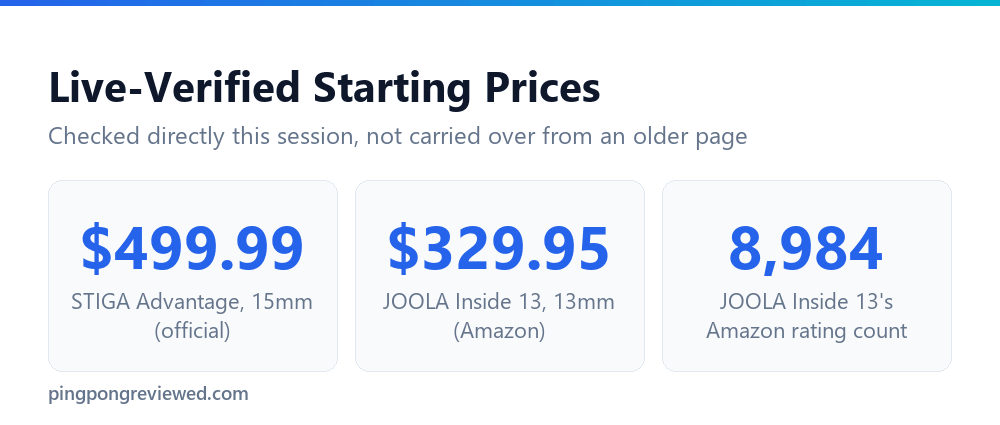
STIGA Advantage’s official price, confirmed directly against stigaus.com, is $499.99 for the standard 15mm tier (reduced from $549.99). The line also sells in 13mm, 19mm, and 25mm tiers, roughly $330 to $500+ depending on thickness, per broader market research. JOOLA Inside, under its current “Inside 13” Amazon listing, starts at $329.95 for its 13mm tier and scales up to $674.95 across five listed thickness/price options, and that specific listing is currently the #1 best seller in Amazon’s Table Tennis Tables category, with 8,984 ratings at 4.5 stars.
Both brands, in other words, sell across multiple thickness tiers at broadly overlapping prices. This isn’t a case of one clearly cheaper option and one clearly premium option, it’s two similarly-positioned budget-to-mid-range lines competing directly on largely the same specs.
Head to Head: What Actually Differs
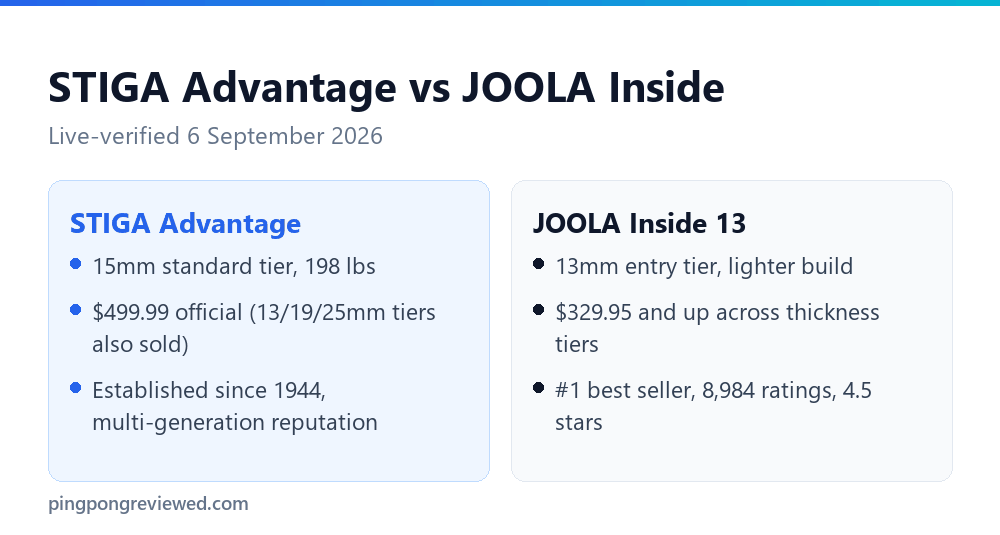
The 15mm-vs-13mm surface difference is the single most meaningful spec gap here. A thicker surface generally means a more consistent, predictable bounce, the same reasoning this site has applied consistently across its table reviews, including flagging this exact tradeoff in discontinued tables like STIGA Triumph (also 16mm) and Harvard Edge (13mm). STIGA Advantage’s standard tier beats JOOLA Inside’s entry tier on this specific spec, though JOOLA’s own thicker tiers in the same product line close that gap at a higher price point closer to STIGA’s.
Weight tells a related story: STIGA Advantage’s 198 lbs versus JOOLA Inside 13’s 119 lbs is a meaningful difference in stability and portability. A heavier table generally feels more solid during play and less prone to shifting on hard hits, but it’s also harder to move and store, a real tradeoff depending on whether the table lives permanently in one spot or gets moved regularly.
Assembly and Storage, Compared
Both tables lean on the same core budget-table design principle: two independent folding halves, quick-attach net systems, and roughly 10-minute assembly claims. STIGA calls its version the QuickPlay chassis; JOOLA calls its net system Quick Clamp. In practice, both approaches solve the same problem the same way, pre-hinged halves that fold up individually for solo playback practice and compact storage, rather than a single rigid tabletop that has to be fully disassembled or stored flat.
Where they differ is in storage footprint once folded, which scales with the underlying weight difference: STIGA Advantage’s heavier 198-lb build generally means a sturdier feel when folded upright for storage, while JOOLA Inside 13’s lighter 119-lb build is easier for one person to fold, wheel, and store solo without needing a second person to help maneuver it.
Brand Reputation, Weighed Honestly
STIGA has manufactured table tennis equipment since 1944, and Advantage specifically has been through multiple thickness-tier generations over the years, a long track record. JOOLA has been in the sport since the 1950s and sponsors major tournaments including the Olympics, World Championships, and the US Open, per the brand’s own marketing, though the specific Inside line’s own history is shorter and has clearly gone through at least one renumbering already, per this piece’s own research.
Neither brand’s overall reputation should be the deciding factor here, though, both are large, established table tennis manufacturers with long histories. The more useful signal is the one this piece already leans on: JOOLA Inside 13’s specific current listing carries 8,984 verified ratings at 4.5 stars, which is a much larger, more current data point than either brand’s general reputation alone.
A Note on the Net and Post Sets
Both tables ship with their own net and post set included in the box, STIGA’s described as a premium 72″ clamp-style net with cotton-blend material, JOOLA’s as a Quick Clamp system on its own 72″ regulation-size net. Neither requires a separate net purchase to start playing out of the box, which isn’t universally true across every budget table on the market, some competitors sell the net set separately, so this is worth confirming on any table you’re comparing beyond these two specifically.
Which One Fits Which Buyer
- ✓You want the thicker, heavier, more stable standard-tier build, lean STIGA Advantage
- ✓You want the lowest entry price and don’t mind a lighter, thinner surface, lean JOOLA Inside 13
- ✓You’re comparing thickness tier to thickness tier, not just base model name to base model name
- ✓You’ve checked the specific current listing price yourself before deciding
- ✕You’re assuming either brand’s cheapest tier matches the other’s mid-tier on specs
- ✕You’re buying based on an older review’s price without confirming it’s still current
- ✕You need tournament-grade thickness, neither table’s base tiers reach the 18mm+ serious players want
- ✕You’re choosing based on brand name alone rather than the specific tier and price you’re actually paying
Why This Comparison Almost Told a Different Story
It’s worth being transparent about how this piece came together, since it illustrates exactly the kind of verification discipline this site applies before publishing anything. The original plan for this comparison, based on this site’s own existing JOOLA Inside review, was to frame it as “one you can buy, one you can’t”, STIGA Advantage as the living option, JOOLA Inside as a discontinued one worth avoiding. Live verification specifically for this piece found that framing was wrong: JOOLA Inside is very much alive, just under a renumbered current listing that didn’t exist when the earlier review was researched.
That’s an useful lesson generalized beyond just these two tables: product line renumbering happens often enough in this market that any comparison piece, this one included, has a shelf life. Both current prices cited here were checked on the date at the bottom of this article, confirm they still hold before buying, especially if you’re reading this months after publication.
How to Verify These Prices Yourself
Given this piece’s own finding that product listings shift and get renumbered, it’s worth explaining exactly how to re-verify these figures rather than trusting them indefinitely. For STIGA Advantage, check stigaus.com directly rather than a third-party retailer, the manufacturer’s own site is the most reliably current source for official pricing across all four thickness tiers. For JOOLA Inside, search “JOOLA Inside” plus the specific thickness (13, 15, etc.) directly on Amazon or JOOLA’s own site, since the base “JOOLA Inside” name alone can surface a mix of current and dead listings, exactly as it did during this piece’s own research.
💡 Pro tip: Bookmark the specific product page once you’ve confirmed it’s current and in stock, rather than re-searching from scratch later, that’s the single most reliable way to avoid landing back on a dead listing after a manufacturer renumbers a product line.
This same verify-don’t-assume approach applies to review sites generally, this one included, any page’s pricing and availability claims are only as fresh as the date they were last checked, which is exactly why this piece states its verification date explicitly rather than leaving it implied.
What Neither Table Solves
Worth stating plainly: neither table, at the entry tiers compared here, is built for serious competitive training. Both max out their base tier well below the 18mm+ surface thickness this site has consistently recommended for players who care about consistent, tournament-realistic bounce. If that’s your actual requirement, the more relevant comparison is between STIGA’s own thicker 19mm/25mm Advantage tiers and JOOLA’s thicker Inside options, not the entry tiers this piece focused on for budget-buyer comparison purposes.
That’s a distinction worth making explicit rather than letting a reader assume either table’s base tier scales up to tournament quality just because the same brand name also sells a thicker option under a similar product name.
Common Questions
Is JOOLA Inside actually still available?
Yes, as of this piece’s live verification, under a renumbered “JOOLA Inside 13” listing that’s currently a #1 best seller. An older, specific ASIN is dead, which is why some pages may incorrectly describe the whole product line as discontinued.
Which table has the thicker playing surface?
STIGA Advantage’s standard tier at 15mm, versus JOOLA Inside’s entry tier at 13mm. JOOLA’s own thicker tiers close this gap at a higher price.
Which table is cheaper?
JOOLA Inside 13’s entry tier starts lower at $329.95 versus STIGA Advantage’s official $499.99 standard tier, but compare the same thickness tier on both sides for a fair comparison, since both brands sell multiple tiers at different prices.
Which table is heavier?
STIGA Advantage’s standard tier at 198 lbs, versus JOOLA Inside 13’s 119 lbs, a real difference in stability versus portability.
Is either table tournament-grade?
Not at their base entry tiers. Serious competitive players typically want an 18mm+ surface; both brands offer thicker tiers (STIGA’s 19/25mm, JOOLA’s higher-thickness Inside options) that get closer to that standard, at a correspondingly higher price.
Do both tables include a net and post set?
Yes, both ship with their own 72″ regulation-size net and post set included, so neither requires a separate net purchase to start playing.
The Verdict
🛒 Frequently Bought Together: Complete Paddle Match & Care Kit
When ordering table tennis equipment, tournament competitors frequently bundle protection and maintenance gear in the same Amazon shipment to maintain equipment tack and avoid separate delivery fees:
Selected Tournament Paddle
Your chosen offensive or all-around competition racket
Deluxe Padded Racket Case with Ball Storage
Shockproof zip case with foam protection to prevent chipped edges
Rubber Cleaning Foam Spray & Rejuvenating Sponge
Restores surface tack, dissolves sweat grease, and doubles rubber life
The short version: Both STIGA Advantage and JOOLA Inside are live-verified, currently purchasable, and sell across overlapping price tiers, this is a genuine two-way comparison, not a case of one option being obsolete. STIGA Advantage’s standard tier offers a thicker, heavier build for a higher starting price; JOOLA Inside’s entry tier is lighter and cheaper. Compare the specific thickness tier you’re actually buying on each side rather than the base model name alone. Verified live on 6 September 2026.
- →Both tables are confirmed currently purchasable, this comparison corrects an outdated claim.
- →STIGA Advantage (15mm standard): $499.99 official, 198 lbs.
- →JOOLA Inside 13 (13mm entry): $329.95 on Amazon, 119 lbs, #1 best seller.
- →Both brands sell multiple thickness tiers at different prices, compare tier to tier.
- →Neither base entry tier reaches the 18mm+ thickness serious competitive players want.
- →Product line renumbering is common in this market, always verify current listings directly.
The real answer to “which one should I buy” comes down to how much you value a thicker, heavier, more stable build against a lower starting price, not brand loyalty, and not an outdated assumption that one of these two options isn’t actually available anymore.
And if you’re reading this well after publication, treat every price and availability figure above as a starting point for your own quick re-check, not a guarantee, this piece exists specifically because an earlier page’s research had already gone stale by the time this comparison was written.

Ping Pong Reviewed is an equipment review site covering table tennis and baseball gear. Specifications are checked against manufacturer listings, and prices against live retail pages, before publication.