Are Dead Rubbers Anti-Spin Rubbers? No, Here’s the Difference
No, a dead rubber and an anti-spin rubber are two different things, even though both describe a rubber that isn’t gripping the ball the way a player expects. The confusion is understandable, since both produce a similarly slick, unresponsive feel. The cause behind that feel is where they completely part ways.
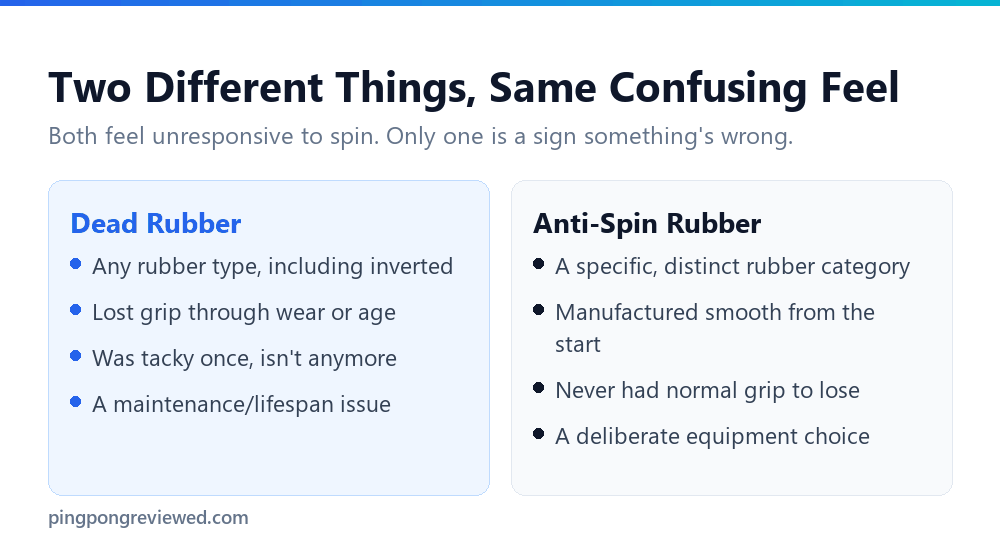
Short answer: A dead rubber is any rubber, of any type, that has lost its original grip through wear, age, or oxidation, it used to be tacky and isn’t anymore. An anti-spin rubber is a distinct, deliberately manufactured rubber category that’s smooth and low-friction from the day it’s made, it never had normal grip to lose in the first place. A brand-new anti-spin sheet and a worn-out inverted rubber can feel similarly slick, which is exactly why the two get confused, but they’re not the same thing. Verified against independent sources on 5 September 2026.
Table of Contents
Why This Gets Confused So Often
Both phrases describe a rubber that fails to do the thing players expect rubber to do: grip the ball and translate a stroke into strong, readable spin. A player who picks up a worn-out rubber and one who picks up a brand-new anti-spin sheet can have a very similar first impression, the ball just doesn’t respond the way it’s supposed to. That shared symptom is exactly why the two terms drift together in casual conversation, even though the underlying cause is completely different in each case.
What Makes a Rubber “Dead”
A dead rubber is a rubber, of any type, inverted, pips-out, anti-spin, anything, that has lost the grip and tack it originally had. This happens through genuine physical degradation: the topsheet oxidizes with exposure to air and light over time, and repeated play breaks down the material at a molecular level, both of which reduce the surface’s ability to grip the ball. A rubber can even degrade sitting unused in storage, simply from age and exposure, not just from active play.
The defining feature of a dead rubber is that it used to work differently. It had real tack when new, and that tack has diminished or disappeared. That’s a maintenance and lifespan story, not a description of what the rubber was designed to do.
What Makes a Rubber “Anti-Spin”
Anti-spin rubber is a completely different story. It’s a distinct, recognized rubber category, manufactured to be smooth and very low-friction from the moment it’s produced. It was never designed to grip the ball strongly, that low-grip characteristic is the entire point of the product, not a flaw or a sign of use. A brand new anti-spin sheet, straight out of the packaging, plays with the same slick, low-response character it will have a year later.
Because anti-spin rubber doesn’t grip the ball strongly to begin with, it interacts with incoming spin very differently than a normal inverted rubber does, often flattening or even reversing the spin a player feeds into it. That’s a deliberate design outcome that players choose specifically because of the tactical confusion it creates for opponents, not an accident of manufacturing or a byproduct of age.
- ✓Check whether a slick-feeling rubber was ever grippy when new
- ✓Look at the rubber’s printed name/type to confirm anti-spin vs standard
- ✓Clean a dead standard rubber before assuming it’s ruined
- ✓Treat an anti-spin sheet’s low grip as expected, not a defect
- ✕Assume a dead rubber is secretly an anti-spin rubber, or vice versa
- ✕Try cleaning an anti-spin rubber expecting more grip to appear
- ✕Blame anti-spin’s low grip on poor cleaning or maintenance
- ✕Ignore a worn-out standard rubber because you assumed it was anti-spin
The One Question That Settles It
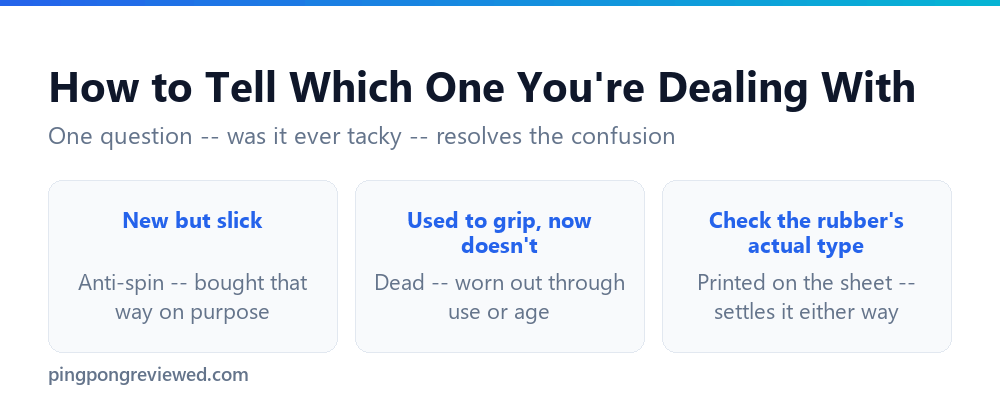
There’s a single, reliable question that resolves the confusion every time: was this rubber ever meaningfully tacky when it was new? If yes, and the grip has since faded, that’s a dead rubber, a maintenance and replacement question. If no, and it’s always felt this way since day one, that’s simply what an anti-spin rubber is supposed to feel like, and no amount of cleaning or care is going to change its fundamental character.
Checking the exact rubber name printed on the sheet against its manufacturer’s own product category is the most direct way to confirm this if there’s any doubt, a rubber marketed and sold as an anti-spin product was never going to grip like a standard inverted rubber, regardless of how new or well-cared-for it is.
⚠️ Watch out: Don’t spend money on rubber cleaner or replacement expecting to restore grip to a rubber that’s actually an anti-spin product working exactly as designed. Confirm the rubber’s actual category first.
Why the Distinction Actually Matters
Getting this right changes what action actually makes sense. A dead standard rubber is a problem worth solving, either through proper cleaning if it’s not too far gone, or through replacement if the degradation is too advanced for cleaning to help. An anti-spin rubber behaving like an anti-spin rubber isn’t a problem at all; it’s the product doing exactly what it was bought to do, and no cleaning routine will or should change that character.
Misdiagnosing one as the other leads to wasted effort in both directions: cleaning a rubber that was never going to grip differently no matter how well maintained, or replacing a perfectly healthy standard rubber because its low grip was mistaken for wear rather than correctly identified as an unrelated issue, like an incorrect rubber choice for the intended playing style.
Where the Two Actually Do Overlap
There’s one genuine point of overlap worth naming, since it’s part of what keeps the confusion alive: an anti-spin rubber can itself go dead over time, exactly the way any other rubber can. Anti-spin sheets still degrade with age and exposure, even though they weren’t tacky to begin with, other physical properties, like the sponge’s responsiveness and the topsheet’s surface consistency, still change as the material ages, even if grip specifically was never part of the equation.
This means it’s entirely possible to own a rubber that is both anti-spin AND dead at the same time, an old anti-spin sheet that has lost whatever consistent low-friction character it had when new, becoming even less predictable than a fresh anti-spin rubber would be. That’s a more advanced diagnostic question, but it doesn’t change the core distinction: “dead” is about degradation happening to a rubber over time, and “anti-spin” is about which category of rubber it was to begin with. A rubber can belong to either category, or both conditions at once, but the two words are still answering different questions.
Why Beginners Run Into This Confusion More Than Veterans
Experienced players rarely mix these two terms up, mostly because they’ve handled enough different rubber types over the years to recognize an anti-spin sheet on sight or on first contact. The confusion shows up disproportionately among newer players, especially those who’ve only ever owned one or two rubbers and have limited direct comparison points for what “normal” grip actually feels like against a low-friction surface.
That’s not a knock on newer players, it’s simply a function of experience. Handling an anti-spin sheet for the first time with no prior reference point makes it entirely reasonable to wonder whether something is wrong with the rubber rather than recognizing it as a distinct, intentional product. The vocabulary gap closes quickly once a player has handled a few different rubber categories directly.
💡 Pro tip: If you’re ever unsure whether a rubber you’ve been handed to try is dead or anti-spin, ask directly rather than guessing. It’s a completely normal question, and getting a clear answer saves you from misjudging the rubber’s actual performance based on the wrong assumption.
A Quick Self-Check Before You Worry About Either
Before spending time or money chasing this question, it’s worth asking a more basic thing first: does the rubber’s current behavior actually match what you’d expect from its type, whichever type it turns out to be? A standard inverted rubber that grips noticeably worse than it did six months ago, with no change in storage or care, is showing real signs of degradation worth addressing. A rubber that’s always played this way since the day you got it, and that’s labeled as an anti-spin product, isn’t showing a problem at all, it’s simply doing its job.
That comparison, against its own past behavior, not against some generic idea of what rubber “should” feel like, is usually enough to sort dead from anti-spin without needing to look up anything further.
The Short Version, Restated
Dead and anti-spin describe two unrelated things that happen to produce a similar low-grip feel. Dead means a rubber, of any type, has lost tack it used to have. Anti-spin means a rubber was built smooth and low-friction from the start, as a deliberate design choice, not a sign of wear.
One question settles which one you’re actually dealing with: was it ever tacky to begin with? The answer points you toward either cleaning and maintenance, or simply accepting that the rubber is doing its job exactly as intended.
Two words, two separate causes, and one simple question to tell them apart. That’s all this comes down to, once the shared symptom, a rubber that doesn’t grip the way expected, stops being mistaken for a shared cause.
Keep that distinction handy the next time either phrase comes up in a club conversation or a product listing, and the whole question stops being confusing for good.
Dead Rubber vs Anti-Spin, Answered
Are dead rubbers the same as anti-spin rubbers?
No. A dead rubber is any type of rubber that has lost grip through wear or age. Anti-spin is a distinct rubber category manufactured to be smooth and low-friction from the start.
How can I tell if my rubber is dead or was always anti-spin?
Ask whether it was ever meaningfully tacky when new. If yes and it’s since faded, it’s dead. If it’s felt this way since day one, check the rubber’s printed name, it may simply be an anti-spin product.
Can cleaning fix an anti-spin rubber’s low grip?
No. Anti-spin’s low grip is a deliberate design feature, not a sign of dirt or degradation, so cleaning won’t change its fundamental character.
Can a dead rubber be brought back with cleaning?
Sometimes, if it’s dirty rather than degraded. If the topsheet has actually oxidized and broken down, cleaning won’t restore lost tack, and replacement is the real fix.
Is any rubber type capable of going dead?
Yes. Dead rubber can happen to inverted, pips-out, or any other rubber type through wear or age. It’s not limited to a specific category the way anti-spin is.
One is a maintenance story. The other is an equipment choice. Neither is a mystery once they’re named correctly.
The Short Version
- →Dead rubber and anti-spin rubber are two different things.
- →Dead means grip was lost over time through wear, age, or oxidation.
- →Anti-spin means the rubber was built low-friction from the start.
- →A single question, was it ever tacky, tells you which you have.
- →Cleaning helps a dead rubber but won’t change an anti-spin rubber’s nature.

Ping Pong Reviewed is an equipment review site covering table tennis and baseball gear. Specifications are checked against manufacturer listings, and prices against live retail pages, before publication.