Can You Touch the Table With Your Racket in Table Tennis?
Yes, you’re allowed to touch the table with your racket. Most players assume otherwise, usually because they’ve absorbed a vague sense that touching the table is against the rules without ever learning the actual, much narrower version of that rule.
Short answer: You can touch the playing surface with your racket, your racket hand, your clothing, or any other part of your body, without penalty, as long as you don’t visibly move the table while doing it. The one specific thing that isn’t allowed is your free hand, the hand not holding the racket, touching the table while the ball is in play. Either your free hand touching the table, or anything moving the table, costs you the point outright. Verified against independent sources on 5 September 2026.
Table of Contents
The Actual Rule, Not the Rumor
The version of this rule that circulates informally, “don’t touch the table”, is close enough to be dangerous, because it’s wrong in the specific way that matters. The real rule isn’t about the table being off-limits in general. It’s about two narrow, specific conditions: which hand touches it, and whether the contact moves it.
Once you separate those two conditions out, the rule stops being a blanket restriction and becomes something much easier to actually play by, since almost everything most players worry about, brushing the table with a racket on a low return, leaning a knuckle on the edge while reaching for a wide ball, turns out to be completely fine.
What’s Actually Allowed
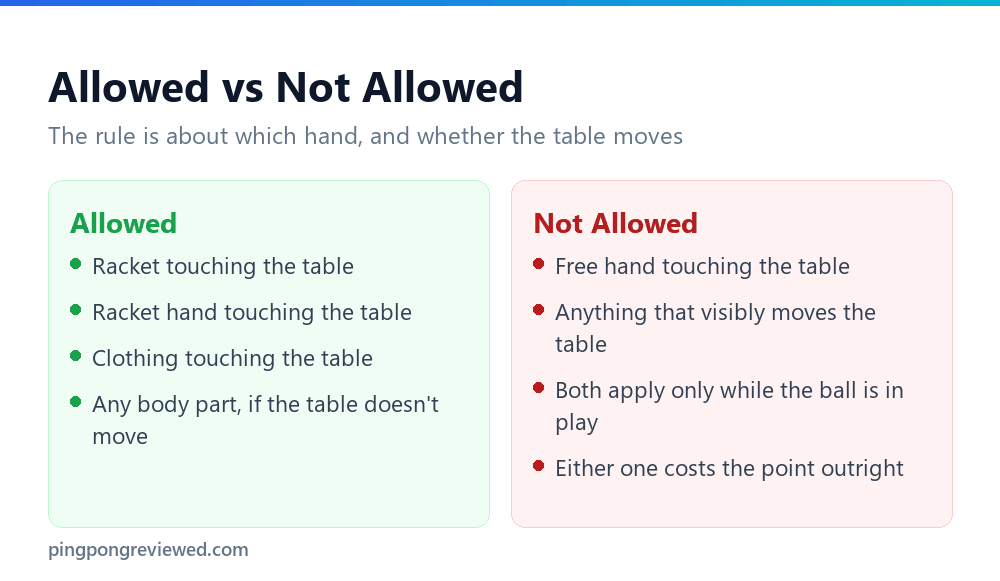
Your racket can touch the table. Your racket hand, the hand holding the racket, including the wrist and forearm, can touch the table. Your clothing can touch the table. Any other part of your body can touch the table. None of that is restricted in any way, as long as the table itself doesn’t move as a result. A player diving for a wide ball and bracing a hip or forearm against the table edge on the way past hasn’t broken any rule at all.
This surprises a lot of players who’ve only ever heard the shorthand version of the rule, because it means far more contact with the table is legal than the common wisdom suggests. The racket knocking against the table top during a low return, in particular, is a completely normal and legal part of the game, not a fault waiting to be called.
The One Specific Thing That Isn’t
The actual restriction is narrow: your free hand, specifically the hand not holding the racket, touching the playing surface while the ball is in play costs you the point immediately. This isn’t a judgment call about whether the touch helped you or affected the shot in any way. It’s a flat rule: free hand on the table during a live rally means the point goes to your opponent, full stop.
Players sometimes brace their free hand on the table edge for balance while lunging for a wide shot, which is exactly the situation this rule is built to catch, since it’s the most natural moment for a free hand to end up on the table without a player even noticing they’ve done it.
- ✓Let your racket touch the table on a low return
- ✓Brace your racket hand, wrist, or forearm against the table
- ✓Let clothing brush the table during a lunge
- ✓Recover your balance with any body part except your free hand
- ✕Touch the playing surface with your free hand while the ball is live
- ✕Push off the table with your free hand to reach a wide shot
- ✕Grip or steady the table with your free hand during a rally
- ✕Let any contact visibly move or shift the table while the ball is in play
The Second Fault: Moving the Table
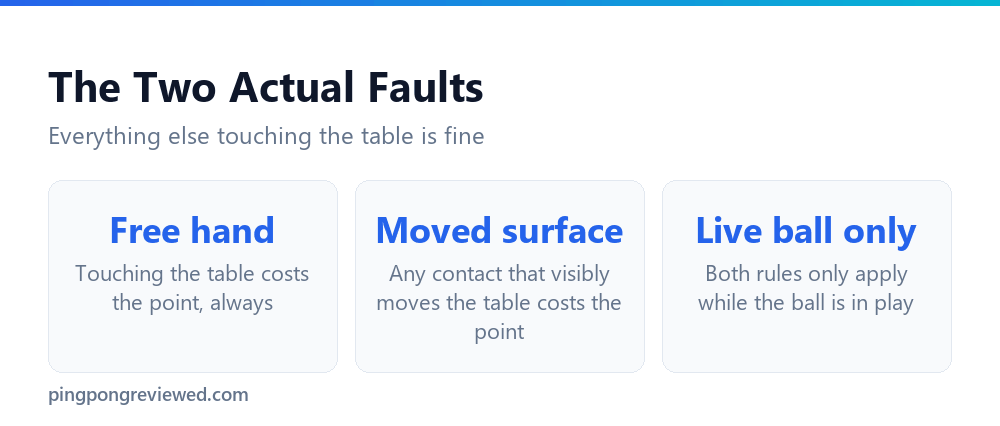
Separately from the free-hand rule, there’s a second, independent condition that also costs the point: visibly moving the playing surface while the ball is in play, regardless of what caused the movement. A racket, a body part, or even a free hand that doesn’t technically violate the first rule can still trigger this one if the contact is forceful enough to shift the table.
In practice, the two rules overlap for a free hand pressed onto the table, that’s usually both a free-hand touch and, if it’s forceful, a table movement, either of which alone is already enough to lose the point. But the moved-surface rule also applies independently to racket or body contact that’s unusually forceful, which is the rare edge case where even a normally allowed touch can still become a fault.
⚠️ Watch out: A gentle racket touch on the table is fine. A hard enough contact that the table visibly shifts, rocks, or slides is a fault regardless of which part of your body or equipment caused it.
Why It’s the Free Hand Specifically
The free-hand rule isn’t arbitrary, it targets a genuine potential advantage. A player pressing their free hand flat on the table can use it to brace, stabilize their body, or gain leverage for a shot they otherwise couldn’t reach or generate power for, in a way that touching the table with a racket or clothing simply doesn’t provide to the same degree.
Singling out the free hand closes that specific loophole without restricting the far more common, incidental contact that happens constantly during normal play, a racket brushing the table on a low ball, a sleeve grazing the edge during a lunge. Those don’t give either player a meaningful physical advantage, which is why they’re left alone while the one form of contact that actually could isn’t.
A Worked Example
Picture a player stretched wide for a ball near the edge of the table. Their racket brushes the table top mid-swing, completely legal, play continues. If instead they’d planted their free hand flat on the table to steady themselves for that same reach, the point would go to their opponent the moment the hand made contact, regardless of whether the shot that followed would otherwise have been a winner.
That contrast, one form of contact completely free, the other an automatic loss of point, from the same physical situation, is exactly why this rule catches so many players off guard the first time it’s called against them. It looks, from the outside, like the same kind of incidental contact either way.
📊 Note: This rule applies identically in doubles. A player’s free hand touching the table costs the point the same way it would in singles, with no exception for the extra players on court.
How This Gets Called at the Table
In refereed play, an umpire watches for both faults directly and calls them the moment they happen, there’s no appeal process for a free-hand touch the umpire clearly saw, and no requirement that the touch actually changed the outcome of the point. The rule is applied on contact, not on effect.
In casual or club play without an umpire, this becomes a self-officiated call, which is exactly where the vague version of the rule causes the most confusion. A player who doesn’t know the actual distinction might call a fault on an opponent’s legal racket touch, or fail to call an actual free-hand violation because they assumed only ‘touching the table’ in general mattered rather than which hand did it. Knowing the precise rule avoids both mistakes in either direction.
Why This Rule Rarely Comes Up in Casual Play
Most recreational games never actually trigger this rule, simply because most players don’t play close enough to the table’s edge, or with enough physical intensity in their footwork, to end up bracing a free hand on the surface. It becomes far more relevant at a faster, more physical level of play, where players are lunging and stretching for shots near the edges of their reach, which is also exactly the situation the rule is designed to keep fair.
That’s worth knowing if you’ve played for years without ever hearing this rule called: it’s not that the rule doesn’t exist, it’s that your style of play has never put you in the specific situation where it applies. The first time you do play at a pace or intensity where a free-hand brace becomes tempting, it’s worth already knowing the line rather than finding out from a referee mid-match.
💡 Pro tip: If you’re prone to lunging for wide shots, practice recovering your balance with your racket-side arm, your feet, or your body weight instead of your free hand. It’s a small habit change that removes the temptation entirely, rather than relying on remembering the rule under pressure.
The Short Version, Restated
Touching the table isn’t the violation most players think it is. Your racket, your racket hand, your clothing, and your body can all touch the table without penalty. The two things that actually cost you the point are your free hand touching the playing surface while the ball is live, and any contact, from any source, that visibly moves the table.
Once those two specific conditions replace the vague “don’t touch the table” instinct, the rule becomes something you can actually play around instead of something you’re nervously avoiding on every reach for a wide ball.
None of this requires memorizing a long list of exceptions. Two conditions, both tied to the ball being live: free hand on the table, or the table visibly moving. Everything else, racket, clothing, the rest of your body, is simply part of the game, including the contact that happens naturally on a low or wide return.
Touching-the-Table Questions, Answered
Can you touch the table with your racket in table tennis?
Yes. Touching the table with your racket is fully allowed, as long as the contact doesn’t visibly move the table.
What happens if your free hand touches the table during play?
Your opponent wins the point immediately. A free hand touching the playing surface while the ball is in play is an automatic fault, regardless of the rest of the shot.
Can your clothing touch the table without penalty?
Yes. Clothing touching the table is treated the same as a racket or body touch, allowed, as long as it doesn’t move the table.
Is moving the table always a fault, even accidentally?
Yes. Any contact that visibly moves the playing surface while the ball is in play costs the point, regardless of what caused it or whether it was intentional.
Does this rule apply between points, not just during a rally?
No. The free-hand and moved-table rules only apply while the ball is actually in play. Leaning on the table between points carries no penalty.
The Short Version
- →Your racket, racket hand, clothing, and body can all touch the table.
- →Only your free hand touching the table is restricted.
- →A free hand on the table during a live rally is an automatic point loss.
- →Any contact that visibly moves the table is also an automatic fault.
- →Both rules only apply while the ball is in play, not between points.

Ping Pong Reviewed is an equipment review site covering table tennis and baseball gear. Specifications are checked against manufacturer listings, and prices against live retail pages, before publication.