Yasaka Mark V Review: The Real Verdict on a 1969 Rubber
The Yasaka Mark V was released in 1969. It is still in Yasaka’s current catalogue, still in stock, and still selling. Almost nothing else in table tennis equipment has managed that.
So the interesting question is not whether it is good. It is what a rubber designed before tensor technology existed can still do for you in 2026, and who should actually buy one.
Short answer: Mark V is a non-tensor inverted rubber with a roughly 42.5 degree sponge. Yasaka rates it 80 speed, 60 spin and 70 control out of 100. It costs about $33.31 on Amazon and is in stock. Buy it for control, consistency and feel. Do not buy it expecting modern spin numbers, because it does not have them and was never built to.
Table of Contents
Why the Mark V Mattered in 1969
The Yasaka Mark V was one of the first rubbers to blend natural and synthetic rubber in the topsheet. That sounds like a small manufacturing detail. But it produced a level of grip that simply had not been available before.
The result changed how the sport was played. Heavy topspin attacking went from one option to the dominant style. And it has stayed dominant ever since. The Mark V did not invent the loop. But it made looping reliable enough to build a whole game on.
The competitive record arrived fast. Hans Alser won the 1970 European Championships using it. Then Stellan Bengtsson, aged 18, took Sweden’s first ever World singles gold in 1971. So the rubber became the default for a generation.
📊 Note: Mark V is frequently described as the best-selling table tennis rubber ever made. That is not a claim anyone can audit, since manufacturers do not publish sales figures. What is verifiable is that it has been in continuous production for over five decades, which no competitor sheet can match.
Yasaka Mark V Specifications
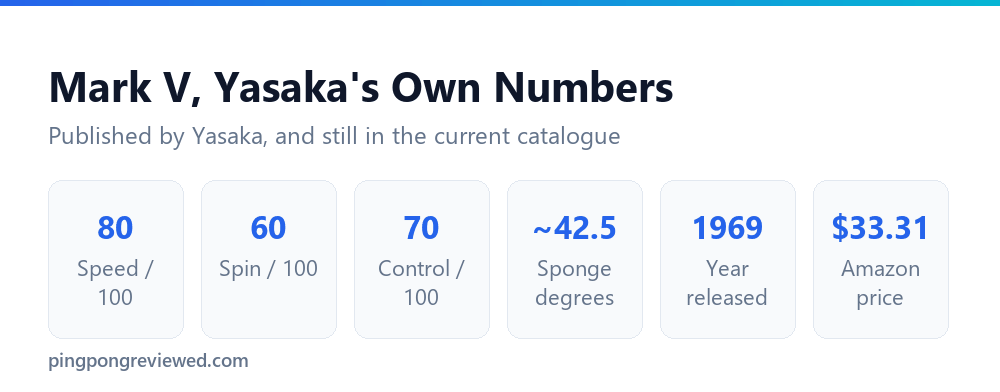
These are Yasaka’s current published figures. They rate out of 100, so the numbers look larger than ratings from brands that use a scale of 10.
The word missing from that table is the important one. Rakza 7 is listed as inverted tensor. Mark V is listed only as inverted. So Mark V has no built-in tension, and everything it does comes from the topsheet and the sponge alone.
Mark V Against a Modern Tensor Rubber
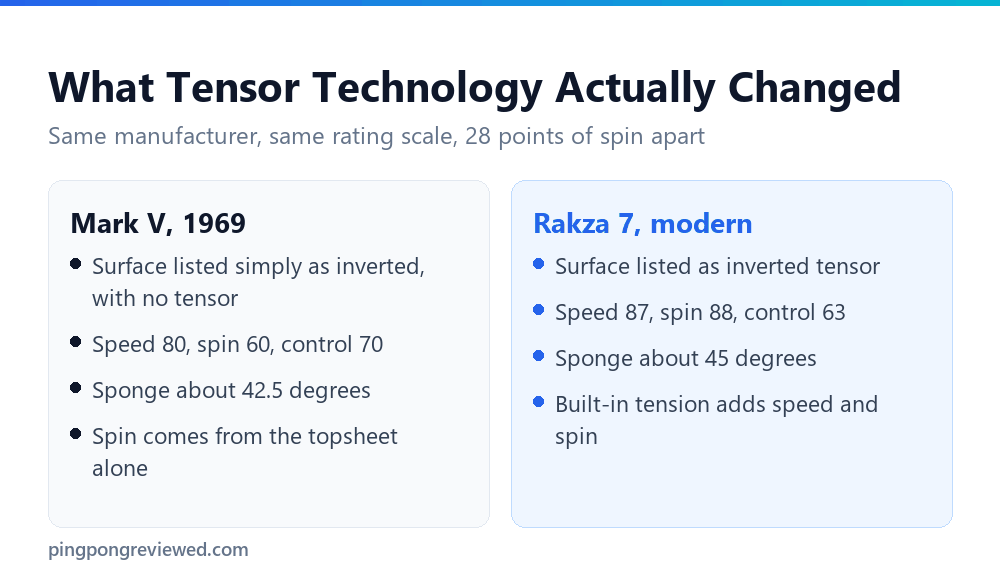
This comparison is unusually clean. Both rubbers come from Yasaka, and both are rated on the same scale. So the differences are real, rather than an artefact of comparing two companies’ marketing.
The spin gap is the headline. Sixty against eighty-eight is not a small refinement. Rather, it is the clearest illustration of what tensor technology added to the sport. And it is measured by the company that makes both rubbers.
But look at control. Mark V scores 70 against Rakza 7’s 63. So the older rubber is not simply worse. It trades spin for predictability, which is exactly the trade a developing player should want.
Who Should Buy a Mark V in 2026
Yasaka positions it as suitable from beginner through to advanced, which is a wide claim. The honest version is narrower and more useful.
- ✓You are learning strokes and want a rubber that behaves predictably
- ✓You want a low-cost sheet that is genuinely good rather than merely cheap
- ✓You play a control-based or all-round game rather than heavy topspin
- ✓You are curious what the pre-tensor era actually felt like
- ✕You want maximum spin, where 60 against 88 tells the story
- ✕You play a modern looping game built on tensor speed
- ✕You are chasing the highest ceiling your technique can reach
- ✕You expect a modern rubber’s catapult, which this does not have
There is a coaching argument for the Yasaka Mark V that goes beyond nostalgia. A rubber with less built-in help makes your technique visible. So a stroke that is slightly wrong gives a slightly wrong result. The equipment does not rescue it. But that feedback is useful while you are still building the stroke.
Which Mark V Are You Actually Buying?
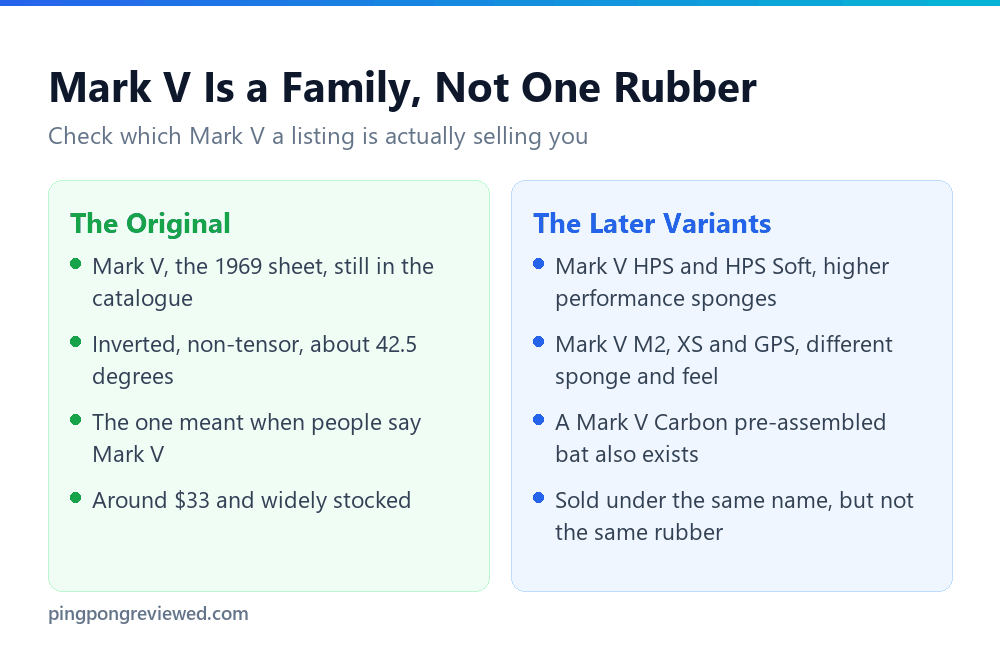
Mark V is not a single product. Yasaka’s own Mark V category lists several sheets, and they are not interchangeable.
- Mark V is the original 1969 sheet and the one people mean by the name. Non-tensor, roughly 42.5 degrees.
- Mark V HPS and HPS Soft are later, higher performance versions with different sponges.
- Mark V M2, XS and GPS are further variants with their own feel, sold under the same family name.
- Mark V Carbon is a pre-assembled bat rather than a rubber sheet, which catches people out.
⚠️ Watch out: Listings routinely say only Mark V without specifying the variant. So check the sponge thickness and the exact model before ordering. The Amazon listing verified for this review was the original, in red, at 1.5mm thickness.
Ignore the Speed and Spin Numbers on the Listing
The Amazon listing for Mark V prints its own specifications in the product bullets. They read: Speed 10. Spin 10.
Those numbers are meaningless. Yasaka rates this rubber 80 for speed and 60 for spin. A listing claiming a perfect 10 for both is not using any scale that Yasaka recognises, and it certainly does not reflect a rubber whose defining trait is moderate spin.
This is a pattern rather than a one-off. Marketplace listings for table tennis rubber routinely carry invented or stale specification text. So treat the manufacturer’s page as the source, and the listing as a way to buy the thing.
Why a Yasaka Mark V Ages Differently
This follows directly from the tensor point, and it is the practical advantage nobody mentions. A tensor rubber starts losing its built-in tension from the day it is manufactured. That happens whether you play with it or not.
The Yasaka Mark V has no built-in tension to lose. So it does not go stale sitting in a drawer, and it does not have the sharp drop-off in the first few weeks that tensor sheets are known for. What it has on day one is roughly what it has in month three.
It still wears out, of course. The topsheet collects dust and oxidises. Then grip fades as it does. But that decline is slower and more linear than tension loss. So a Mark V feels consistent right up until it is genuinely worn.
💡 Pro tip: This makes the Yasaka Mark V unusually sensible to buy in advance or in pairs. Stocking up on tensor rubber wastes some of what you paid for. Stocking up on Mark V does not.
It also explains why the rubber remains popular with players who train infrequently. Someone playing once a fortnight gets poor value from a tensor sheet, because the tension decays on a calendar rather than on playing hours. The Mark V has no such clock running.
Choosing a Yasaka Mark V Thickness
Mark V is sold across a range of sponge thicknesses, and the listing verified for this review was 1.5mm in red. That is thinner than most modern offensive players would choose, and it changes the character noticeably.
- Thicker sponge, around 2.0mm and up, gives more speed and more spin potential. It is the choice for attacking play.
- Middle thicknesses around 1.8mm balance the two, and suit a player who attacks and blocks in roughly equal measure.
- Thinner sponge, 1.5mm and below, maximises control and feel. It is a common choice on the backhand, and for defensive and all-round players.
Given that control is the Yasaka Mark V’s strongest attribute, thinner sponge leans further into what the rubber is already good at. So if you are buying it for control, a thinner sheet is not a compromise. It is the point.
⚠️ Watch out: Check the thickness before ordering. Listings for this rubber frequently lead with the model name and bury the sponge measurement, and 1.5mm and 2.0mm are genuinely different products in the hand.
Pairing a Mark V With a Blade
Because the Yasaka Mark V supplies less speed than a tensor sheet, the blade matters more here than it does with a modern rubber. The blade has to make up the difference.
On an all-round wood blade, the combination is slow, controlled and very readable. That is a genuinely good setup for learning, and it is roughly what a generation of players grew up on.
On a faster offensive or carbon blade, the Mark V gets more interesting. The blade supplies pace. Then the rubber keeps the trajectory predictable. Some players prefer that division of labour to a fast rubber on a flexible blade.
What does not work well is pairing it with a very slow defensive blade unless you genuinely play defence. The result has plenty of control and almost no ability to finish a point.
Old and Cheap Against New and Cheap
At around $33, the Yasaka Mark V competes with a large field of modern budget rubbers, many of them under $20. So the fair question is whether the older sheet is worth the difference.
The case for the Yasaka Mark V is consistency and a known quantity. It has been made for over fifty years by a major manufacturer. So it performs the same way across sheets. But cheap unbranded rubber is far more variable, and that variation is not in your favour.
The case against is that some modern budget tensor rubbers genuinely do produce more spin than a Mark V. If spin is what you want and your budget is tight, that is a real alternative rather than a marketing claim.
So the decision comes back to what you are optimising for. Buy the Yasaka Mark V for predictability and build quality at a fair price. Buy a budget tensor sheet if you want spin above all and can accept more variability.
📊 Note: One thing worth weighing separately is that the Mark V is a genuine ITTF-legal competition rubber with decades of pedigree, not a recreational product. At this price that combination is rare.
Where to Buy a Yasaka Mark V
The Yasaka Mark V is one of the easier rubbers on this site to actually buy. It is a current catalogue product rather than old stock, and it is carried widely.
The Amazon listing verified for this review was in stock at $33.31, with 212 ratings averaging 4.3 stars. Specialist table tennis retailers also stock it, usually across a wider range of thicknesses than a marketplace listing offers.
- Check the variant. Mark V, HPS, HPS Soft, M2, XS and GPS are different rubbers sold under one family name.
- Check the thickness. Listings often bury it, and 1.5mm plays very differently from 2.0mm.
- Check the colour. One side of a legal bat must be black, and the other red, pink, purple, green or blue.
💡 Pro tip: Because the Yasaka Mark V has no tension to decay, buying two sheets at once is sensible here in a way it is not with modern tensor rubber. The spare will play the same when you come to fit it.
Three Mistakes People Make With the Mark V
Most disappointment with this rubber traces back to a mismatch of expectation rather than a fault in the sheet. Three come up repeatedly.
- Expecting modern spin. Yasaka rates it 60 for spin. So a player arriving from a tensor rubber will find it flat by comparison. That is the design, not a defect.
- Buying the wrong variant. HPS, HPS Soft, M2, XS and GPS all carry the Mark V name. But only the plain Mark V is the 1969 sheet.
- Pairing it with too slow a blade. Because the rubber supplies less pace than a tensor sheet, a slow blade underneath leaves you with no way to finish a point.
Avoid those three and the Yasaka Mark V does exactly what it has done for five decades. It gives you a predictable ball and asks you to supply the rest.
Yasaka Mark V Questions, Answered
When was the Yasaka Mark V released?
1969. It has been in continuous production ever since and is still listed in Yasaka’s current catalogue, which no other table tennis rubber can claim.
How much does the Yasaka Mark V cost?
About $33.31 on Amazon for the original sheet, in stock, with a 4.3 star rating from 212 ratings. That is well under half the price of a premium modern rubber.
What are the Mark V specs?
Yasaka rates it 80 for speed, 60 for spin and 70 for control out of 100, with a sponge of about 42.5 degrees and a medium arc. The surface is listed as inverted, not inverted tensor.
Is the Mark V a tensor rubber?
No. Yasaka lists the surface as inverted, without the tensor designation their modern Rakza rubbers carry. It predates tensor technology, and all of its grip comes from the topsheet and sponge.
Is the Mark V still good in 2026?
For control and consistency, yes. For spin, it is clearly behind modern rubbers, and Yasaka’s own numbers say so at 60 against Rakza 7’s 88. It suits developing players and control-based games rather than heavy topspin attackers.
Is Mark V good for beginners?
It is one of the better choices. The control rating of 70 is higher than modern offensive rubbers, and a sheet with less built-in help makes technique errors visible rather than hiding them.
What is the difference between Mark V and Mark V HPS?
HPS is a later, higher performance version with a different sponge. The plain Mark V is the original 1969 sheet. Yasaka also sells M2, XS and GPS variants, plus a Mark V Carbon pre-assembled bat.
Which players used the Mark V?
Hans Alser won the 1970 European Championships with it, and Stellan Bengtsson used it to win Sweden’s first World Championship singles gold in 1971 at the age of 18.
The Verdict on the Yasaka Mark V
- →Released in 1969 and still in production, which is unique in table tennis equipment.
- →Yasaka rates it 80 speed, 60 spin, 70 control, with a roughly 42.5 degree sponge.
- →It is not a tensor rubber, and the 28-point spin gap against Rakza 7 shows what that technology added.
- →It beats modern offensive rubbers on control, at 70 against 63.
- →About $33.31 and in stock, making it one of the best value genuine rubbers available.
The Yasaka Mark V has survived over fifty years because it does something modern rubbers gave up. It behaves the same way every single time. That is worth less to a player chasing the highest spin ceiling. But it is worth a great deal to anyone still building the strokes that ceiling depends on.
As an Amazon Associate, we earn from qualifying purchases through links on this page.

Ping Pong Reviewed is an equipment review site covering table tennis and baseball gear. Specifications are checked against manufacturer listings, and prices against live retail pages, before publication.