Best Ping Pong Paddle Brands (Stiga vs Killerspin vs Budget)
Looking for the best ping pong paddle brand? A quick clarification first: every product in this brand comparison is a complete, pre-assembled paddle — blade and rubber already attached — not a bare blade. Among paddle brands, Stiga offers the most complete range across skill levels, while Killerspin and budget unbranded options fill specific niches.
- →“Blade brand” searches usually turn up complete paddles, not bare blades — every product here has rubber pre-attached, worth knowing before you buy.
- →Stiga offers the widest range across price points and skill levels of any brand in this comparison.
- →Killerspin targets a specific mid-range niche, distinct from Stiga’s broader lineup.
- →Budget unbranded paddles trade manufacturing consistency for a lower price — reasonable for casual play, less so for serious training.
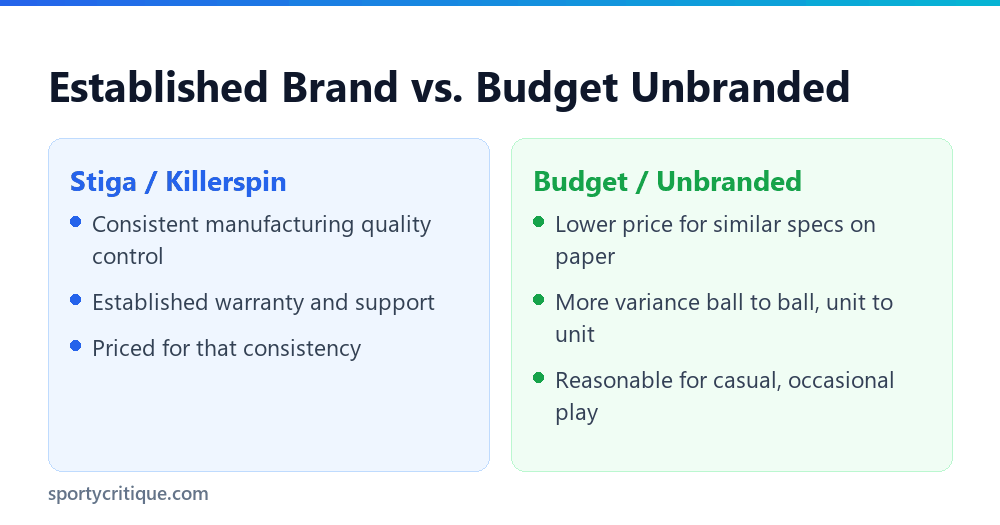
Brand matters more in table tennis paddles than in a lot of sporting goods categories, mainly because manufacturing consistency directly affects how predictably a paddle performs. This guide compares brands rather than individual models — Stiga’s broad range, Killerspin’s specific niche, and budget unbranded options — to help you pick a brand direction before narrowing to a specific paddle.
Table of Contents
Stiga: The Widest Range

Stiga covers more of the market than any other brand in this comparison, from the Evolution ($69.99 on STIGA’s US site) through the Pro Carbon ($79.99) and the Carbon+ ($99.99), all of which STIGA lists as performance rackets. We haven’t tested any of them, so these are STIGA’s own figures: Speed 96, Spin 94 and Control 90 for the Evolution, 99, 100 and 80 for the Pro Carbon, and 98, 94 and 75 for the Carbon+, with no stated scale.
- ✓Widest range across skill levels of any brand here
- ✓Published figures for each racket on STIGA’s US pages
- ✓Easy to step up within the same brand as you improve
- ✕Not the cheapest option at the true budget end
- ✕So many models that choosing within the brand takes real research
Stiga Carbon+ Bundle: Outfitting More Than One Player

This Stiga Carbon+ bundle is listed on Amazon as a Carbon+ bundle at $65.99 on October 2, 2026. The listing says it includes a racket, a neoprene racket cover, a STIGA player wristband and two 3-star balls. We haven’t compared it with the standalone Carbon+ listing, so we can’t say the two rackets are identical.
Killerspin: A Distinct Mid-Range Niche

The Killerspin Jet200 represents a different brand philosophy from Stiga’s broad range — Killerspin focuses on a narrower set of recreational and intermediate paddles rather than spanning the full skill spectrum. It’s worth comparing directly against Stiga’s mid-tier options if you’re deciding between the two brands specifically.
💡 Pro tip: Comparing brands rather than individual models first can simplify a confusing decision — pick the brand whose overall range and price positioning fits your budget, then narrow to a specific paddle within that brand.
Budget Pick: Pro Spin Paddles

The Pro Spin paddle set represents the budget end of this brand comparison, typically sold as a multi-paddle set at a lower price than Stiga or Killerspin. It won’t match either established brand on manufacturing consistency, but for casual play or outfitting a family game night, it’s a genuinely functional low-cost option.
Unbranded Budget Option: With Carry Case

This unbranded paddle bundles a hard carry case, a practical inclusion for anyone who wants to protect and transport their paddle without buying a case separately. Like the Pro Spin set, it’s a reasonable budget pick without the manufacturing consistency guarantees an established brand name provides.
Best Ping Pong Paddle Brand: Why Consistency Actually Matters
Unlike some sporting goods where brand is mostly marketing, paddle manufacturing consistency has a real, measurable effect on play. An established brand like Stiga or Killerspin holds tighter tolerances on rubber tackiness, sponge density, and blade flex from unit to unit, which means the paddle you receive plays closer to what the specs promise. Budget unbranded manufacturers vary more, which is part of why the same-priced budget paddle sometimes gets wildly different reviews from different buyers.
How This Differs From Our Complete Paddle Guide
Our separate guide to top-rated ping pong paddles covers several of these same products individually, ranked by performance rather than brand. This guide exists specifically to help you choose a brand direction first — useful if you’re earlier in the decision process and want to narrow the field by manufacturer reputation before comparing specific models. Read both if you want the fuller picture.
Comparing Handle Feel Across Brands
Handle shape and feel vary subtly between brands even within similar overall paddle categories. STIGA’s own pages word handles in more than one place: the Nitro page’s title says an anatomic Italian composite handle while its spec table says flared, and the Pro Carbon’s spec table says flared, so check the spec table. Killerspin and budget options vary more, since handle tooling is one of the easier places for manufacturers to cut costs without obviously changing performance specs on paper. If handle comfort matters a lot to you personally, that’s worth testing in person before committing, regardless of which brand’s numbers look best.
Paddle Weight Consistency by Brand
Established brands publish and generally hold to consistent weight specifications across units of the same model, which matters for players sensitive to swing feel. Budget and unbranded paddles sometimes show more unit-to-unit weight variance, even within the same listing, since manufacturing tolerances tend to loosen as price drops. That variance is rarely dramatic enough to notice for casual play, but it’s a real, measurable difference between the brand tiers in this comparison.
Warranty and Support Differences
Established brands like Stiga and Killerspin typically offer clearer warranty terms and more accessible customer support than budget unbranded sellers, where warranty claims can be slower or harder to resolve. That’s part of the real price premium you’re paying for with a recognized brand — not just the paddle itself, but the support behind it if something goes wrong.
A Quick Recap
Stiga for range and reliability across every skill level, Killerspin for a distinct mid-range option worth comparing directly, and budget or unbranded paddles for genuinely casual play where manufacturing consistency matters less. None of these are bare blades — every pick here ships with rubber already attached, ready to play out of the box.
Reading Between the Lines on Listing Titles
Listing titles on marketplaces like Amazon often blur the line between blade and paddle language deliberately, since “blade” ranks well in search even when the product is a complete pre-assembled racket. A quick way to check: if a listing mentions rubber thickness, sponge type, or a specific rubber name alongside the blade description, that’s a strong signal you’re looking at a complete paddle rather than a bare blade, regardless of what the title emphasizes.
How Each Brand Positions Itself
Stiga positions itself as the do-everything brand, with a genuine model for nearly every skill level and budget under one recognizable name — that breadth is the brand’s core value proposition. Killerspin positions itself more narrowly, focused on delivering solid mid-range performance without trying to cover every tier the way Stiga does. Budget and unbranded sellers position on price alone, competing purely on cost rather than a specific performance niche or brand identity.
Manufacturing Origin and Quality Control
Established brands like Stiga and Killerspin maintain consistent manufacturing processes and quality control standards across their product lines, which is exactly what you’re paying the brand premium for. Budget and unbranded sellers often source from multiple manufacturers or change suppliers between batches, which explains why identical-looking budget paddles can perform noticeably differently between orders even when the listing hasn’t changed.
Resale and Long-Term Value
Paddles from established brands tend to hold resale value better than unbranded alternatives, since buyers recognize the name and trust the manufacturing consistency even secondhand. That’s a minor consideration for most recreational players who’ll use a paddle until it wears out rather than reselling it, but it’s worth factoring in if you’re the type of player who upgrades equipment frequently and expects to sell or trade older gear along the way.
Where to Verify Brand Claims Yourself
Rather than taking any brand’s marketing at face value, checking verified buyer reviews on the specific listing is the most reliable way to confirm consistency claims for yourself. Patterns across dozens of reviews — recurring complaints about weight variance, glue quality, or handle comfort — tell you more about actual manufacturing consistency than a brand’s own product description ever will, regardless of which brand you’re evaluating.
How Often Paddle Brands Release New Models
Established brands like Stiga typically refresh their lineup every few years rather than constantly, which is part of why a Stiga model from a couple of years back often remains a perfectly current, competitive choice rather than an outdated one. Budget and unbranded sellers cycle products faster and less predictably, sometimes replacing a listing entirely rather than issuing a genuine next-generation update, which makes long-term parts or replacement rubber availability less certain for those options.
When Brand Matters Less Than You’d Think
For genuinely casual, occasional play — a paddle that comes out a few times a year for family game nights — brand consistency matters far less than it does for a player training regularly. The performance gap between a budget unbranded paddle and a Stiga at this play frequency is unlikely to be something you’d actually notice, which makes the budget option a reasonable choice specifically for that lighter use case.
What is the best ping pong paddle brand?
Stiga offers the widest range across skill levels; Killerspin fills a distinct mid-range niche, and budget unbranded options work for casual play.
Is a ‘blade brand’ the same as a paddle brand?
In most buying guides, yes in practice — ‘blade’ searches usually return complete paddles with rubber pre-attached, not bare blades.
Is Stiga or Killerspin better?
Stiga offers a broader range across price points; Killerspin focuses on a narrower mid-range niche — compare the specific models within your budget.
Are budget unbranded paddles worth buying?
Yes, for casual or occasional play — they trade manufacturing consistency for a lower price, which matters less if you’re not training seriously yet.
Do established brands offer better warranties?
Generally yes — Stiga and Killerspin offer clearer warranty terms and support than most budget unbranded sellers.
How can I verify a brand’s consistency claims myself?
Check verified buyer reviews on the specific listing — patterns across many reviews reveal actual manufacturing consistency better than marketing copy.
How do I tell a blade listing from a paddle listing?
If the listing mentions rubber thickness, sponge type, or a specific rubber name, it’s a complete paddle, regardless of what the title calls it.
As an Amazon Associate, we earn from qualifying purchases through links on this page.

Ping Pong Reviewed is an equipment review site covering table tennis and baseball gear. Specifications are checked against manufacturer listings, and prices against live retail pages, before publication.