Injury Timeouts in Table Tennis: The 10-Minute Cap, Explained
This is a different rule from the standard timeout this site has already covered, and mixing the two up is an easy mistake, one is a single, player-requested strategic pause; the other is a specific medical allowance with its own conditions.
This page covers what qualifies, the 10-minute limit, the separate bleeding provision, and who makes the call.
Short answer: Under the ITTF Regulations, the referee may allow a suspension of play of no more than 10 minutes if a player is temporarily incapacitated by an accident, but not for cramp, exhaustion, or a disability that was present or reasonably to be expected at the start of the match. If anyone in the playing area is bleeding, play is suspended immediately and does not resume until that person has received medical treatment and all traces of blood have been removed.
Table of Contents
Not the Same as the Standard Timeout
It’s worth stating this clearly upfront: this injury allowance is separate from the standard one-timeout-per-match rule this site has covered elsewhere. In the Regulations, a player or pair may claim one time-out period of up to 1 minute during an individual match (3.4.4.2). The injury suspension is a different provision (3.4.4.4 and 3.4.4.5) with its own 10-minute limit and its own conditions.
What Actually Qualifies: the Accident Requirement
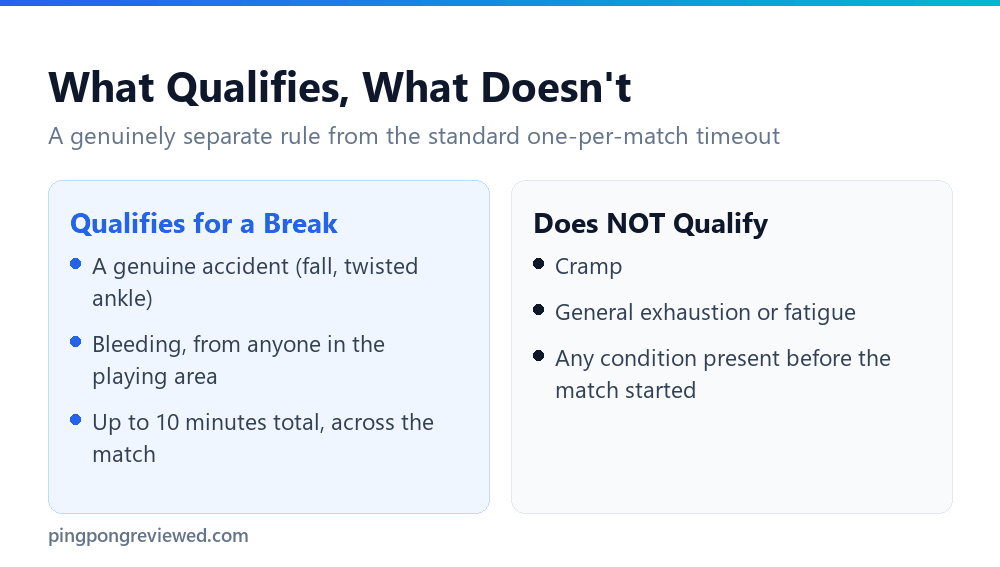
The eligibility test is whether a player is “temporarily incapacitated by an accident”, and the word “accident” matters. The Regulation says a suspension shall not be allowed for a disability which was present or was reasonably to be expected at the beginning of the match, or where it is due to the normal stress of play. It adds that disability such as cramp or exhaustion, caused by the player’s current state of fitness or by the manner in which play has proceeded, does not justify a suspension, which may be allowed only for incapacity resulting from an accident, such as injury caused by a fall.
The only example the Regulation gives of a qualifying accident is an injury caused by a fall. Other incidents are for the referee to judge, and the referee also has to be of the opinion that the suspension is not likely to be unduly disadvantageous to the opposing player or pair.
⚠️ Watch out: Cramp and exhaustion caused by a player’s current state of fitness or by the manner in which play has proceeded do not justify a suspension under the Regulation, even though they can be painful. The Regulation contrasts them with incapacity resulting from an accident, such as injury caused by a fall.
The 10-Minute Cap: Cumulative, Not Per-Incident
An easy detail to misread: the Regulation says the suspension is in no circumstances more than 10 minutes, and the ITTF Handbook for Match Officials (16th edition, July 2019, section 13.5.3) treats the limit as a total for the match. It says that once a player has been granted an interval for recovery from injury, normally no further such interval should be allowed during that match. Exceptionally, where the first interval was very short, another brief interval may be allowed for treatment, provided it is not likely to be prejudicial to the opponent and the total period for which play is suspended during the match does not exceed 10 minutes.
The Bleeding Rule: a Separate Provision
Bleeding is covered by its own provision (3.4.4.6): if anyone in the playing area is bleeding, play shall be suspended immediately. The provision contains no accident test and applies to anyone in the playing area, not only the players.
Resumption requires both of two conditions: the person must have received medical treatment, and all traces of blood must have been removed from the playing area (3.4.4.6). The Regulation does not say why both are required.
💡 Pro tip: If you umpire or organize casual competitive play, the Regulation’s wording is that play shall be suspended immediately if anyone in the playing area is bleeding. It does not mention a minor-bleeding exception, so stopping play is the safer reading.
What the Regulation Says About Limits
The Regulation does not explain why it excludes a disability that was present or reasonably to be expected at the start of a match, or that is due to the normal stress of play. What it does say is that the suspension must be of the shortest practical duration, never more than 10 minutes, and only where in the referee’s opinion it is not likely to be unduly disadvantageous to the opposing player or pair.
- ✓Understand this as a separate provision from the standard one-timeout-per-match allowance
- ✓Expect an injury caused by a fall to be the kind of accident that can qualify, at the referee’s discretion
- ✓Track cumulative injury-break time across the whole match, not per incident
- ✓Treat any bleeding in the playing area as a reason to suspend play immediately
- ✕Expect cramp or general exhaustion to qualify for an injury break
- ✕Assume a second injury resets the 10-minute cap
- ✕Try to resume play after bleeding without both treatment AND blood removal
- ✕Confuse this rule with the standard 60-second strategic timeout
What Happens to the Match Clock and Score During an Injury Break
The Regulation describes the injury allowance as a suspension of play and does not provide for any point to be awarded or deducted because of it. The Handbook for Match Officials adds that the timekeeper should time the suspension from the time when the referee is called, not from the time the referee arrives at the playing area (13.5.1).
Neither provision attaches a scoring penalty to an injury suspension. Any loss of rhythm during the break is a practical matter, separate from the rules.
Why This Rule Matters More in Longer Tournaments
Players who play several matches in one day should note that the Regulation excludes cramp and exhaustion caused by the player’s current state of fitness or by the manner in which play has proceeded. The Regulation does not mention tournament fatigue specifically, so how it would be applied to the later rounds of a long day is a matter for the referee. Planning conditioning, hydration and recovery between matches is general advice rather than something the rules address.
The Short Version, Restated
An accident can lead the referee to allow a suspension of play, up to 10 minutes in total across the match, but cramp and exhaustion do not qualify. Bleeding has its own provision: play is suspended immediately and resumes only once the person has been treated and all traces of blood have been removed. The standard one-per-match timeout is a separate provision.
Who Makes the Call: the Referee
A player does not automatically receive an injury suspension by asking for one. The Regulation says the referee may allow it, provided that in the referee’s opinion it is not likely to be unduly disadvantageous to the opposing player or pair. The Handbook for Match Officials says that if a player is unable to continue owing to accident or illness, the umpire must report immediately to the referee, and that the referee may authorise an emergency suspension if satisfied that the break will not unfairly affect an opponent and that the player will be able to resume play within a reasonably short time (13.5.1).
The decision therefore sits with the referee rather than the player, and a player should expect the request to be assessed before a suspension is granted.
How This Applies in Casual, Non-Officiated Play
Without a referee, nobody is assigned to make the call that this Regulation gives to the referee, so in casual play it comes down to what the players agree between themselves. The 10-minute limit and the cramp exclusion are written for competitions run under the ITTF Regulations, and a local league may have its own rule.
Common Questions
How long can an injury timeout last in table tennis?
No more than 10 minutes. The Handbook for Match Officials treats it as a total for the match, not 10 minutes per injury.
Does cramp qualify for an injury break?
No. The Regulation says cramp or exhaustion caused by the player’s current state of fitness or by the manner in which play has proceeded does not justify a suspension.
What happens if a player is injured a second time in the same match?
According to the Handbook for Match Officials, normally no further interval is allowed, except a brief additional one if the first was very short, and the total of 10 minutes still applies.
What happens if someone is bleeding during a match?
Play is suspended immediately. It resumes only once the person has received medical treatment and all traces of blood have been removed from the playing area.
Is the injury timeout the same as the standard one-per-match timeout?
No, they are separate provisions. A time-out is up to 1 minute and is requested by the player or pair; the injury suspension is allowed by the referee after an accident and is limited to 10 minutes.
Does the score change or reset during an injury break?
The injury provision does not provide for any change to the score.
Who decides whether an injury actually qualifies for a break?
The referee. The Regulation says the referee may allow the suspension if, in the referee’s opinion, it is not likely to be unduly disadvantageous to the opposing player or pair.
The Short Version
One narrow medical allowance, a 10-minute limit, and a separate provision for bleeding.
- →An accident can lead the referee to allow a suspension of up to 10 minutes in total per match.
- →Cramp and general exhaustion specifically do not qualify.
- →A second injury normally doesn’t grant a fresh break beyond the same 10-minute cap.
- →Bleeding in the playing area triggers an immediate suspension under a separate provision.
- →Play resumes after bleeding only once treatment is given AND blood is removed.
- →This is a completely separate rule from the standard one-timeout-per-match allowance.

Ping Pong Reviewed is an equipment review site covering table tennis and baseball gear. Specifications are checked against manufacturer listings, and prices against live retail pages, before publication.