
Is Playing Ping Pong Good Exercise? A Direct Comparison (2026)
Yes, is playing ping pong good exercise is a fair question with a genuinely straightforward answer: it’s a real moderate-intensity workout, not just a casual pastime. This page focuses specifically on how it actually compares to other common exercises, since that comparison is what most people asking this question actually want to know. For broader health benefits beyond pure exercise intensity, cardio, balance, brain effects, our full health benefits guide covers that ground in more depth.
It’s worth naming why this question gets asked so often in the first place: ping pong doesn’t look like exercise the way running or lifting does, no visible sweat-drenched struggle, no heavy equipment, often played indoors in regular clothes. That appearance genuinely undersells what’s actually happening physically during a fast rally, which is part of why the comparison to more visibly strenuous activities below matters more than a simple yes-or-no answer would.
Table of Contents
How It Actually Compares to Other Exercise
Table tennis is commonly classified in roughly the 4 to 8 MET range depending on play intensity, MET being the standard measure exercise scientists use to compare activity intensity against resting metabolism. Casual, slower-paced doubles sits toward the lower end of that range, comparable to a brisk walk. Fast, competitive singles with extended rallies pushes toward the higher end, into territory closer to light jogging or moderate cycling. That’s a wider intensity range than a lot of people assume going in, and it means the honest answer to “how does it compare” really depends on how you’re actually playing, not the sport in the abstract.
Heart rate response backs this up better than METs alone convey, since METs measure average energy expenditure over time while heart rate during actual play often spikes and recovers repeatedly within a single game, closer to interval training than to a steady jog. A hard-fought rally can push your heart rate meaningfully above what a casual walk would, even briefly, before a pause between points lets it settle back down. That interval-like pattern is part of why table tennis can feel more demanding during actual play than its average MET classification alone might suggest, and it’s a genuinely different cardiovascular stimulus than sustained, flat-intensity cardio provides.
What Muscles It Actually Works
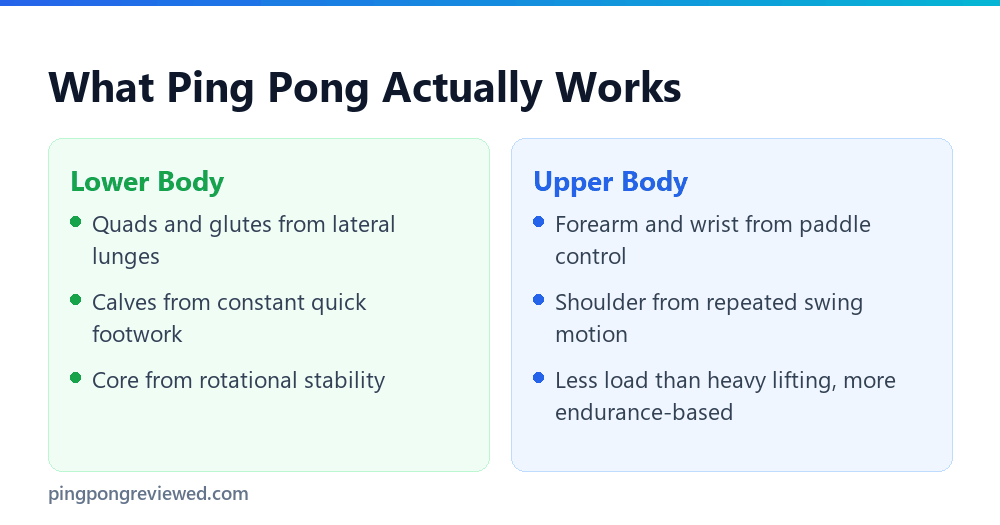
The lower body does more work than most casual players realize, quads and glutes from repeated lateral lunges toward wide shots, calves from constant on-the-balls-of-your-feet footwork, and core muscles working continuously for rotational stability during swings. The upper body gets a real but different kind of workout: forearm and wrist endurance from sustained paddle control, and shoulder engagement from repeated swing motion, though at nowhere near the load of resistance training. Table tennis builds muscular endurance more than raw strength, which is a meaningful distinction if you’re comparing it specifically to weight training rather than to other cardio activities.
Grip and forearm endurance specifically builds faster than most new players expect, since maintaining paddle control through dozens of consecutive shots without resetting your grip works those muscles in a sustained, low-load way that’s genuinely different from a single heavy lift. It’s common for new players to feel real forearm fatigue after their first few sessions even without any noticeable soreness elsewhere, which is a fair signal that the sport is working muscles you might not have expected from watching it played casually.
Who This Is Actually a Good Fit For
- People who find steady cardio boring — the reactive, unpredictable nature keeps engagement high in a way a treadmill often doesn’t.
- Anyone managing joint sensitivity — genuinely lower impact than running or most court sports involving jumping.
- Players wanting a social workout — built-in social structure that solo cardio doesn’t offer.
- Beginners easing into exercise — intensity scales naturally with your own pace and opponent skill level.
Who it’s a weaker fit for: anyone specifically training for pure cardiovascular endurance at a serious level, marathon training being the clear example, where sustained, predictable-pace cardio work is genuinely more effective than an intermittent, stop-start sport. Table tennis complements that kind of training well as cross-training variety, but it isn’t a substitute for it.
It’s also worth being honest that consistency matters more than any single session’s intensity, the same way it does for any exercise. One hard match a week contributes far less to genuine fitness improvement than three or four shorter, regular sessions would, even if the total playing time works out roughly similar. This is a general exercise-science principle rather than anything specific to table tennis, but it’s easy to overlook when a single intense session feels like it should count for more than it actually does toward building lasting fitness.
Court or table access is also a real practical factor worth weighing against a home cardio routine you can start instantly. If you don’t already own a table or belong to a club, getting genuinely regular sessions in requires more upfront logistics than lacing up running shoes does, which is worth planning around honestly rather than assuming access will simply work itself out once you decide to start playing more.
How We Sourced This
The MET intensity range cited above reflects the standard exercise-science classification system, the Compendium of Physical Activities, rather than an invented calorie figure. We deliberately gave a range tied to play intensity instead of a single flat number, since a casual rally and a competitive match genuinely differ enough in intensity that one number would mislead more than it would inform.
Age and prior fitness level matter more for this comparison than they get credit for too. A reasonably fit adult new to table tennis specifically, though experienced with other sports, will likely operate toward the higher end of that intensity range almost immediately, while someone new to regular exercise generally will naturally settle into slower, lower-intensity rallies at first regardless of the sport’s theoretical upper range. Neither starting point is wrong; the range simply reflects where different players genuinely land depending on their own baseline.
We also cross-checked this against the same real research cited on our brain-benefits page, since open-skill sports like table tennis engage the body and the nervous system simultaneously in a way pure steady-state cardio doesn’t, which is a genuinely separate consideration from raw calorie burn and worth factoring into any honest comparison against a plain walk or jog covering similar MET territory.
Frequently Asked Questions
Is playing ping pong actually good exercise?
Yes — it’s a real moderate-intensity activity, roughly 4 to 8 METs depending on play intensity, engaging both lower-body footwork and upper-body endurance.
How does ping pong compare to walking for exercise?
Casual, slower-paced ping pong sits at a similar intensity to brisk walking. Fast, competitive play is noticeably more intense than walking, closer to light jogging.
Is table tennis good for weight loss?
It can contribute to weight loss the same way any regular moderate-intensity activity does, as part of a broader calorie deficit, not through any special property specific to the sport itself.
What muscles does ping pong actually use?
Primarily quads, glutes, calves, and core from footwork and rotational stability, plus forearm, wrist, and shoulder endurance from paddle control and swing motion.
Can beginners get real exercise value from casual play?
Yes, though slower casual rallies sit toward the lower end of the intensity range. Playing with more consistent movement and longer rallies pushes the intensity up meaningfully.
Is ping pong a substitute for cardio or strength training?
It’s a genuine complement to both, not a full substitute for either — it doesn’t match dedicated cardio for sustained endurance work or weight training for building raw strength.
Does playing ping pong count toward weekly exercise guidelines?
Yes, moderate-intensity play genuinely counts toward general guidelines like 150 minutes of moderate activity weekly, the same as any other moderate-intensity activity would.
How many calories does ping pong actually burn?
It depends heavily on your body weight, play intensity, and session length, so a single flat calorie number would mislead more than genuinely help. Use the 4-8 MET range above along with your own weight and session length for a more honest, personalized estimate rather than trusting a generic figure.
Is ping pong better exercise than tennis?
They’re genuinely different activities rather than one being categorically better — tennis generally demands more raw power and larger-scale court coverage, while table tennis demands faster reflexes and reaction time at much closer range, a real tradeoff rather than a simple hierarchy.
Should I warm up before playing ping pong for exercise?
Yes, the same as before any moderate-to-vigorous activity involving quick lateral movement — a brief dynamic warm-up reduces strain risk on the ankles and knees specifically, given how much quick direction-changing the sport actually demands.
As an Amazon Associate, we earn from qualifying purchases through links on this page.

Ping Pong Reviewed is an equipment review site covering table tennis and baseball gear. Specifications are checked against manufacturer listings, and prices against live retail pages, before publication.