What Is the Expedite System in Table Tennis? Full Rule Explained
If you’ve ever watched a table tennis match suddenly speed up, serves alternating every single point, a defender seemingly forced to attack out of nowhere, you were probably watching the expedite system kick in.
Short answer: The expedite system comes into operation after 10 minutes’ play in a game, unless 18 points in total have been scored, or earlier if both players or pairs request it (ITTF Statutes 2026, Law 2.15). Once active, each player serves for one point in turn, and if the receiving player or pair makes 13 correct returns in a rally, the receiver scores the point. It stays in effect for the rest of the match once triggered, restarting from 0-0 in every following game.
Table of Contents
Why This Rule Exists at All
The Handbook for Match Officials describes the expedite system as the method provided by the laws to prevent unduly long games, which may result from negative play by both players or pairs (section 15.1.1, 17th edition, July 2023). A frequently cited example is the first point of a 1936 World Championships match between Alojzy Ehrlich and Farkas Paneth, which Wikipedia’s entry on Ehrlich reports as lasting two hours and 12 minutes.
Without some version of this rule, a sufficiently defensive player could theoretically stall an opponent indefinitely by refusing to attack, turning what’s meant to be a fast, exciting sport into exactly the opposite. Expedite exists specifically to prevent that outcome without banning defensive play outright.
Exactly When It Triggers
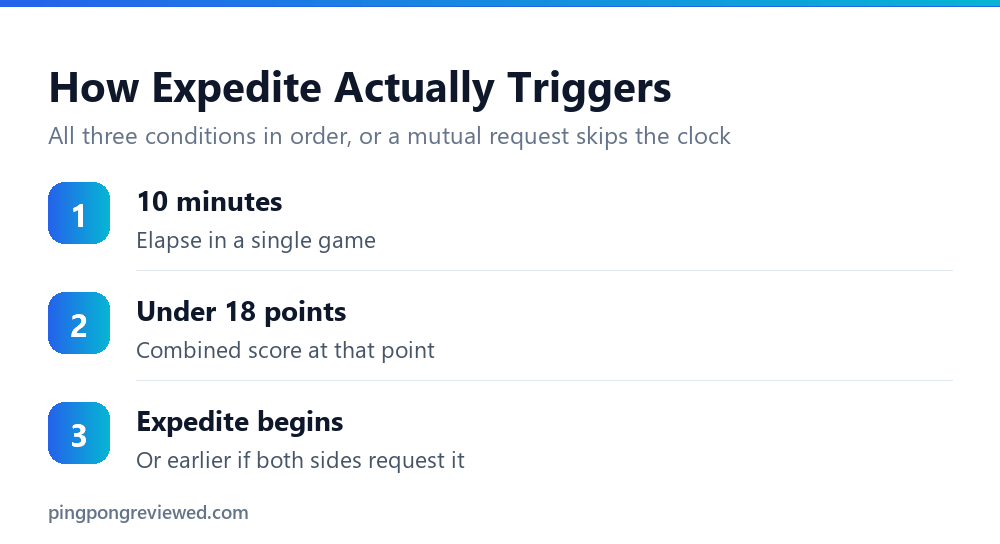
Two conditions have to line up for expedite to be introduced automatically: the game has reached 10 minutes’ play, and fewer than 18 points in total (both scores added together) have been scored. Law 2.15 says the expedite system shall not be introduced in a game if at least 18 points have been scored. The Laws do not give a reason for the 18-point cutoff.
There is also a second path in: expedite can be introduced at any time when both players or pairs request it (Law 2.15.1). Because both sides have to ask, neither player can introduce it alone.

What Actually Changes Once It’s Active
The most visible change is the serve rotation. Normal play has each server keep serve for two consecutive points before it rotates. Under expedite, that changes to alternating every single point, one serve each, back and forth, for the rest of the match.
The second change is the 13-return limit. Under Law 2.15.4, if the receiving player or pair makes 13 correct returns in a rally, the receiver scores a point. The Handbook for Match Officials describes this as the server having 13 strokes, including the service stroke, in which to win the point (section 15.1.2).
💡 Pro tip: Once expedite is active, a stroke counter (the assistant umpire or a separate official, Law 3.3.2.6) counts the receiver’s returns aloud from one to thirteen (Handbook for Match Officials 15.2.2), so you can follow the 13-return limit by listening to the count.
The Serving Handoff Rule When It Triggers Mid-Rally
One easy-to-miss detail: expedite can technically trigger while a rally is already underway at the 10-minute mark, not just cleanly between points. When that happens, the rule for who serves next depends on how play was interrupted. If the game was stopped mid-rally specifically because the clock hit 10 minutes, service in the next point goes to whoever served in that interrupted rally. If play had already paused naturally between points when the 10-minute mark passed, service instead goes to whoever received the previous rally.
This is a small procedural detail, but it matters for anyone actually umpiring or playing under expedite conditions.
⚠️ Watch out: Once expedite activates in any single game, it stays in effect for every remaining game in that match, it does not reset or turn off partway through, and each new game starts under expedite conditions from 0-0 rather than needing to re-trigger.
How This Affects Playing Style
Some players may change how they play around the 10-minute mark, either trying to finish the game before it arrives (reaching 18 combined points avoids the trigger entirely) or preparing to play more aggressively once it begins. That is general tactical reasoning rather than anything the Laws prescribe.
Knowing the rule also helps you read a match as it happens: once serves start alternating every point, you know the expedite system is on.
How Umpires Track and Announce It
At officiated matches, the Handbook for Match Officials says the timekeeper calls Time when the limit is reached, and the umpire declares a let if necessary and tells the players that the rest of the match will be played under the expedite system (section 15.2.1). Counting is done by a stroke counter, normally a separate official, though the assistant umpire can do it (Handbook section 4.5; Law 3.3.2.6). The stroke counter counts the receiver’s returns aloud, and if the 13th return is good the umpire calls stop and awards the point to the receiver (section 15.2.2).
In casual play without officials, someone has to keep track of the 10 minutes and the count themselves, because the Laws assume that officials do it.
Expedite in Doubles Play
The same trigger conditions and mechanics apply in doubles matches as in singles, with the serve-alternation rule folding into doubles’ existing rotation pattern rather than replacing it entirely. Under expedite, each server on a doubles team still only gets one serve before rotation moves on, matching the same one-serve-per-turn principle used in singles, layered on top of doubles’ standard requirement that serves land in the correct diagonal service box.
The 13-shot automatic-win rule also applies identically in doubles, counted across the whole team’s returns in a rally rather than per individual player, since a doubles rally already alternates which partner strikes each shot as a normal part of doubles play.
The Short Version, Restated
Expedite is table tennis’s built-in answer to the marathon-rally problem: a hard 10-minute-and-18-point threshold that flips serve rotation to every point and caps any single rally’s practical length via the 13-shot automatic-win rule. Once it triggers, it’s on for the rest of the match, every remaining game, from 0-0 each time.
Knowing it is useful for anyone who plays timed games, and it helps spectators recognise why a match suddenly changes pace partway through.
Common Questions
What is the expedite system in table tennis?
A rule that activates after 10 minutes of play in a game with fewer than 18 combined points scored, alternating serves every point and automatically awarding the point to a receiver who returns 13 shots in a rally.
Can expedite be requested before 10 minutes?
Yes, but only if both players or pairs agree to request it early. Neither side can invoke it unilaterally.
Does expedite turn off once triggered?
No. Once it activates in any game, it remains active for every remaining game in that match, restarting from 0-0 in each new game.
What happens if a rally reaches 13 returns under expedite?
The receiving player or pair scores the point (Law 2.15.4).
Why doesn’t expedite trigger if 18+ points are already scored?
Law 2.15 says the expedite system shall not be introduced in a game if at least 18 points have been scored. The Laws do not explain the reasoning.
Does expedite apply the same way in doubles?
Yes, the same triggers and 13-shot rule apply, layered on top of doubles’ existing serve rotation and diagonal service-box requirements.
The Short Version
- →Triggers after 10 minutes of play with fewer than 18 combined points.
- →Both players can also jointly request it earlier.
- →Serve alternates every single point once active, instead of every two.
- →A receiver who returns 13 shots in a rally automatically wins the point.
- →Stays active for the rest of the match once triggered, resetting to 0-0 each new game.
- →Does not trigger at all if 18+ combined points are already on the board at 10 minutes.

Ping Pong Reviewed is an equipment review site covering table tennis and baseball gear. Specifications are checked against manufacturer listings, and prices against live retail pages, before publication.