
Sun Yingsha: The Best in the World, and 2 Olympic Silvers

Sun Yingsha has been the best women’s player in the world since February 2022. She has two World Championship titles, three World Cups and three Olympic golds.
She has also lost two Olympic singles finals, both to the same opponent, both by the same score. That is the one gap in an otherwise complete record.
Short answer: Sun Yingsha is 25, born on 4 November 2000 in Shijiazhuang, and right-handed. She has topped the world ranking since February 2022. She won the World Championships in 2023 and 2025, and took Olympic gold in the team event at Tokyo and in both mixed doubles and team at Paris. The Olympic singles title is the only major honour she has not won.
Table of Contents
Two Olympic Finals, One Opponent
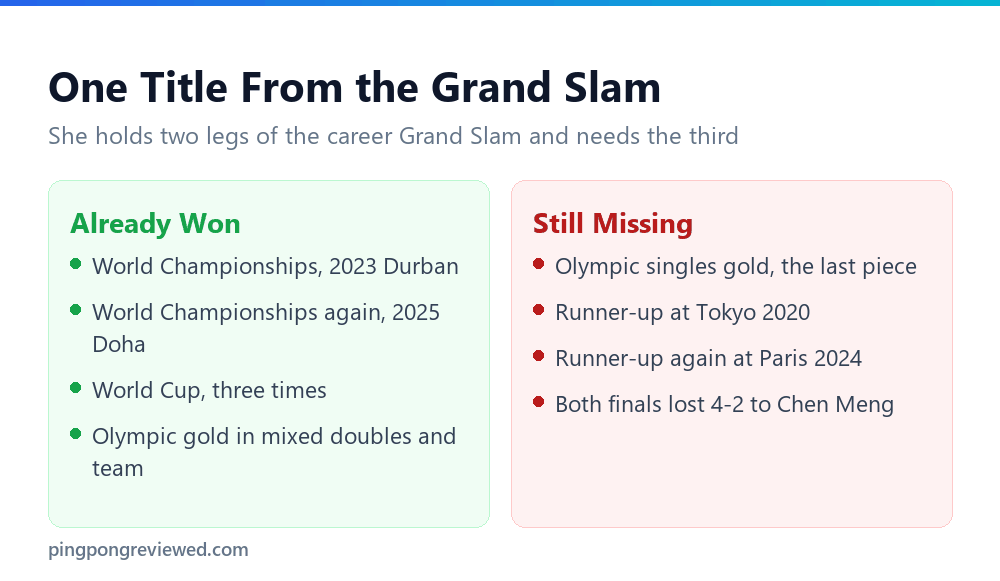
She reached the Olympic singles final at Tokyo in 2021 and lost 4-2 to Chen Meng. Then she reached it again at Paris in 2024 and lost 4-2 to Chen Meng.
Same round, same opponent, same scoreline, three years apart. Chen Meng became the third woman in history to win back-to-back Olympic singles golds, and Sun Yingsha was the player on the other side of the table both times.
The detail people miss is that she was world number one going into Paris. So she was not an outsider losing to a stronger player. She was the favourite, and it did not convert.
What She Has Won
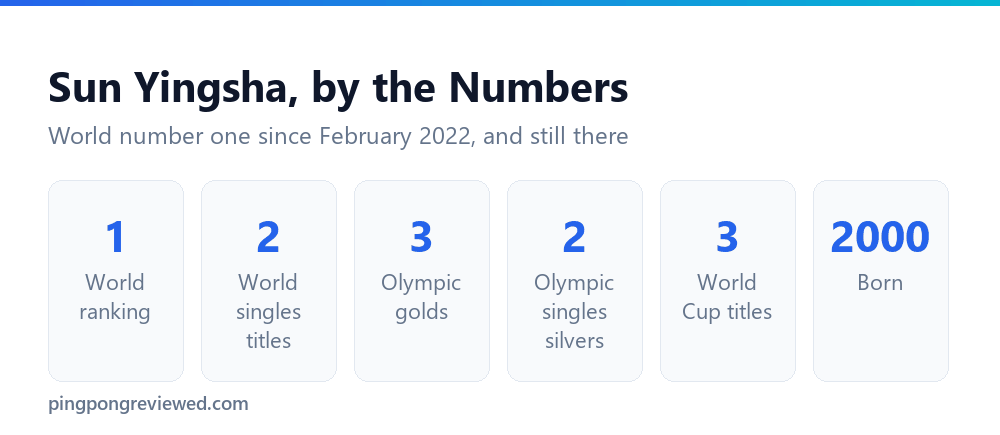
Four years at the top of the ranking is the number that should stand out. Women’s table tennis has enormous Chinese depth, and holding the first place through it for that long is rare.
Her Equipment, and the Set That Carries Her Name
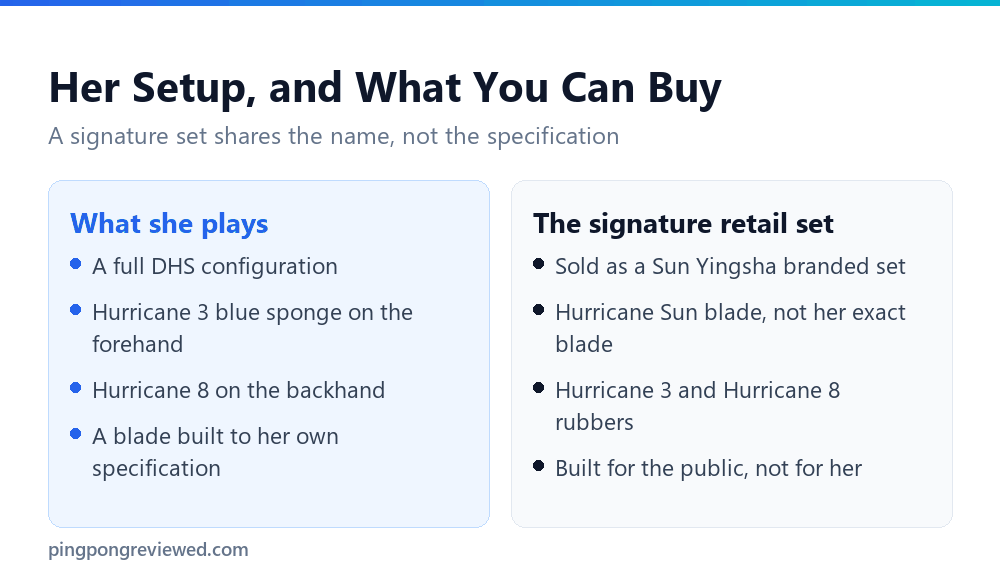
She plays a full DHS configuration. Hurricane 3 with blue sponge on the forehand, and Hurricane 8 on the backhand.
That split is worth noting, because it is the same one Wang Chuqin uses. Two of the strongest players in the world run a tacky Hurricane 3 on the forehand and a different sheet entirely on the backhand.
The logic is that the two wings do different jobs. The forehand needs grip for heavy spin at slower contact. The backhand needs speed off a shorter stroke, because there is less room to swing.
⚠️ Watch out: We are not naming a blade model here. Different sources give different names for the blade she plays, and we would rather leave a gap than print a specification we cannot stand behind.
DHS does sell a Sun Yingsha signature set to the public. It pairs a Hurricane Sun blade with Hurricane 3 and Hurricane 8 rubbers, which mirrors the shape of her setup without being the same equipment.
Should You Buy Her Setup?
Almost certainly not, and the reason is the same one that applies to every Chinese professional’s forehand rubber.
Hurricane 3 grips through surface tackiness rather than a springy sponge. So it needs a fast, committed swing to activate the sponge underneath.
A slower club-level swing gets a slow, spinny ball out of it instead of a fast one. That is the opposite of what most buyers expect when they switch to a professional’s rubber.
- If you are new, a pre-assembled bat with 2mm sponge will teach you more in a year than any signature set.
- If you already loop with real racket speed, a tacky forehand is worth trying, but buy a single sheet before committing to a whole setup.
- If you want the backhand idea, that one transfers freely. Running different rubbers on each wing costs nothing extra and suits most players better than two identical sheets.
💡 Pro tip: The transferable lesson from her setup is not the brand. It is that she chose each wing separately, for what that wing has to do. Most club players buy two of the same sheet without ever asking the question.
The Partnership With Wang Chuqin
Three World Championship mixed doubles titles and an Olympic gold, all with the same partner, is a record no other pair can match.
Mixed doubles rewards movement rather than power, because the pair must alternate strokes. So every second ball belongs to the other player, and two people have to share a space designed for one.
She is right-handed and he is left-handed, which is part of why the pairing works. They rotate away from each other after each shot instead of colliding, and between them they can attack both wide angles with a forehand.
Their Paris 2024 gold was also the mixed doubles title China had most wanted back. It is a comparatively new Olympic event, and both players won their first Olympic singles medal of any colour at the same Games.
Why She Wins
At 1.62 metres she is not an imposing physical presence, and her game is not built on overwhelming power. It is built on speed and placement.
She takes the ball early and keeps rallies short. So opponents get less time between shots, which is a more reliable pressure than hitting harder.
Her serve and receive are the other half. Because she attacks short serves rather than pushing them back, she takes the initiative in rallies where the server would normally hold the advantage.
Then there is consistency, which is the least glamorous part and the most important. Four years at world number one is not a run of good tournaments. It is an absence of bad ones.
📊 Note: This is the part worth copying at club level. Taking the ball earlier costs nothing, needs no equipment change, and takes time away from opponents who rely on winding up a big swing.
The Women’s Game Around Her
Her record only makes sense against the depth she plays through. Chinese women’s table tennis is as dominant as the men’s side, and arguably harder to break into.
Chen Meng is the clearest example. She has beaten Sun Yingsha in two Olympic finals, and she was not the world number one going into either of them.
So the ranking and the Olympic result measure different things. A ranking rewards consistency across a whole season. An Olympic final rewards one afternoon, once every four years.
That gap is the story of her career so far. She has been the most consistent player in the world for four years, and the two biggest single matches went the other way.
What Four Years at Number One Means
The ranking gets quoted constantly, but few people know what it actually measures. So it is worth a moment.
It is not a record of who beat whom. Instead it is a points total, earned by results at ranked events and weighted by how big each event was.
Because points expire, a player cannot coast on an old title. They have to keep entering and keep winning, or the total falls away underneath them.
So holding first place for four years means something specific. It means she has not had a bad six-month stretch since early 2022.
But it also explains the Olympic gap. A ranking rewards being excellent every month. An Olympic final rewards being excellent on one particular afternoon, and those are not quite the same skill.
📊 Note: This is why ranking and titles disagree so often across sports. Neither number is wrong. They are simply measuring different things, and a career needs both to look complete.
How She Got There
She was winning senior titles young. At the 2018 Asian Games she took gold in both mixed doubles and the team event, and she was 17.
Then came the Asian Games singles title in Hangzhou in 2022, followed by her first World Championship in Durban in 2023.
But the world number one ranking arrived before the world title did. She reached the top in February 2022, more than a year before winning her first World Championship.
That order is unusual and it tells you how she plays. She was already the most consistent player on the circuit before she won the tournament that certifies it.
ShaSha, and the Other Names
Chinese fans mostly call her ShaSha, which is simply a doubling of the last syllable of her name. It is affectionate rather than descriptive.
The more interesting one is Xiao Mowang, which translates roughly as little monster. It is a compliment about how she plays rather than a comment on her size.
There is also Xiao Doubao. So the nicknames run warm, which matches how she is regarded at home. She is one of the most popular athletes in China, and not only among table tennis followers.
The 2028 Question
Everything about her record now points at one tournament. She needs the Olympic singles title to complete the career Grand Slam, and the next chance is Los Angeles in 2028.
She would be 27, which is squarely inside a table tennis player’s prime. So age is not the obstacle.
The obstacle is the same one that has always been there. Because China can only enter a limited number of players, she has to be selected first, and then beat teammates who would be favourites against anyone else in the world.
Chen Meng will be 34 by then, so that particular matchup may not repeat. But the Chinese team refreshes constantly, and a new opponent is not necessarily an easier one.
Still, two silver medals is a strong platform rather than a curse. Very few players reach two Olympic finals at all, and she reached both before turning 24.
If You Only Ever Watch the Men’s Game
Plenty of people follow table tennis and only really watch the men. So it is worth saying what changes when you switch over.
First, rallies tend to last longer. Because the average ball speed is slightly lower, more shots come back, and points are decided by placement rather than by one winner.
Second, the blocking and counter-hitting is more visible. Instead of a rally ending on the third ball, you often see six or eight exchanges where both players are attacking.
Then there is the tactical side. Because you can actually follow the ball, the positioning becomes legible in a way it sometimes is not in the men’s game.
So if you are trying to learn from watching rather than just enjoying it, the women’s game is arguably the better teacher. The patterns are the same, but they happen at a speed you can read.
💡 Pro tip: Watch a Sun Yingsha match and follow only where she puts the ball, not how hard. The placement pattern is the whole point, and it is far easier to see in her matches than in a men’s third-ball rally.
Two other names are worth knowing. Chen Meng is the double Olympic champion who beat her in both finals. Wang Manyu is the other player who has consistently troubled her.
Sun Yingsha Questions, Answered
How old is Sun Yingsha?
She was born on 4 November 2000 in Shijiazhuang, Hebei province, which makes her 25. She is 1.62 metres tall and plays right-handed with a shakehand grip.
Is Sun Yingsha the world number one?
Yes. She first reached the top of the women’s singles ranking on 1 February 2022 and has held it since, which is more than four years at number one.
Has Sun Yingsha won an Olympic gold medal?
Yes, three. Team gold at Tokyo 2020, and both mixed doubles gold and team gold at Paris 2024. She has not won the Olympic singles title, taking silver in 2021 and again in 2024.
Who beat Sun Yingsha in the Olympic finals?
Chen Meng, both times. She won 4-2 in the Tokyo final and 4-2 again in the Paris final, becoming the third woman to take back-to-back Olympic singles golds.
Has Sun Yingsha won a career Grand Slam?
Not yet. She holds the World Championship and the World Cup, so the Olympic singles title is the only piece missing. She would be 27 at the next Olympic Games.
How many World Championships has Sun Yingsha won?
Two in singles, in Durban in 2023 and Doha in 2025. She has also won three World Championship mixed doubles titles, all partnering Wang Chuqin.
Who is better, Sun Yingsha or Chen Meng?
The ranking says Sun Yingsha, who has been world number one since February 2022 and holds two World Championship titles to Chen Meng’s Olympic pair. But Chen Meng has beaten her in both Olympic singles finals, which is the argument on the other side. They measure different things.
What equipment does Sun Yingsha use?
A full DHS setup, with Hurricane 3 blue sponge on the forehand and Hurricane 8 on the backhand. That is the same rubber split Wang Chuqin uses. Reports of her exact blade model vary, so we do not state one.
How tall is Sun Yingsha?
She is 1.62 metres, which is short for an elite player. But her game is built on taking the ball early and placing it well rather than on power, so height matters less than it would in a hitting-based style.
What are Sun Yingsha’s nicknames?
ShaSha is the most common. Chinese fans also use Xiao Mowang, which translates as little monster, and Xiao Doubao.
The Short Version
- →Born 4 November 2000, so 25, and right-handed with a shakehand grip.
- →World number one since February 2022, which is over four years at the top.
- →Two World Championship singles titles, in 2023 and 2025.
- →Three Olympic golds, but two singles silvers, both lost 4-2 to Chen Meng.
- →One Olympic singles title away from a career Grand Slam, at 25.
The record is close to complete and she is 25. So the interesting question is not whether she is the best player in the women’s game, because the ranking has answered that for four years. It is whether the one missing title arrives in 2028.
One last thing worth saying plainly. The women’s game gets far less coverage than the men’s across this sport, and the gap is not explained by anything happening on the table. A player who has held the world number one ranking for four straight years should not be harder to read about than a retired men’s player from a decade ago.

Ping Pong Reviewed is an equipment review site covering table tennis and baseball gear. Specifications are checked against manufacturer listings, and prices against live retail pages, before publication.