STIGA Pro Carbon Review: Spin 100, and the Real Trade-Off
STIGA rates the Pro Carbon at 100 for spin. Not 99, not 96. The maximum. That is unusual enough to be worth examining, because manufacturers rarely max out a rating on their own scale.
The number that matters more sits next to it, though. Control is rated 79, and the cheaper STIGA Evolution is rated 90. So the carbon in this blade costs you eleven points of control, and that trade is the whole decision.
Short answer: the STIGA Pro Carbon is $69.99, in stock, and rated speed 99, spin 100 and control 79 out of 100. It uses a 7-ply blade with two carbon layers. If you attack hard and want the pace, it earns its price. If you are still developing, the Evolution at $59.99 gives up little speed and gains eleven control points.
Table of Contents
STIGA Pro Carbon Specifications
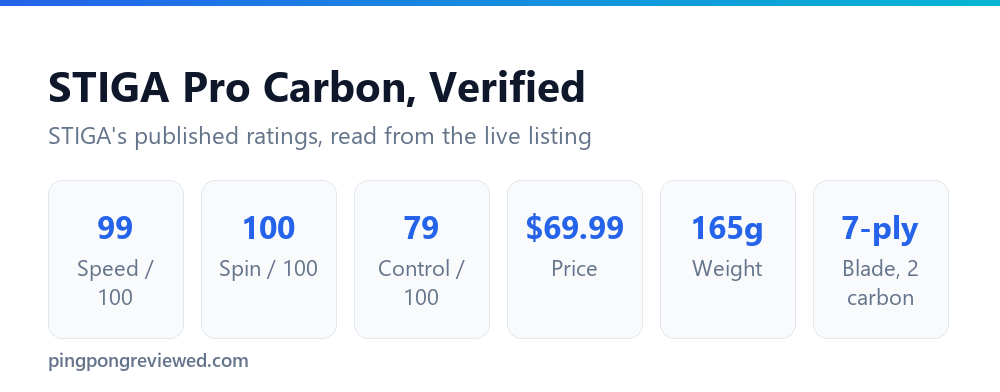
The blade construction is the interesting part. Five layers of balsa and two of carbon fibre is an unusual recipe. Balsa is very light, so it offsets the weight carbon normally adds. That is how a carbon bat arrives at 165 grams.
STIGA also cites Nano Composite, ACS, Crystal and WRB technologies. Those are brand names for blade and rubber treatments rather than measurable specifications. So treat them as marketing language, and judge the bat on the three numbers.
STIGA Pro Carbon Against the Evolution
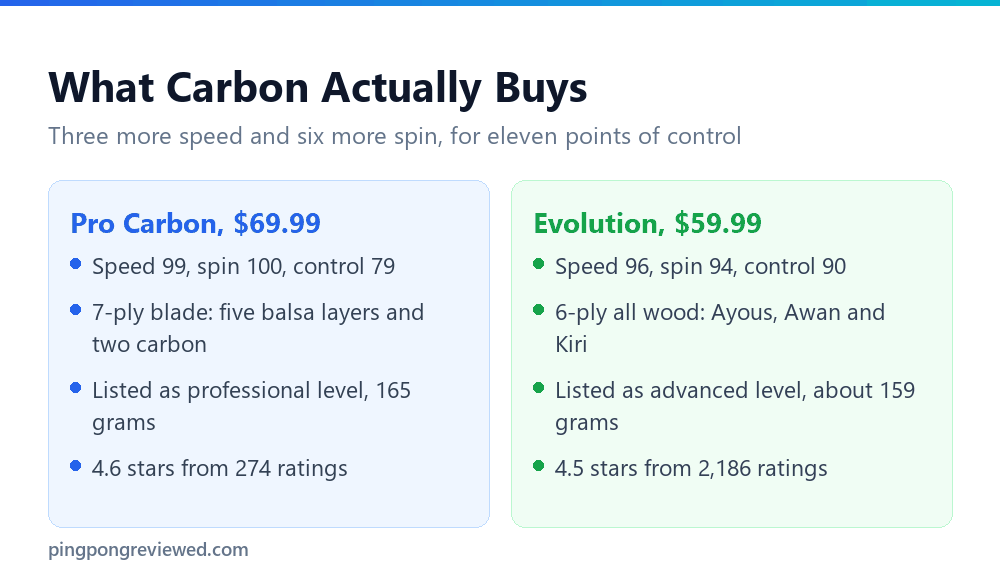
This is the comparison most buyers are actually making, and STIGA rates both on the same scale. So the numbers line up honestly.
Ten dollars buys three points of speed and six of spin. It costs eleven points of control. So this is not a straightforward upgrade, and STIGA’s own numbers say so plainly.
The ratings history reinforces the point. The Evolution carries 2,186 ratings at 4.5 stars. The Pro Carbon has 274 at 4.6. Both are good, but the Evolution has been tested by far more buyers.
What Carbon Layers Actually Do
Carbon fibre in a blade does two things, and understanding them explains the numbers above.
First, it stiffens the blade. A stiff blade flexes less on impact, so more of your swing energy goes into the ball instead of bending wood. That is where the speed comes from.
Second, it widens the sweet spot. Carbon spreads the impact across the blade face, so an off-centre hit loses less than it would on pure wood. STIGA states exactly this on the listing.
The cost is feedback. A stiff blade transmits less information about where and how you struck the ball. That matters most on touch shots near the net, where feel is the entire skill. So control drops, and the drop is real rather than a marketing artefact.
📊 Note: This is why carbon suits players who already have technique. If your strokes are consistent, a wider sweet spot and more speed are pure gain. If they are not, you lose the feedback that would have told you what went wrong.
The Raptor Bundle Costs the Same as One Racket
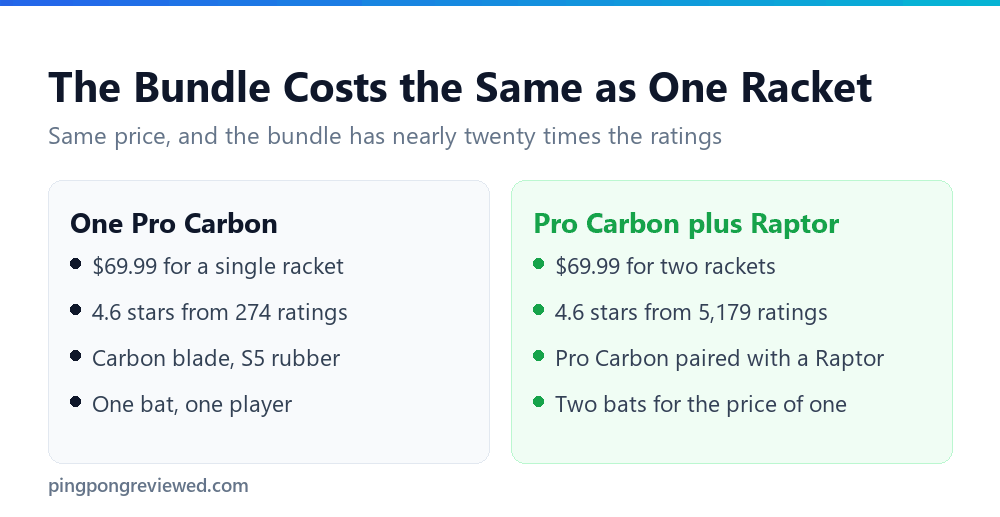
This is the pricing detail worth knowing before ordering. A single Pro Carbon is $69.99. But the Pro Carbon paired with a STIGA Raptor is also $69.99.
Two rackets for the price of one is an unusual offer, and that listing carries 5,179 ratings at 4.6 stars against the single’s 274. So it is both cheaper per bat and far more widely bought.
⚠️ Watch out: Read the listing title before ordering. STIGA sells the Pro Carbon as a single, as a bundle with a Raptor, and as a Pro Carbon Plus at $105.97. The names are similar and the prices are not.
Who the STIGA Pro Carbon Suits
- ✓You attack with pace and have the technique to control it
- ✓You want the widest sweet spot a pre-assembled bat can give you
- ✓You want maximum spin, which STIGA rates at 100
- ✓You need two bats, where the Raptor bundle makes the price work
- ✕You are still building strokes, where the Evolution’s control of 90 helps more
- ✕You rely on touch play near the net, which carbon dulls
- ✕You want to choose your own blade and rubber separately
- ✕You assume carbon automatically means better, which the control rating disproves
STIGA’s Technology Names, Decoded
STIGA attaches five brand names to this bat. None of them are measurements, and knowing what each refers to makes the listing far easier to read.
- Nano Composite and ACS describe treatments applied to the rubber. STIGA says they form stronger, tighter bonds for speed and spin.
- Crystal refers to a hardening treatment on the blade surface, which stiffens it and raises speed.
- WRB is a handle construction feature. STIGA pairs it with Crystal to claim faster returns and more touch.
- SDT, or Shock Dispersion Tube, appears on the Evolution rather than the Pro Carbon, and is described as spreading impact through the handle.
None of these appear on any independent scale, so you cannot compare them against another brand’s technology names. Judge the bat on the three published numbers instead, since those at least sit on one consistent STIGA scale.
⚠️ Watch out: This applies across the category. Every manufacturer invents names for its blade and rubber treatments. So a listing dense with capitalised technologies is not evidence of a better bat, and two brands’ names are never comparable.
Why Five Layers of Balsa
The blade recipe looks odd until you think about weight. Carbon fibre is stiff but adds mass, and a heavy bat is slow to move between wings. So STIGA offsets it.
Balsa is among the lightest structural woods available. Using five balsa plies with two carbon layers produces a blade that is stiff where it matters and light overall. That is how the finished STIGA Pro Carbon arrives at 165 grams.
The trade is that balsa is soft. A soft core with stiff outer layers gives a distinctive feel: fast on full strokes, and slightly hollow on soft ones. Some players love it. Others find it lacks the solid feedback of a denser all-wood blade.
That difference in feel, rather than any number, is why trying before buying matters more with carbon-balsa blades than with conventional wood. If you can borrow one at a club before ordering, do.
What the 2mm Sponge Tells You
Both STIGA bats use a 2mm sponge, and that number places them firmly in tournament territory rather than recreational.
The legal maximum for sponge and topsheet together is 4mm. Competition players typically run sponge around 2.0mm to 2.1mm, because more sponge stores more energy and returns it as speed. Recreational bats often use 1.5mm or thinner.
So a 2mm sponge on a $69.99 pre-assembled bat is genuinely competition-grade rather than a marketing claim. It is one of the clearer signals that separates a real bat from a toy.
The STIGA Pro Carbon Against Other Brands
It is tempting to line these numbers up against other manufacturers. But every brand rates on its own scale, so the comparison needs handling carefully.
What the table does show reliably is the shape of each range. Every one of these makers trades control against speed as price rises. So the useful question is not which brand rates highest. It is where in that trade your own game sits.
Looking After a Carbon Bat
A carbon blade is more durable than pure wood, but the rubber is not, and the rubber is what wears out first on any pre-assembled bat.
- ✓Wipe the rubber after sessions with a proper rubber cleaner
- ✓Use protective film on both sides between sessions
- ✓Keep the bat in a case, since edge knocks damage carbon blades too
- ✓Check the edge tape regularly, because a lifting edge peels rubber
- ✕Use household cleaners, which strip the topsheet
- ✕Leave it in a hot car, which ruins rubber faster than play does
- ✕Assume a carbon blade cannot be damaged, since balsa cores dent
- ✕Try to re-rubber a pre-assembled bat, which rarely works cleanly
One point specific to balsa. The soft core dents more easily than a dense hardwood blade, so a knock against a table edge does more damage than it would on an all-wood bat. Keeping it in the case is not just about the rubber.
When a Pre-Assembled Bat Stops Making Sense
The STIGA Pro Carbon sits near the top of what a pre-assembled bat can be, so it is worth knowing where the format runs out.
You cannot replace one side independently. The forehand rubber usually dies first, and replacing the whole bat means discarding a good backhand sheet and a carbon blade that would have lasted years.
You also cannot tune it. Most improving players eventually want something specific, such as a softer backhand or a different handle shape. A custom build lets you change one variable at a time, and a pre-assembled bat does not.
The signal to move on is being able to name the change you want. Until then, a bat with a genuine carbon blade, ITTF-approved rubber and a 2mm sponge at $69.99 remains a lot of equipment for the money.
Four Pro Carbon Listings, Four Different Products
STIGA sells several things with Pro Carbon in the name, at prices from $69.99 to $105.97. The titles are close enough that ordering the wrong one is easy.
Three of them cost the same $69.99 and contain different things. So the price is not the signal here. Read the title, then check the ratings count, since the Raptor bundle is by far the most widely bought of the group.
💡 Pro tip: If you want two bats, the Raptor bundle is the clear answer. If you want one Pro Carbon, make sure the title does not carry a plus sign or the word Blast, because both denote different products.
Knowing When the Rubber Is Finished
The carbon blade will outlast the rubber by years, so the question is always when the sheets have gone rather than when the bat has.
- The surface goes matte where you contact the ball most, while a fresh sheet has an even sheen across the face.
- Backspin serves stop biting. That shot has the least margin, so it fails first when grip fades.
- The sound dulls. A worn topsheet gives a flatter note at contact than a fresh one.
- Blocks start flying long. Lost grip means less bite on an incoming loop, so the ball comes off faster than you expect.
On a pre-assembled bat at this price, most people replace the whole thing rather than re-rubbering it. That is a fair call at $69.99, though it does mean discarding a carbon blade that still had plenty of life left in it.
STIGA Pro Carbon Questions, Answered
How much does the STIGA Pro Carbon cost?
$69.99 for a single racket, in stock, with 4.6 stars from 274 ratings. A bundle pairing it with a STIGA Raptor costs the same $69.99 and carries 5,179 ratings.
What are the STIGA Pro Carbon ratings?
STIGA publishes speed 99, spin 100 and control 79 out of 100. The spin figure is the maximum on their scale, and the control figure is the lowest of the three.
Is the STIGA Pro Carbon better than the Evolution?
It is faster and spinnier, but less controllable. STIGA rates the Pro Carbon 99, 100 and 79 against the Evolution’s 96, 94 and 90. So it gains three speed and six spin while giving up eleven points of control.
Is the STIGA Pro Carbon good for beginners?
No. STIGA lists it as professional level, and its control rating of 79 is the lowest in this comparison. A beginner learns faster on a more controllable bat.
What is the STIGA Pro Carbon blade made of?
Seven plies: five layers of lightweight balsa and two integrated carbon fibre layers, paired with a 2mm sponge. The balsa is what keeps the finished bat at 165 grams despite the carbon.
Is the STIGA Pro Carbon ITTF approved?
Yes. STIGA states the S5 smooth inverted rubber is ITTF approved. As always, one side of the bat must be black and the other red, pink, purple, green or blue.
What is the difference between Pro Carbon and Pro Carbon Plus?
The Pro Carbon Plus is a separate, more expensive model at $105.97, described for advanced offensive competitive players. The names are close enough that it is worth checking the title and price before ordering.
How heavy is the STIGA Pro Carbon?
165 grams. That is light for a carbon bat, because five of the seven plies are balsa, which offsets the weight the carbon layers add.
The Verdict on the STIGA Pro Carbon
- →Spin rated 100 out of 100, which is the maximum STIGA publishes.
- →Control rated 79, eleven points below the cheaper Evolution.
- →$69.99, and the two-racket Raptor bundle costs exactly the same.
- →7-ply blade with two carbon layers and five of balsa, at 165 grams.
- →The Evolution has 2,186 ratings against the Pro Carbon’s 274.
The Pro Carbon is a genuinely fast bat and STIGA does not pretend otherwise about the cost. Speed 99, spin 100, control 79. If your technique can absorb that trade, it is very good value at $69.99. If it cannot, the ten dollars you save on the Evolution buys you the eleven control points you actually need.
As an Amazon Associate, we earn from qualifying purchases through links on this page.

Ping Pong Reviewed is an equipment review site covering table tennis and baseball gear. Specifications are checked against manufacturer listings, and prices against live retail pages, before publication.