Palio Expert 2 Review: Still on Sale, and the $10 Mistake

If you are looking for the Palio Expert 2, here is the direct answer. It is still on sale, it is in stock, and it costs $39.99. That is the same price as the Palio Expert 3.0 that supposedly replaced it.
That is an unusual situation. Two generations of the same paddle, sold side by side, at an identical price. So the real question is not what happened to the Palio Expert 2. It is which of the two you should actually buy.
Short answer: both the Palio Expert 2.0 and the Expert 3.0 cost $39.99 and are in stock. Both are rated speed 6, spin 9 and control 10, and both use the same CJ8000 rubbers. The 2.0 has more ratings behind it at 1,507. The 3.0 has a slightly higher average and a revised blade. Buy either with confidence, and do not pay more for the Master.
Table of Contents
The Palio Expert 2 and 3.0 Are Both Still on Sale
Palio added 3.0 versions across the range. But it did not retire the 2.0 versions, and that is where most write-ups get this wrong. Both generations are listed, both are in stock, and both cost $39.99.
The published performance figures are identical. Speed 6, spin 9, control 10 on both. And both use the same ITTF-approved Palio CJ8000 rubbers, which is the component that actually determines how the bat plays.
So the differences are structural. The 3.0 listing cites an upgraded all-wood blade, a redesigned flared handle and thicker edge tape to protect the rubbers. Those are durability improvements rather than a change in playing character.
The review counts point the other way, though. The Palio Expert 2 carries 1,507 ratings against the 3.0’s 839, because it has been on sale far longer. But the 3.0 holds a slightly higher average, at 4.6 against 4.4.
💡 Pro tip: At an identical price, the 3.0 is the marginally better buy for the thicker edge tape alone, since a lifting edge is what ends most pre-assembled bats. But if you find a Palio Expert 2 discounted below $39.99, you are giving up very little.
Palio Expert 3.0 Specifications
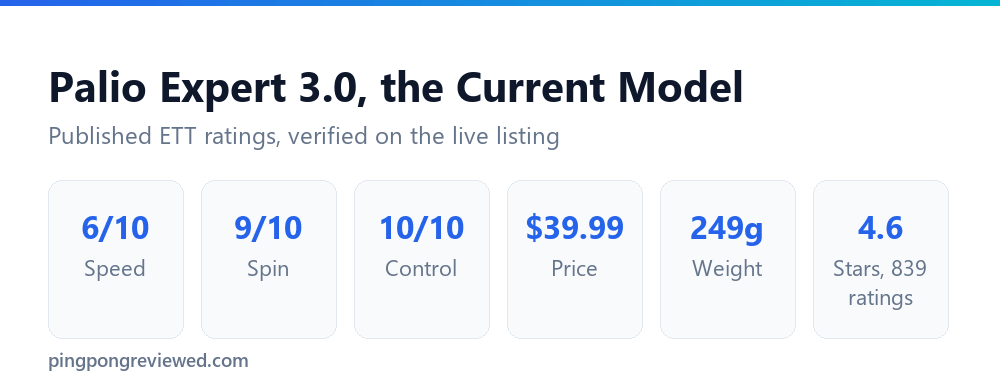
The control rating of 10 out of 10 is the headline. Very few paddles claim the maximum on any axis. Palio pairs it with a speed rating of only 6. So those two numbers together describe exactly what this bat is for.
A spin rating of 9 alongside that is the unusual part. Normally high control means low spin. Both traits come from how much the rubber grips and how fast it throws. But the CJ8000 rubber is what lets Palio claim both.
Do Not Pay More for the Palio Master 3.0
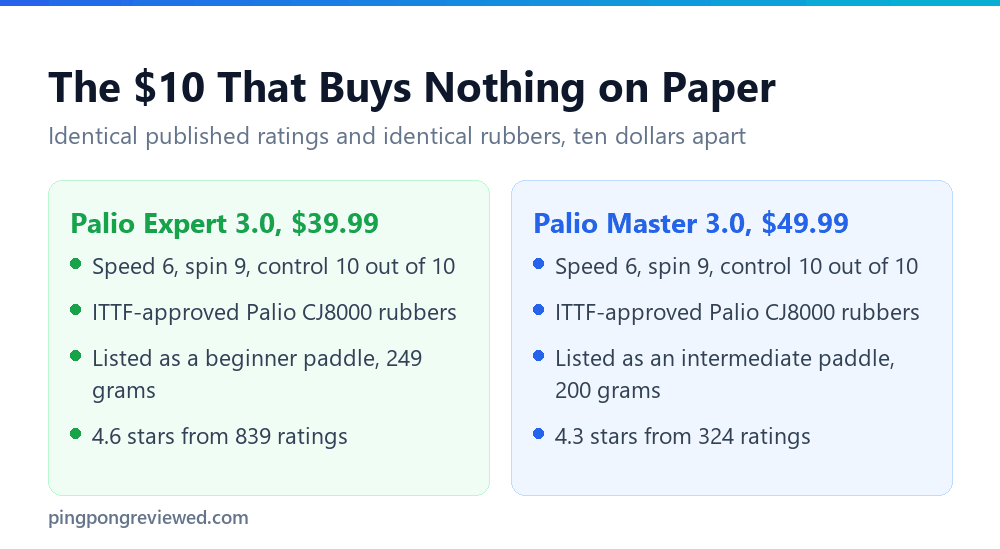
This is the finding worth knowing before you buy anything in this range. The Master 3.0 costs $49.99 against the Expert 3.0’s $39.99. It is described as the intermediate model rather than the beginner one.
But its published ratings are identical. Speed 6. Spin 9. Control 10. The same three numbers, in the same boilerplate sentence. And it uses the same ITTF-approved Palio CJ8000 rubbers.
So what does the extra ten dollars buy? On the published numbers, nothing. The two genuine differences are the stated skill level, which is a label rather than a measurement, and the weight. The Master is 200 grams against the Expert’s 249.
The weight difference is not nothing, to be fair. A 49 gram gap is noticeable, and a lighter bat changes direction faster between wings. But it is a preference rather than an upgrade, and the Expert has more than twice as many ratings behind it.
Where the Palio Ratings Come From
The speed, spin and control figures on these paddles are labelled ETT ratings. That stands for Expert Table Tennis, and the brand field on the listings names them as the brand rather than Palio.
So the Expert range is a co-branded product. Expert Table Tennis is a table tennis site that partners with Palio on these paddles, and the ratings you see quoted come from that partnership rather than from independent testing.
📊 Note: That is worth knowing rather than worrying about. Co-branded equipment is common and perfectly legitimate. But it does mean the numbers are supplied by a party with an interest in the product, which is a different thing from a manufacturer’s laboratory specification or an independent measurement.
The practical effect is the same caution that applies across this category. Use the ratings to compare Palio paddles against each other, since they come from one source on one scale. Do not line them up against a Butterfly or Yasaka figure and expect the comparison to mean anything.
Who the Palio Expert Suits
This is a first proper bat, and it is priced and specified as one. It suits the player who has outgrown whatever came bundled with the table.
- ✓You are learning strokes and want control while you do it
- ✓You want ITTF-approved rubber rather than a recreational bat
- ✓You want spin to be possible to produce and to feel
- ✓You want a case included without paying extra for it
- ✕You already loop hard and want speed, where the Legend fits better
- ✕You want to choose your own blade and rubber separately
- ✕You need a very light bat, since 249 grams is on the heavy side
- ✕You are looking for the Expert 2 specifically, which no longer exists
The honest limitation is the same one every pre-assembled paddle has. You cannot change one side without replacing the whole bat. That is fine while you are learning. It stops being fine once you can name what you want to change.
The Rest of the Palio Range
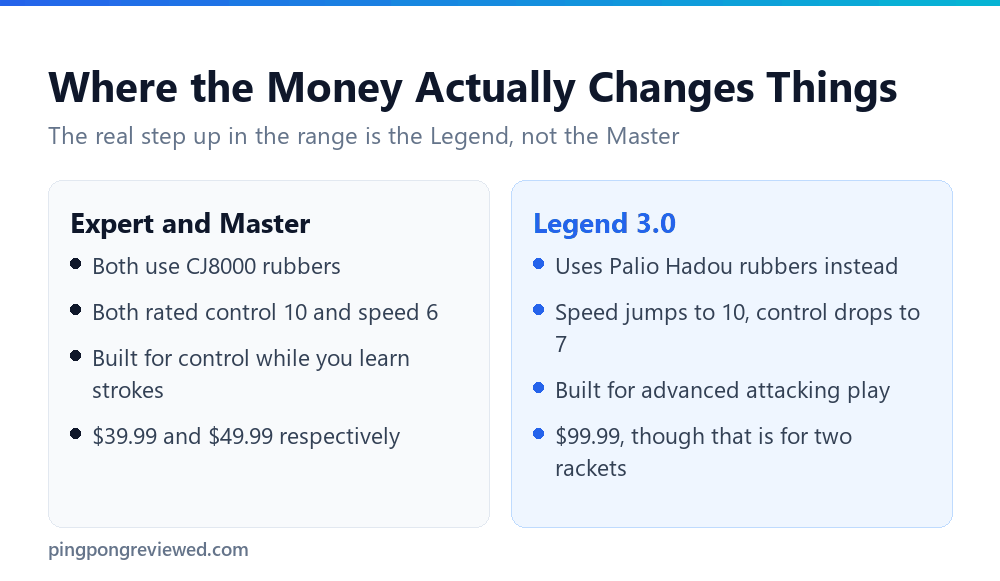
There are three current models, and the meaningful jump is not where the pricing suggests.
- Expert 3.0 at $39.99. Speed 6, spin 9, control 10. CJ8000 rubbers. The beginner and improver choice, and the best value of the three.
- Master 3.0 at $49.99. Identical published ratings and rubbers to the Expert, 49 grams lighter, labelled intermediate.
- Legend 3.0 at $99.99. Palio Hadou rubbers, speed 10, control 7. A genuinely different paddle, and note the price covers two rackets.
💡 Pro tip: If you are buying for two people, the Legend 3.0 listing is a set of two rackets. That works out around fifty dollars each, which changes the comparison considerably against buying two Experts.
What Palio CJ8000 Rubber Actually Is
The rubber does most of the work on any pre-assembled bat. And CJ8000 is what earned the Palio Expert 2 its reputation in the first place. So the 3.0 keeps it.
CJ8000 is a Chinese-style inverted rubber. Chinese topsheets grip the ball through surface tack rather than relying purely on a springy sponge underneath. So they generate spin on slow, brushing contacts, which is exactly the shot a learner spends months trying to produce.
That explains how Palio claims spin 9 and control 10 at the same time. A tacky topsheet grips heavily. But the sponge underneath does not fling the ball away. You get spin without the speed that usually accompanies it.
The trade-off arrives later. Chinese rubbers reward a fast, committed swing and give less free speed than a European tensor sheet. So a player who develops a hard loop eventually wants more pace than CJ8000 supplies. That point is a long way off for most people buying their first real bat.
📊 Note: CJ8000 carries ITTF approval, which the listing states directly. That matters more than it sounds on a bat at this price, because plenty of cheap paddles use unapproved rubber that would fail racket control at a tournament.
Palio Expert Against the Killerspin Jet 200
The Jet 200 is the other paddle people weigh at this price, and the two take genuinely different approaches. We verified both against their live listings.
The spin gap is the meaningful one. Palio claims 9 against Killerspin’s 7, and the ITTF-approved CJ8000 rubber backs that claim up. So if you want to learn to produce spin, the Palio Expert 2 line has always been the stronger choice.
Killerspin wins on weight and on where you can buy it. The Jet 200 is roughly 60 grams lighter, which some players prefer. But it has effectively vanished from Amazon, so you must order it from Killerspin directly.
What ITTF Approved Means on a Pre-Made Bat
Listings throw the phrase around freely, so it helps to know what it actually covers. ITTF approval applies to the rubber, not to the assembled paddle.
- The rubber must appear on the ITTF list and carry the logo. CJ8000 does, which the Palio Expert listing states.
- The colours must be legal. One side black, the other red, pink, purple, green or blue since the rules broadened in October 2021.
- The blade has no approval requirement, though it must be flat and rigid, and mostly natural wood.
- Your league may still have its own rules, so check before assuming any pre-assembled bat qualifies for rated play.
For the Palio Expert 2 and its successor, the practical upshot is good. You can take this bat to a club night without anyone questioning it, which is not true of most paddles sold at supermarket prices.
Looking After a Palio Expert
Tacky Chinese rubber needs slightly different care from a European tensor sheet. The tack is the performance, so protecting the surface protects what you paid for.
- ✓Wipe the rubber with a damp sponge or proper rubber cleaner after playing
- ✓Use protective film between sessions to keep dust off the tacky surface
- ✓Keep the bat in the supplied case rather than loose in a bag
- ✓Check the edge tape occasionally, since a lifting edge peels the rubber
- ✕Clean it with household detergent or alcohol, which strips the tack
- ✕Leave it in a hot car, which kills a topsheet faster than anything else
- ✕Play with it on a dusty outdoor table without cleaning it afterwards
- ✕Try to re-glue a lifting rubber on a pre-assembled bat, which rarely works
You will know the rubber has gone when the surface stops feeling tacky to a fingertip and your serves stop biting. On a $39.99 bat, replacing the whole paddle usually costs about what re-rubbering it would. So most people simply buy another.
Buying a Palio Expert 2 Second Hand
Because the Palio Expert 2 built the reputation, used ones still circulate. So it is worth knowing what you are looking at before paying for one.
The blade on a Palio Expert 2 will outlast the rubber comfortably. Wood does not wear out from play. But the CJ8000 topsheet loses its tack, and that tack is the whole reason the paddle is worth owning.
- Touch the rubber. A healthy CJ8000 surface feels slightly sticky to a fingertip. A dead one feels dry and smooth.
- Look for a matte patch where the previous owner contacted the ball most. That is the first place the tack goes.
- Check the edge tape for lifting, since a peeling edge takes the rubber with it.
- Compare against $39.99. A used Palio Expert 2 with tired rubber is worth considerably less than a new Expert 3.0.
💡 Pro tip: A second hand Palio Expert 2 with a good blade and dead rubber is not worthless. You can strip it and glue fresh sheets on. But at that point you are building a custom bat, and you should choose the rubber deliberately rather than defaulting to CJ8000.
One last practical note on sizing. Palio lists the grip at 4 inches, which is a standard adult flared handle. So it will feel normal in most adult hands. But it is genuinely too large for a young child, and no amount of coaching fixes a handle that does not fit. For a junior player, look for a bat with a shorter, slimmer handle rather than assuming an adult paddle will do.
Palio Expert Questions, Answered
Is the Palio Expert 2 still available?
Yes. It is in stock at $39.99, the same price as the Expert 3.0, with 4.4 stars from 1,507 ratings. Both generations are sold side by side, which is unusual and is why several reviews wrongly describe the 2.0 as discontinued.
How much does the Palio Expert 3.0 cost?
$39.99, in stock, with 4.6 stars from 839 ratings and over 100 bought in the past month at the time of checking. A carry case is included.
What changed between the Palio Expert 2 and 3.0?
An upgraded all-wood blade, a redesigned flared handle and thicker edge tape. The published ratings are identical at speed 6, spin 9 and control 10, and both use the same CJ8000 rubbers. So the revision is about durability, not performance.
Is the Palio Master 3.0 better than the Expert 3.0?
Not on the published figures. Both are rated speed 6, spin 9 and control 10, and both use CJ8000 rubbers. The Master costs $10 more, is 49 grams lighter, and is labelled intermediate rather than beginner.
Is the Palio Expert good for beginners?
Yes, and that is its stated purpose. A control rating of 10 out of 10 against a speed rating of 6 is exactly the balance that keeps the ball on the table while you learn where it goes.
Is the Palio Expert ITTF approved?
The CJ8000 rubbers are ITTF approved, which is stated on the listing. That makes it usable in sanctioned play, subject to the usual requirement that one side is black and the other is red, pink, purple, green or blue.
What are ETT ratings?
They come from Expert Table Tennis, which co-brands this range with Palio. The listings name Expert Table Tennis as the brand. So the figures are supplied by a commercial partner rather than by independent testing, and they are only comparable within the Palio range.
How much does the Palio Expert weigh?
249 grams, which makes it the heaviest of the three current Palio paddles. The Master and Legend are both listed at 200 grams.
The Verdict on the Palio Expert
- →The Palio Expert 2 is not discontinued. It sells alongside the 3.0 at the same $39.99, with more ratings behind it.
- →Both generations are $39.99 and in stock, rated 4.4 from 1,507 and 4.6 from 839 respectively, with a case included.
- →Control is rated 10 out of 10 and speed only 6, which is exactly right for learning.
- →The Master 3.0 has identical published ratings and rubbers for $10 more.
- →The Legend 3.0 is the real step up, and its $99.99 price covers two rackets.
The Palio Expert 2 earned its reputation by being the cheapest bat genuinely worth owning. Then the 3.0 kept the rubber that made that true, at a price that has barely moved. So the recommendation survives the version change. That is more than most product revisions manage.
As an Amazon Associate, we earn from qualifying purchases through links on this page.

Ping Pong Reviewed is an equipment review site covering table tennis and baseball gear. Specifications are checked against manufacturer listings, and prices against live retail pages, before publication.