Ping Pong Injuries: Causes, Treatment & Prevention

I’ve been playing table tennis for 17 years and coaching players of all levels for over a decade. And one of the most common things I hear — especially from newer players — is some version of: “I thought ping pong was a safe sport?”
The short answer is: it’s safer than most. But “safe” doesn’t mean injury-free. Table tennis demands explosive lateral movement, thousands of repetitive arm rotations per session, and rapid trunk rotation on nearly every point. Done incorrectly, or for too long without rest, those movements catch up with you.
Let me walk you through every common ping pong injury — why it happens, how to treat it properly, and exactly how to avoid it.
Table of Contents
📋 Table of Contents
How Ping Pong Strokes Actually Cause Injuries
Understanding why injuries happen is the most effective form of prevention. Each table tennis stroke places specific stress on specific joints — and once you see the pattern, a lot of the injuries below start to make obvious sense.
Backhand flick & backhand topspin → Wrist injuries
Both require rapid wrist flexion and extension at high angular velocity. The faster the flick, the more stress on the tendons along the ulnar (little-finger) side of the wrist. Over hundreds of repetitions, this causes tendinitis.
Forehand topspin & forehand smash → Shoulder & elbow injuries
These strokes demand full shoulder rotation and powerful forearm pronation. Without proper relaxation during the follow-through, the rotator cuff muscles never fully recover between shots — and that’s how tendinitis develops.
Explosive lateral footwork → Ankle & knee injuries
Fast side-to-side movement places sudden, uneven load on ankle ligaments and knee tendons. Most acute ankle sprains happen when a player is off-balance at the moment of contact with a wide ball.
Trunk rotation → Lower back strain
Every topspin stroke involves significant hip and spinal rotation. In a high-intensity session, a player performs this movement thousands of times. Fatigued or undertrained core muscles can’t absorb the load — and that’s where back pain comes from.
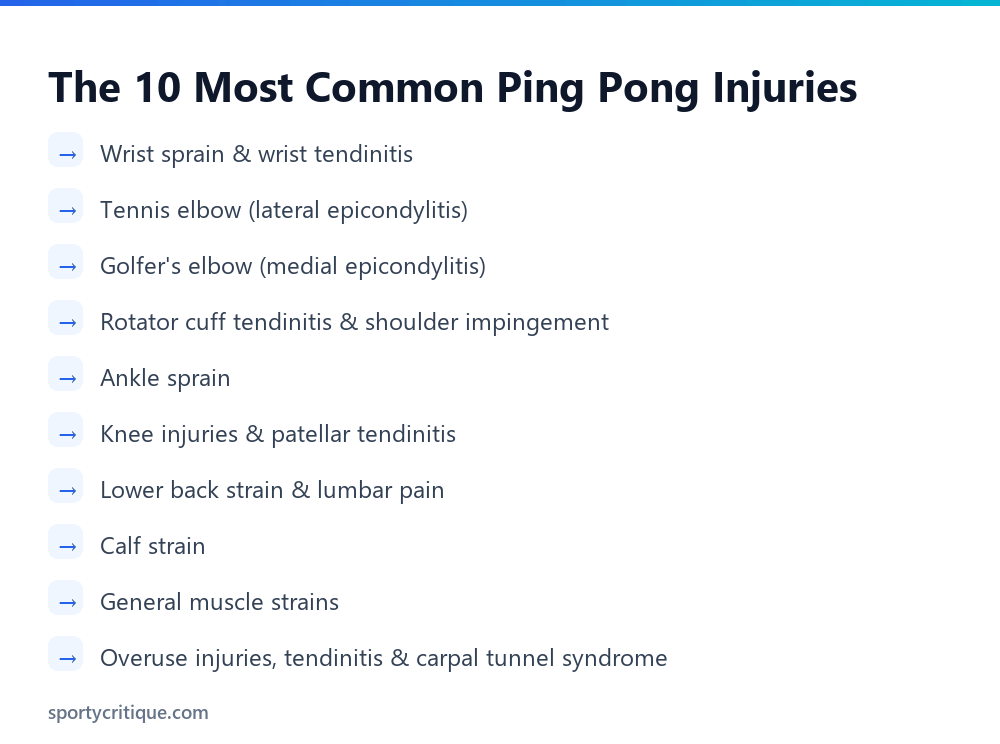
The 10 Most Common Ping Pong Injuries
1. Wrist Sprain & Wrist Tendinitis
What it is: A wrist sprain is a stretch or tear of the ligaments that support the wrist, usually from a sudden forceful movement. Wrist tendinitis is slower-developing — inflammation of tendons caused by repetitive strain over time. Both are extremely common in table tennis.
Why it happens: The backhand flick is the main culprit. Players new to the game tend to generate power from the wrist alone rather than from the whole arm. That isolated wrist snap overloads the tendons along the back of the wrist. I’ve seen this injury sideline beginners after just a few weeks of heavy practice.
Pain on the little-finger side of the wrist during or after backhand play is almost always early tendinitis. Don’t play through it — wrist tendons have poor blood supply and heal slowly. A small ignored strain easily becomes a 3-month injury.
Symptoms: Pain and swelling around the wrist (especially the ulnar side). Reduced grip strength. Pain that worsens during backhand play.
Treatment: Apply the PRICE protocol immediately for acute sprains (see section below). Rest from wrist-intensive play for 1–2 weeks for mild cases. Anti-inflammatory medication reduces swelling in the first 72 hours. A wrist brace protects the joint during gradual return to play.
Prevention: Learn to generate backhand power through forearm rotation, not wrist snapping. Stretch and loosen the forearm muscles before every session — tight forearms stiffen the wrist and make sprains far more likely.
2. Tennis Elbow (Lateral Epicondylitis)
What it is: Inflammation of the tendons that attach the forearm extensor muscles to the outer bony knob of the elbow. Despite the name, tennis elbow is arguably the most common upper-body injury in table tennis — I’ve had it twice myself.
Why it happens: Repetitive forehand strokes continuously stress the extensor tendons. When the ball’s energy isn’t cleanly transferred through the paddle — due to poor technique, too-tight grip, or a blade that’s too stiff for your skill level — that energy fires back into the elbow joint instead. Over weeks and months, the tendon breaks down faster than it can repair.
Check your grip pressure. Holding the paddle too tightly is one of the leading causes of tennis elbow in table tennis players. Your grip should be firm but relaxed — think “holding a bird without letting it fly or hurting it.”
Symptoms: Dull, burning pain on the outer side of the elbow. Pain when gripping the paddle or extending the wrist. In advanced cases, pain radiates down the forearm.
Treatment: Rest is the single most important step — continuing to play through tennis elbow is the most reliable way to turn a 6-week injury into a 6-month one. Ice the lateral elbow for 15–20 minutes, 3–4 times daily. An elbow compression sleeve worn just below the elbow reduces pain significantly. Eccentric wrist extension exercises, guided by a physio, have strong clinical evidence for speeding recovery.
3. Golfer’s Elbow (Medial Epicondylitis)
What it is: The mirror image of tennis elbow — inflammation of the tendons on the inner side of the elbow, where the forearm flexor muscles attach. Less common than lateral epicondylitis in ping pong, but it shows up in power players who generate a lot of forehand smash force.
Symptoms: Pain on the inner side of the elbow, especially when flexing the wrist or gripping tightly. Occasional tingling into the ring and little fingers.
Treatment: Same approach as tennis elbow — rest, ice, compression, and physio-guided eccentric exercises.
4. Rotator Cuff Tendinitis & Shoulder Impingement
What it is: The rotator cuff is a group of four muscles and their tendons that stabilize the shoulder. Tendinitis is inflammation from overuse. Impingement is when those tendons get pinched between the shoulder bones during rotation. In clinical practice, they usually occur together.
Why it happens: The forehand topspin and smash place the shoulder in an externally rotated, loaded position at high speed. Players who don’t have a proper relaxation phase after each stroke — or who train for many hours without rest — accumulate micro-damage in the rotator cuff faster than tissue can repair. Beginners who generate power from the shoulder alone are at highest risk. I coached a junior player last year who developed impingement after just 3 weeks of daily smash drills without proper arm relaxation between shots.
Symptoms: Deep, aching pain around the shoulder blade and joint, especially after play. Weakness lifting the arm above shoulder height. Pain that disturbs sleep on the affected side.
Cease all overhead and power shots the moment you feel shoulder pain during play. Every session you push through shoulder pain extends recovery — often significantly. A player who stops immediately with early impingement may recover in 4 weeks. One who plays through it for another month may need 6.
Treatment: Ice and rest for the first 72 hours. Physio-specific rotator cuff strengthening is essential. Far-infrared heat applied for 30-minute intervals improves blood flow to tendon tissue (tendons heal slowly because of limited natural blood supply). Corticosteroid injection may be needed for persistent cases after 8–12 weeks.
5. Ankle Sprain
What it is: Damage to the outer ankle ligaments when the foot rolls inward. The single most common acute injury in table tennis — and one most people don’t expect from a sport played at a small table.
Why it happens: Unlike tennis or badminton where players have a longer follow-through that helps control deceleration, table tennis involves extremely short explosive bursts. A player lunges for a wide ball, plants the foot at an awkward angle, and the ankle rolls. It happens in a fraction of a second — and most players say they didn’t see it coming.
Symptoms: Immediate pain on the outer ankle. Rapid swelling and bruising within hours. In mild cases, players can still walk. In moderate-to-severe cases, they cannot bear weight.
Do not try to “walk off” an ankle sprain. Ligaments that are forced to bear load while swollen can develop into chronic ankle instability — where the ankle rolls repeatedly for months or years afterward. The 5 minutes you save playing through it can cost you a much longer recovery.
Treatment: PRICE protocol immediately (see below). After 48–72 hours, gentle range-of-motion exercises help restore mobility. An ankle brace is strongly recommended for the return-to-play period. Balance training on a wobble board after recovery dramatically reduces re-sprain risk.
6. Knee Injuries & Patellar Tendinitis
What it is: Knee injuries in table tennis range from acute ligament strains (from sudden twisting) to chronic patellar tendinitis — inflammation of the tendon connecting the kneecap to the shinbone. Knee injuries are less common than ankle injuries, but they take longer to heal.
Why it happens: The constant semi-crouched ready position places ongoing load on the patellar tendon. Repeated explosive knee bending during play — combined with never fully straightening the legs between points — causes the tendon to accumulate micro-tears. Professional players like Wang Hao and Zhang Jike wore knee straps routinely throughout their careers for exactly this reason.
Treatment: PRICE protocol for acute injuries. A patellar tendon strap (worn just below the kneecap) provides significant pain relief during recovery. Eccentric single-leg decline squats are the gold standard physiotherapy exercise for patellar tendinitis.
7. Lower Back Strain & Lumbar Pain
What it is: Strain of the lumbar muscles and tendons from repeated trunk rotation. One of the most underappreciated injuries in the sport — and particularly prevalent in veteran players whose core strength and flexibility have declined.
Why it happens: Every topspin stroke involves trunk rotation. In a high-intensity session, a player may perform this movement 3,000–5,000 times. When the deep core muscles are fatigued or undertrained, the lumbar spine itself absorbs the rotational stress — which is exactly what it’s not built for.
Back pain that radiates from the lower back into the leg (sciatica) is a warning sign of possible nerve involvement and should be evaluated by a doctor promptly — don’t self-treat this one.
Treatment: Rest from twisting movements. Heat to the lumbar region relaxes muscle spasm. Any back pain not resolving within 2 weeks, or accompanied by leg symptoms, needs medical evaluation.
8. Calf Strain
What it is: A tear of the gastrocnemius or soleus muscle in the back of the lower leg — ranging from a few fibres to a complete rupture. More common in players over 35.
Why it happens: A sudden explosive push-off to reach a wide ball tears fatigued or cold calf muscle fibres. Often described as a sudden “pop” sensation.
Treatment: PRICE protocol immediately. Severe tears need medical evaluation. Never return to play until the calf is completely pain-free under load.
9. General Muscle Strains
What it is: A stretch or partial tear of muscle fibres, most commonly in the hamstrings, hip flexors, forearm, or neck extensors. The classic “pulled muscle.”
Why it happens: Rapid, unprepared movements — especially when cold. Playing through fatigue dramatically increases strain risk because tired muscles lose the ability to absorb sudden force.
Treatment: PRICE protocol for the first 48 hours. Mild strains resolve within 1–3 weeks with rest and progressive stretching. A proper warm-up (see below) virtually eliminates cold-muscle strains.
10. Overuse Injuries, Tendinitis & Carpal Tunnel Syndrome
What it is: Overuse injuries result from accumulating micro-damage faster than the body can repair it. In table tennis, the most common overuse conditions beyond those already listed are carpal tunnel syndrome (compression of the median nerve in the wrist, causing hand and finger tingling) and De Quervain’s tenosynovitis (inflammation of thumb tendons from repeated grip-and-rotate movements).
Why it happens: Pure volume. Players who train many hours daily without adequate rest days — especially young players and veterans who underestimate their recovery needs — are most vulnerable.
Carpal tunnel symptoms: Tingling, numbness, or burning in the thumb, index, and middle fingers. Often worse at night. Weak grip over time.
Treatment: Rest is primary. Wrist splinting at night relieves carpal tunnel symptoms. Persistent cases need physio, or in severe situations, surgical decompression. Schedule at least one full rest day per week and use periodized training to prevent overuse buildup.
First Aid: The PRICE Protocol
Whenever an acute injury happens — a sprained ankle, a pulled muscle, a knee strain — the first 48 hours are critical. The clinically standard response is the PRICE protocol.
-
P — Protection
Remove the player from activity immediately. The most common mistake in sport is continuing to play after an injury. Every additional minute of play on a damaged joint risks escalating a Grade 1 injury into a Grade 2 or 3. Stop playing. Full stop.
-
R — Rest
Avoid movements that stress the injured area for at least 48 hours. For lower-limb injuries, avoid weight-bearing if the injury is severe. Rest doesn’t mean zero activity — light pain-free movement of surrounding joints can begin after 24–48 hours.
-
I — Ice
Apply an ice pack (wrapped in a thin cloth to protect the skin) for 15–20 minutes every 2–3 hours for the first 24–48 hours. Ice limits internal bleeding and the secondary tissue damage that causes most of the long-term soreness.
-
C — Compression
Wrap the injured area with an elastic bandage, starting below the injury and wrapping upward. The bandage should be firm but not cut off circulation — if you feel numbness or increased pain, loosen it immediately. For knee injuries: start below the knee, finish slightly above it.
-
E — Elevation
Raise the injured limb above the level of the heart as much as possible during the first 24 hours. For an ankle injury: lie down and prop the foot on a pillow. This uses gravity to drain the fluid that causes swelling. Simple, free, and highly effective.
The PRICE protocol is appropriate for most acute soft-tissue ping pong injuries. If you suspect a bone fracture, dislocation, head injury, or if the player cannot bear any weight at all on a lower limb, contact emergency services rather than self-treating.
Injury Risk by Player Type
One of the most useful things to understand is that injury risk in table tennis isn’t uniform — it shifts significantly depending on who you are and how you play.
| Player Type | Most Common Injuries | Primary Cause | Key Fix |
|---|---|---|---|
| Beginners | Shoulder strain, wrist sprain | Arm-only power generation — bypassing hips and core | Learn correct kinetic chain technique early |
| Junior/youth (12–25) | Wrist tendinitis, lower back, elbow pain | Overtraining — too many intense sessions without recovery | Scheduled rest days, periodized training volume |
| Adult recreational (25–50) | Muscle strains, ankle sprains, tennis elbow | Irregular training — long gaps followed by intense sessions | Consistent warm-up, maintain baseline fitness |
| Veteran/senior (50+) | Ankle, knee, arthralgia (joint pain) | Reduced joint lubrication, slower warm-up response, less flexibility | Extended warm-up time, regular joint mobility work |
Older players literally need more time for synovial fluid (the joint lubricant) to distribute before high-intensity play begins. What feels like a sufficient warm-up at 25 is often not enough at 55. Add 5 extra minutes of light movement before you increase intensity — your joints will thank you for years.
Complete Prevention Guide
The Warm-Up: The Single Most Important Habit
A proper warm-up raises muscle temperature, increases blood flow, lubricates joints, and primes the neuromuscular system for fast reactions. Skip it and you’re gambling every session.
| Phase | Duration | What to Do | Why It Matters |
|---|---|---|---|
| Cardiovascular | 5 min | Light jogging, skipping, footwork drills | Raises heart rate, begins warming muscles |
| Dynamic stretching | 5–7 min | Leg swings, hip circles, arm circles, trunk rotations, ankle circles | Distributes synovial fluid, prepares range of motion |
| Sport-specific movement | 3–5 min | Slow, easy rallying — progressively increase pace | Primes motor patterns before demanding fast reactions |
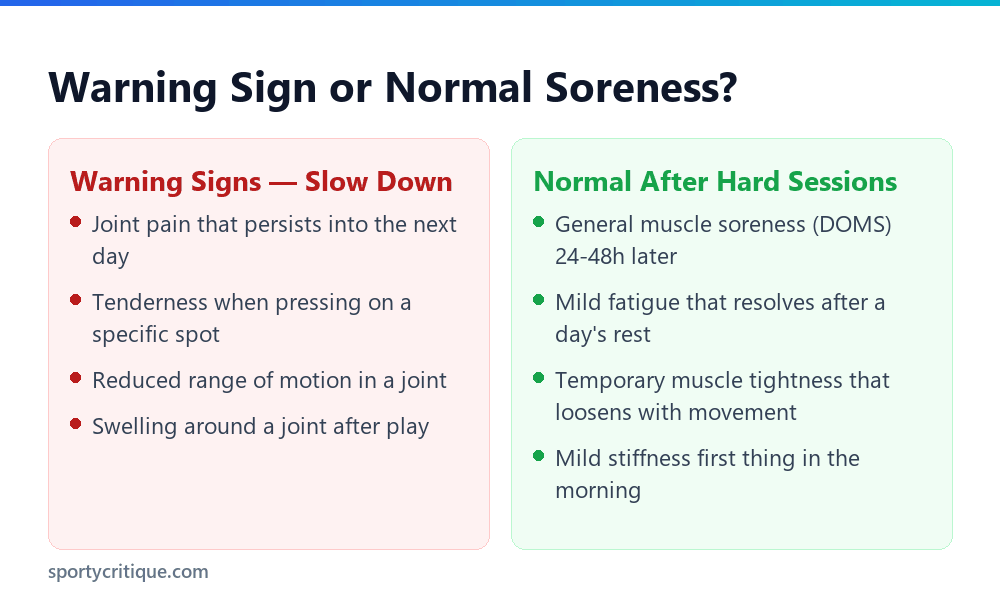
Signs You May Be Heading Toward an Injury
⚠ Warning Signs — Slow Down
- Joint pain that persists into the next day
- Tenderness when pressing on a specific spot
- Reduced range of motion in a joint
- Pain that appears at the start of a session and gets worse
- Swelling around a joint after play
- Fatigue that doesn’t resolve after normal rest
✅ Normal After Hard Sessions
- General muscle soreness (DOMS) 24–48h later
- Mild fatigue that resolves after a day’s rest
- Temporary muscle tightness that loosens with movement
- Elevated heart rate during training
- Mild stiffness first thing in the morning
- Slightly sore forearms after heavy topspin work
Technique Habits That Prevent Injury
Many chronic ping pong injuries are technique injuries in disguise. Fix the movement pattern, fix the injury risk.
Generate power from the ground up
Hip rotation → trunk rotation → shoulder → forearm → wrist. When the kinetic chain is correct, no single joint bears disproportionate load. When it’s skipped, the arm and shoulder compensate — and break down.
Relax between strokes
The third phase of every stroke is deceleration and recovery. Skipping it — holding the arm tense after each shot — is a primary cause of elbow and shoulder tendinitis. Actively relax your arm between every rally.
Grip pressure matters
Gripping the paddle too tightly is one of the most common causes of tennis elbow. Your grip should be firm but relaxed at all times — particularly during the swing phase of the stroke.
Move your feet, not just your arm
Reaching for balls with the arm instead of moving the feet is both bad technique and a common cause of shoulder and wrist injury. Proper footwork positions you optimally before contact — and protects every joint above the waist.
Cool-Down & Recovery
Stopping abruptly after intense play allows metabolic waste to pool in muscles, contributing to soreness and tightening. After every session, spend 5–10 minutes on these sport-specific stretches:
- Posterior shoulder stretch: Bring one arm across your chest, press it gently with the opposite hand. 30 seconds per side.
- Forearm stretch: Extend arm with palm up, gently pull fingers back. 30 seconds per side.
- Hip flexor lunge: Step forward into a lunge, lower the back knee toward the floor. 30 seconds per side.
- Lumbar rotation: Lie on your back, bring both knees to chest, lower them to one side with shoulders flat. 20 seconds per side.
- Calf stretch: Heel pressed into the floor, knee straight, facing a wall. 30 seconds per side.
Equipment Choices That Reduce Injury Risk
The gear you play with directly affects your injury risk — especially for upper-body injuries. This is an area most players completely overlook.
| Equipment | Injury-Smart Choice | Why It Matters |
|---|---|---|
| Blade | All-round or all-round+ for beginners/intermediate | Stiff/fast blades transfer more vibration into the elbow on mishits. A forgiving blade means less joint stress per session. |
| Rubber | 1.8–2.0mm medium sponge hardness | Thick, hard rubber (2.2mm max, 55° sponge) amplifies vibration on off-center contact — accelerating elbow and wrist wear. |
| Shoes | Table-tennis-specific with low heel profile | Running shoes have elevated heels that increase ankle roll risk and no lateral support. TT shoes are designed for the lateral forces of the sport. |
| Wristband | Worn during high-volume training | Provides mild compression and proprioceptive feedback. Recommended for players with a history of wrist issues. |
| Elbow sleeve | Compression sleeve just below the elbow | Reduces pain during tennis elbow recovery. Can be worn prophylactically by players with chronic elbow history. |
| Knee strap | Patellar tendon strap below the kneecap | Redistributes patellar tendon stress. Used by professional players including Zhang Jike and Wang Hao throughout their careers. |
| Ankle brace | Semi-rigid support for return-to-play | Strongly recommended after any ankle sprain and for players with a history of ankle instability. |
When to See a Doctor
Self-treatment is appropriate for many minor ping pong injuries. But there are specific situations where medical evaluation is essential — and waiting makes outcomes meaningfully worse.
🏥 See a Doctor If:
- Pain doesn’t improve within 2 weeks of rest
- Pain present in everyday activities, not just sport
- Pain is disturbing your sleep
- A joint feels unstable or “gives way”
- You heard or felt a pop at the moment of injury
- Significant bruising or swelling after acute injury
- Back pain radiating into the leg
- Tendon injury not improving after 4–6 weeks
🏠 Safe to Self-Treat:
- DOMS (general post-session muscle soreness)
- Mild wrist soreness that resolves with 2–3 days rest
- Grade 1 ankle sprain with PRICE protocol
- Minor forearm tightness with stretching
- Blisters on hands or feet
- General fatigue responding to rest and sleep
A sports medicine physiotherapist is the best first port of call for the vast majority of ping pong injuries. They diagnose the specific structure involved, rule out serious pathology, and design a targeted rehab program. An orthopaedic surgeon is needed only if conservative treatment has failed or a structural injury (ligament tear, tendon rupture, stress fracture) is suspected.
Frequently Asked Questions
Is ping pong actually a high-injury sport?
Compared to contact sports, no. But ping pong has a surprisingly high rate of overuse injuries compared to other racket sports — primarily because of the high repetition volume in training (thousands of strokes per session) and the explosive lateral movement involved. Research shows ankle injuries alone account for roughly 24% of all table tennis injuries. The sport is safe when played with correct technique, adequate warm-up, and sensible training loads — but it isn’t injury-free.
What is the most common ping pong injury?
By frequency, ankle sprains are the most common acute injury, accounting for nearly 24% of all table tennis injuries by body region. Tennis elbow (lateral epicondylitis) is the most common chronic/overuse injury, particularly affecting regular players. Wrist tendinitis and shoulder impingement are also extremely common in players who train frequently.
How long does tennis elbow from ping pong take to heal?
Mild cases typically resolve in 4–6 weeks with proper rest and anti-inflammatory measures. Moderate cases take 6–12 weeks and benefit significantly from physiotherapy-guided eccentric exercises. Severe or chronic tennis elbow that has been played through for months can take 6+ months to fully resolve, and may require corticosteroid injection or shockwave therapy. The single biggest mistake players make is continuing to play through early elbow pain — this almost always extends recovery dramatically.
Can beginners get ping pong injuries?
Yes, and in some ways beginners are more vulnerable to certain injuries — particularly shoulder strain and wrist sprain — because they generate power incorrectly, using the arm and shoulder alone rather than the whole kinetic chain. The good news is that learning correct technique early not only improves your game but also protects your joints from the start. If you’re new to the sport, prioritize proper form over power.
Should I play through ping pong pain?
No — and this distinction matters: muscle fatigue and soreness are fine to play through (within reason). Localized joint pain, tendon pain, or any pain that gets worse during a session is a signal to stop. The body’s pain system exists to prevent damage accumulation. Playing through tendon or joint pain almost always converts a short injury into a long one. When in doubt, rest for 2–3 days. If the pain disappears completely, you can return gradually. If it persists, see a physiotherapist.
Do professional ping pong players get injured often?
Yes — professional table tennis players experience significant injury rates, largely because of their extreme training volumes. Ma Long (widely considered the greatest player of all time) missed over 6 months of competition due to a knee injury. Zhang Jike, Wang Hao, and many top players wore knee straps routinely. Chen Meng suffered a notable ankle injury during competition. The injuries are the same as those affecting recreational players — the volume and intensity are simply much higher at the elite level.
What shoes should I wear to avoid ping pong injuries?
Table-tennis-specific shoes are strongly recommended. They feature a low heel-to-toe drop (important for lateral stability), wide forefoot design, non-marking rubber sole with strong grip, and lateral reinforcement for side-to-side movements. Running shoes are poorly suited to table tennis — their elevated heels increase ankle roll risk and they offer inadequate lateral support. Investing in proper TT shoes is one of the most cost-effective injury prevention measures you can make.
What is the PRICE protocol for ping pong injuries?
PRICE stands for Protection, Rest, Ice, Compression, and Elevation. It’s the clinically recommended first-aid response for most acute soft-tissue injuries in sport. In table tennis, it’s most commonly applied to ankle sprains, knee injuries, and muscle strains. Begin PRICE immediately after injury: stop play (Protection), avoid loading the injured area (Rest), apply ice for 15–20 minutes every 2–3 hours (Ice), wrap with an elastic bandage (Compression), and raise the limb above heart level (Elevation). Continue for at least 48 hours after injury.
Ping pong injuries are real — but nearly all of them are preventable. Warm up every session without exception, learn technique that distributes load through the whole body, wear the right shoes, and act fast when pain appears. The players who stay injury-free the longest aren’t the luckiest — they’re the most disciplined about prevention.
Similar Posts
How to Hold a Ping Pong Paddle: Shakehand vs. Penhold
Shakehand is right for almost everyone. The shakehand and penhold technique, what research says about the crossover point, and the 5 grip mistakes to avoid.
Where to Play Ping Pong in the United States (2026)
Verified ping pong venues across the US, each checked live, plus what happened to two spots this page used to recommend that have since permanently closed.
20 Quick Ping Pong Tips (Fast Reference for Any Skill Level)
20 fast, practical ping pong tips sorted into four stages, from pre-serve prep to match strategy, each linked to a full guide for the technical breakdown.
Ping Pong at Home: Real Setup, Practice, and Buying Advice (2026)
What actually matters for setting up and playing ping pong at home, including a corrected indoor-vs-outdoor table explanation the previous version had backwards.
Illegal Serves in Ping Pong: 7 Ways Players Break the Rules
The 7 most common illegal serves in ping pong: no toss, hiding the ball, serving below table height, and more, plus why each rule exists and how to fix them.
What Is Ping Pong? Rules, History, and How It’s Played
What is ping pong? A clear explanation of the game, its official name and history, the equipment you need, and exactly how a point is scored and won.