Best Cleaner for Ping Pong Paddle Rubber (10 Real Options, 2026)
The best cleaner for ping pong paddle rubber depends on your routine. For a complete first setup, Butterflys Racket Care Kit bundles everything you need. For quick regular maintenance, the JOOLA Turbo Spray is fast and effective on its own.
- →A dust and oil film, not actual rubber wear, causes most ‘my rubber died’ complaints — cleaning restores far more tack than players expect.
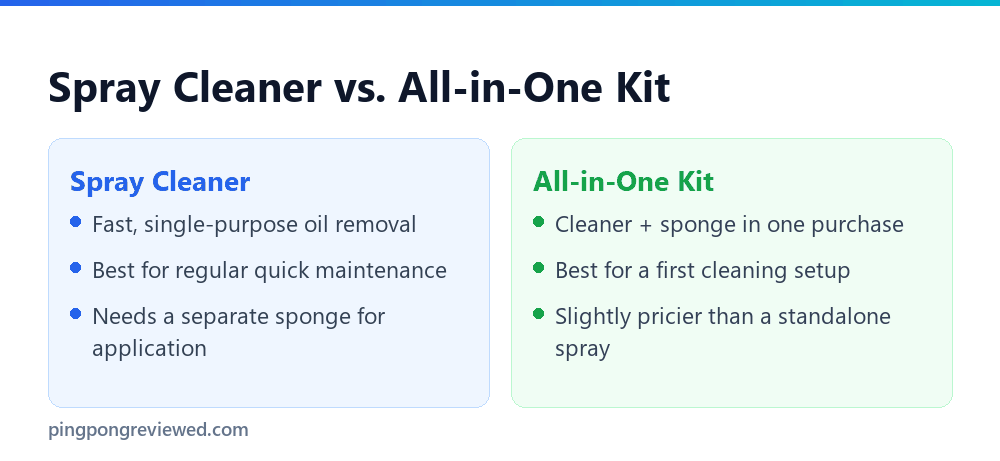
- →Sprays are fastest for regular maintenance; all-in-one kits are better for a first-time setup since they include a sponge.
- →Tacky Chinese-style rubber needs cleaning after nearly every session; tensor rubber tolerates a less frequent routine.
- →None of these products can revive rubber that’s genuinely worn out — cleaning helps a dirty rubber, not a dead one.
Most players who think their rubber has “died” are actually dealing with a dust and oil film building up on the surface, not real wear — cleaning restores a surprising amount of lost tack in cases like that. The products below cover every format: standalone sprays, sponges, and complete kits for players setting up a cleaning routine for the first time.
Table of Contents
Best Complete Kit: Butterfly Racket Care Kit

Butterflys Racket Care Kit bundles a cleaner and sponge in one purchase, rated for roughly 125 cleanings — a genuinely complete starting point if you don’t already own any cleaning supplies. It’s the safest first purchase for a player setting up a real maintenance routine for the first time.
- ✓Complete kit — cleaner and sponge in one purchase
- ✓Rated for roughly 125 cleanings, real long-term value
- ✓From an established, trusted brand
- ✕Pricier than a standalone spray alone
- ✕More than a casual player strictly needs
Best Fast Spray: JOOLA Turbo Rubber Cleaner

The JOOLA Turbo Spray is a standalone cleaner built for speed — spray, wipe, done. It’s the best pick for a player who already has a sponge and just wants an effective, fast product for regular maintenance between sessions.
Best Budget Kit: Pro Spin Cleaning Kit

The Pro Spin kit includes a 200ml cleaner and sponge at a lower price than the Butterfly kit, a reasonable choice for a player who wants a complete setup without the premium-brand cost.
💡 Pro tip: Tacky Chinese-style rubber loses grip to dust noticeably faster than tensor rubber does — if you’re running a tacky setup, cleaning after nearly every session is worth the extra habit, not optional maintenance.
Best for Tacky Rubber: Butterfly Spin Refresh
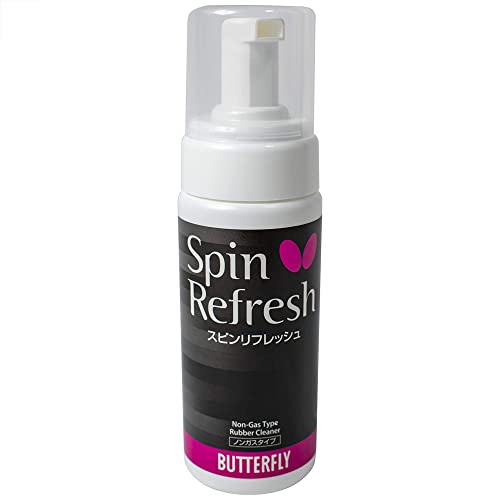
Spin Refresh is a foam-based cleaner specifically formulated for restoring tack on Chinese-style tacky rubber, a category that demands more frequent, more targeted cleaning than tensor rubber does. If you’re running a tacky setup like DHS Hurricane 3, this is a purpose-built pick worth having alongside a general cleaner.
Complete Set: JOOLA Pro Cleaning Set

The JOOLA Pro Set rounds out JOOLA’s cleaning lineup with a complete cleaner-and-sponge bundle, positioned similarly to the Butterfly and Pro Spin kits above. It’s a reasonable alternative if you already trust JOOLA’s other equipment and want to stay within one brand.
Value Pick: Two-Pack All-in-One Kit

This two-pack kit includes two complete cleaner-and-sponge sets, practical if you’re maintaining paddles for more than one player or want a backup on hand. It’s priced to reflect the double quantity rather than a premium single-kit cost.
Basic Option: Generic Paddle Cleaner

This basic paddle cleaner covers the essentials at an accessible price, without the brand recognition of Butterfly or JOOLA. It’s functional for regular maintenance, a reasonable pick if you’re not particular about brand and just want something that works.
Sponge-Only Option: Patikil Care Sponge

The Patikil sponge is sold on its own, useful if you already have a cleaning spray or solution and just need a dedicated application sponge rather than a full kit. Pairing it with the JOOLA Turbo Spray above covers the same ground as a bundled kit at potentially lower total cost.
Specialized Foam: Counterstrike Super Foam

The Counterstrike Super Foam kit uses a foam-based cleaning formula, similar in spirit to Butterfly’s Spin Refresh, at a more budget-friendly price point. It’s a reasonable middle option between the premium brand-name foam cleaners and the most basic spray options.
Deep Clean Option: Butterfly Cure Water

Cure Water is positioned as a deeper, more thorough cleaning solution than a quick-wipe spray, worth reaching for during a monthly deep clean rather than after-every-session maintenance. It complements a faster spray rather than replacing it in a complete routine.
Building a Complete Cleaning Routine
A realistic routine layers these products by frequency rather than picking just one. A quick spray-and-wipe after every session, using something like the JOOLA Turbo Spray, handles daily dust. A more thorough clean weekly, or with a dedicated product like Cure Water monthly, handles the oil buildup a quick wipe misses. Tacky rubber owners should layer in Spin Refresh or a similar tacky-specific product on top of that general routine.
What Cleaning Can’t Fix
No cleaner on this list, no matter how good, restores rubber that’s genuinely worn out rather than dirty. If the surface still feels slick and unresponsive immediately after a proper clean, that’s the topsheet wearing through, not a cleaning problem — replacement time, not another product purchase. Cleaning solves the majority of “my rubber died” complaints, but not all of them.
Cost Comparison Across These Ten Products
Complete kits from established brands like Butterfly and JOOLA sit at the higher end of this comparison, reflecting both the branded formula and the bundled sponge. Standalone sprays and budget kits from less established sellers cost meaningfully less, while specialized foam cleaners like Spin Refresh typically price between the two extremes. None of the ten options here represent a significant expense relative to the rubber they’re maintaining — even the priciest kit costs a fraction of a single premium rubber replacement.
Travel and On-the-Go Cleaning
Smaller standalone products, particularly the sponge-only Patikil option and compact sprays, travel more easily than a full kit with multiple components. If you’re bringing cleaning supplies to a club or tournament rather than keeping them at home, prioritizing a compact, single-item product over a bulkier complete kit is worth the tradeoff, even if it means owning two separate setups for home and travel use.
Spray vs. Sponge vs. Complete Kit
A standalone spray is the fastest to use once you already own a sponge, ideal for players maintaining an established routine. A standalone sponge, like the Patikil, only makes sense paired with a cleaner you already have. A complete kit is the right call specifically for a first-time purchase, since it removes the guesswork of pairing compatible products separately.
Water-Based vs. Foam Cleaners
Most sprays and standalone cleaners in this comparison are water-based, effective for regular oil and dust removal without leaving residue behind. Foam cleaners, like Spin Refresh and the Counterstrike Super Foam kit, work slightly differently, lifting embedded grime from a tacky surface more aggressively than a water-based spray manages on its own. Neither type is universally better — water-based suits routine maintenance, foam suits a deeper periodic clean or tacky-specific rubber care.
How Long a Bottle Actually Lasts
Most standalone cleaner bottles and sprays in this list are rated for well over a hundred applications, meaning a single purchase realistically covers a full season or more of regular use for one player. Complete kits with a bundled sponge typically wear out the sponge before the cleaner itself runs low, which is worth knowing before assuming you need to repurchase the whole kit rather than just a replacement sponge.
Storage Tips for Cleaning Supplies
Keep sprays and cleaning solutions away from direct sunlight and extreme temperature swings, similar to how you’d store the rubber itself — heat degrades cleaning formulas faster than normal shelf life would suggest. A dedicated storage pouch or the original kit packaging works fine for most players; there’s no need for anything more elaborate than keeping supplies in a cool, dry spot alongside your paddle case.
Do Cleaners Ever Damage Rubber?
A properly formulated table tennis rubber cleaner, whether spray, foam, or water-based, is safe for regular use on any rubber type and won’t degrade the compound over time. The real risk comes from substituting household cleaners, solvents, or alcohol-based products instead — those genuinely can break down rubber compounds and shorten a rubber’s life, which is exactly why every product in this list is a dedicated table tennis formula rather than a generic cleaner.
Signs You’re Overdue for a Deep Clean
A quick after-session wipe handles daily dust, but certain signs point to needing a more thorough clean sooner than your usual weekly or monthly routine. A visible dulling of the rubber’s sheen, a faint tacky residue that doesn’t wipe off easily, or a noticeable drop in spin generation despite recent light cleaning all suggest it’s time for a deeper pass with a dedicated cleaner rather than another quick wipe.
Cleaning Pips-Out Rubber: A Different Job Entirely
Every product on this page is described for inverted rubber, the smooth surface most players use, and that’s a real gap if you play with short or long pips. The cleaning problem is genuinely different: on inverted rubber you’re lifting dust off a flat surface, but on pips-out rubber, dust and debris collect between the pimples, where a flat wipe simply doesn’t reach.
The technique that works is directional. Run a soft brush or sponge slowly along the direction the pips lie, working from the handle outward, in small consistent strokes rather than scrubbing in circles. Circular motion on long pips is actively counterproductive because it pushes the pimples in conflicting directions and can bend them, and bent or damaged pips change how the surface behaves, which on a spin-reversal rubber means changing the one property you chose it for.
Long pips deserve the most caution of any surface here. The pimples are long and thin by design so they buckle on ball contact, which also means they’re the easiest to damage during cleaning. Light pressure genuinely matters more than thorough scrubbing, and a purpose-made pip brush is worth the small cost over improvising with a household brush whose bristles may be far too stiff.
Do You Actually Need a Dedicated Cleaner?
Worth being straight about this, since every product on this page costs money and one common alternative costs nothing: plain water works. Tap water applied with a soft sponge removes ordinary dust and light surface grime from most rubber perfectly adequately, and for a recreational player cleaning a paddle every few sessions, it may be all you ever need.
Where dedicated cleaners genuinely earn their price is on tacky rubber, where restoring surface grip matters competitively, and on rubber that’s accumulated more than dust, body oils from handling, residue from table surfaces, or grime that water alone leaves behind. Frequent players notice the difference; occasional players often won’t.
- Plain water + soft sponge: free, safe on every surface type, adequate for routine dust. The sensible default.
- Dedicated cleaner: better at restoring tack and lifting oils; worth it if you play weekly or use tacky Chinese rubber where grip loss is immediately noticeable.
- Isopropyl alcohol: treat as a last resort, not a routine option, and avoid it entirely on tacky rubber where it degrades the surface. If used at all, 100% isopropyl in a thin layer, not repeatedly.
- Household cleaners, dish soap, solvents: avoid. These aren’t formulated for rubber compounds and can cause permanent damage that no amount of later care reverses.
The general principle: the gentlest thing that actually removes the dirt is the right choice. Escalating to harsher agents because a rubber feels slow is usually treating the wrong problem, since rubber that’s genuinely worn out doesn’t get its grip back from cleaning at all.
Storage: Where Rubber Actually Dies
Cleaning gets the attention, but storage does more cumulative damage to rubber than dirt ever will. Two things degrade rubber surfaces over time regardless of how carefully you clean them: ultraviolet light and heat.
Direct sunlight is the specific hazard. UV exposure breaks down rubber compounds progressively, and it does so even through the protective film many players apply, film slows the process but doesn’t stop it. A paddle left on a windowsill, on a car dashboard, or in a sunlit room between sessions is aging faster than one stored in a drawer, and the damage is cumulative and irreversible.
Heat compounds the problem, which makes a car specifically the worst common storage location: it combines sustained heat with direct sun through glass. A rubber that would last a full season in a cupboard can noticeably degrade over a few summer weeks in a car boot.
The practical fix is inexpensive. A paddle case does three jobs at once, blocking UV, buffering temperature swings, and keeping dust off the surface between sessions, which reduces how often you need to clean in the first place. Store the case somewhere cool and dry rather than a garage or shed where temperatures swing seasonally. Protective film adds another layer of dust and UV protection for rubber you’re not using regularly, and our paddle care guide covers when film is worth applying.
If you take one thing from this section: a player who stores a cheap rubber properly will generally get more usable life out of it than a player who stores an expensive rubber on a sunny shelf. Storage habits outrank product choice for longevity.
How Often Is Actually Right?
There’s no single correct interval, because the honest answer depends on how much you play and where. A player training three times a week in a club hall with a dusty floor accumulates surface grime far faster than someone playing once a fortnight in a clean home basement, and prescribing the same schedule to both is the kind of generic advice that fills equipment articles without helping anyone.
A more useful approach is to clean by symptom rather than by calendar. Wipe the surface after each session as routine maintenance, that takes seconds and prevents most build-up from ever forming. Then do a proper clean when you notice the specific signs: the surface looks dulled rather than uniformly matte, your serves are gripping less than they did, or dust is visibly sitting in the surface texture. Those signals are more reliable than any weekly rule.
One caveat worth naming: cleaning more often is not automatically better. Every clean involves physical contact with the rubber surface, and over-cleaning with too much pressure or too harsh an agent wears rubber faster than the dust you’re removing would have. Gentle and as-needed beats aggressive and scheduled.
It’s also worth separating maintenance from replacement in your own head, because they get conflated constantly. Cleaning restores a surface that has dirt on it. It does not restore a surface that has genuinely worn out, and no product on this page claims otherwise. If a thorough clean brings back noticeably less grip than it used to, that is usually the rubber telling you its usable life is ending rather than a sign you need a stronger cleaner.
What is the best cleaner for ping pong paddle rubber?
The Butterfly Racket Care Kit is the best complete starting point; the JOOLA Turbo Spray is the best fast option for an established routine.
How often should I clean my rubber?
A quick wipe after every session, a proper clean weekly, and a dedicated deep clean monthly — tacky rubber needs the proper clean after nearly every session.
Can cleaning actually restore lost tack?
Yes, in most cases — a dust and oil film causes the majority of ‘dead rubber’ complaints, and cleaning restores a surprising amount of that lost grip.
What’s the difference between a spray and a foam cleaner?
Sprays are faster for regular maintenance; foam cleaners like Spin Refresh are formulated specifically for restoring tack on Chinese-style rubber.
When does cleaning stop working?
When the rubber’s topsheet is genuinely worn through — if it’s still slick immediately after a proper clean, that’s replacement time, not a cleaning issue.
How long does a bottle of rubber cleaner last?
Most standalone bottles cover well over a hundred applications, realistically a full season or more of regular use for one player.
As an Amazon Associate, we earn from qualifying purchases through links on this page.

Ping Pong Reviewed is an equipment review site covering table tennis and baseball gear. Specifications are checked against manufacturer listings, and prices against live retail pages, before publication.