Best Table Tennis Shoes for High Arches: 5 Picks for Men (2026)
Finding good table tennis shoes for high arches means looking past generic “athletic shoe” listings for something that actually addresses arch shape rather than cushioning in general. High arches change what you need from a court shoe: less of the flat, motion-control support flat-footed players look for, and more cushioning with a contoured footbed that does not leave the midfoot unsupported. Below are five shoes that are live on Amazon and genuinely address that, rather than generic athletic shoes filed under an arch-support heading.
Table of Contents
Why High Arches Need a Different Shoe
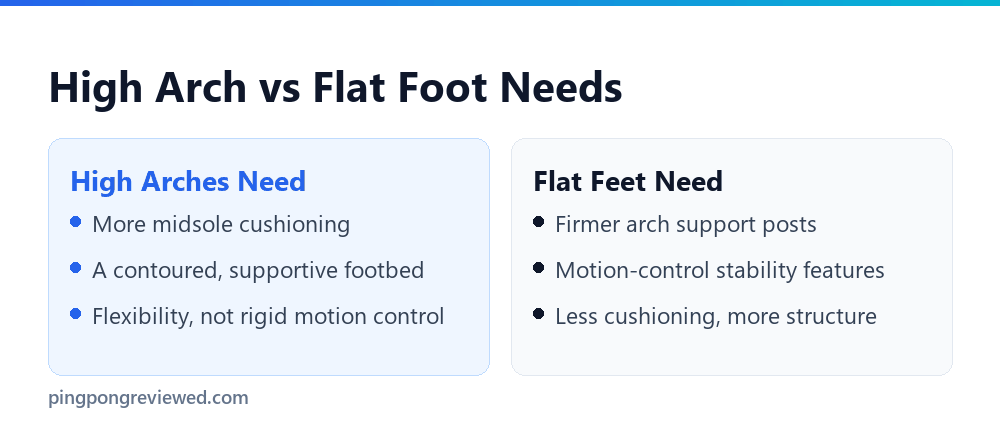
A rigid, heavily-structured “stability” shoe built for overpronation (the flat-foot problem) can actually make high-arch discomfort worse by not letting the foot flex naturally through a step. What actually helps is more cushioning under the midfoot and a footbed shaped to fill the gap under the arch, not a firmer post pushing up against it.
Table tennis adds its own wrinkle on top of general high-arch shoe advice: the sport is almost entirely lateral movement and sudden direction changes over a small footprint, not the forward-heavy stride pattern most running-shoe arch guides are written for. That means the ideal high-arch table tennis shoe needs a low, stable platform for quick side steps in addition to the cushioning a high arch needs — a combination running shoes and general athletic sneakers usually don’t get right, which is part of why this list leans on court-sport and racquet-sport crossover brands rather than running brands.
How We Verified Each Pick
The original version of this page listed ten products, but two were the exact same Skechers shoe listed twice under different ASINs, one (the Butterfly Lezoline Gigu) had already been confirmed discontinued during an earlier Butterfly shoe guide on this site, and several others were generic athletic or tennis shoes with no real arch-support feature beyond a standard insole. We checked every remaining ASIN was live and in stock, removed the duplicate, and kept only the five shoes below that either have an explicit arch-support design or a genuine, disclosed reason to be on a table tennis shoe list.
The 5 Verified Picks
1. FitVille Men’s Wide Pickleball Shoes — Best for Plantar Fasciitis
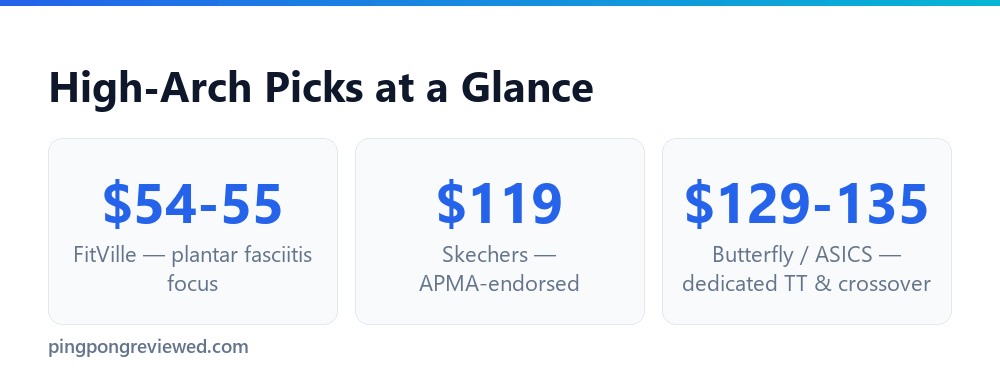
FitVille Men’s Wide Pickleball Shoes with Arch Support, $54, is built specifically with plantar fasciitis and high-arch discomfort in mind — a contoured, cushioned footbed rather than a generic flat insole. The wide toe box is a bonus if you also need extra width, but the arch support is the real reason this tops the list.
2. Skechers Viper Court Pro — Best APMA-Endorsed Support
Skechers Men’s Viper Court Pro Pickleball Shoe, $119, carries the APMA (American Podiatric Medical Association) Seal of Acceptance on its Arch Fit insole — one of the only shoes on this list with an actual third-party podiatric endorsement rather than just marketing copy. The Ultra Go midsole adds real cushioning on top of that arch support.
3. ASICS Gel-Rocket 10 — Best Table Tennis Crossover
ASICS Men’s Gel-Rocket 10 Indoor Court Shoes, $135, is technically a volleyball shoe, not a table-tennis-specific one — ASICS doesn’t make a dedicated table tennis line, a gap we’ve flagged in our other ASICS shoe guide. What it does have is genuine ASICS GEL cushioning in the heel and forefoot, which helps absorb impact for a high arch even without an arch-specific insole design.
4. FitVille Extra Wide Pickleball Tennis Shoes — Best Extra-Wide + High Arch
FitVille Extra Wide Pickleball Tennis Shoes, $55, is FitVille’s wider-still option for players who need both extra width and arch support together, with the same torsion-resistant, cushioned build as their standard-wide model above.
5. Butterfly Lezoline Reiss — Best Purpose-Built Table Tennis Shoe
Butterfly Lezoline Reiss Table Tennis Shoes, $129, is a genuine dedicated table tennis shoe from a brand that actually makes them — unlike ASICS, Babolat, or most other names in this space. It isn’t marketed specifically for high arches, but its cushioned, shock-absorbing sole works reasonably well for most arch types. Worth the honest caveat: if you need dedicated podiatric arch support, the FitVille or Skechers picks above are the more targeted choice.
Brand Honesty Check
Only Butterfly on this list makes a dedicated table tennis shoe. ASICS, Skechers, and FitVille are all genuine crossover brands — ASICS from volleyball, Skechers and FitVille from pickleball and general court sports — that happen to fit table tennis’s side-to-side, quick-stop movement pattern reasonably well. We’re disclosing that upfront rather than implying otherwise, consistent with how we handle every crossover-brand guide on this site.
- Butterfly — genuinely table-tennis-specific
- ASICS Gel-Rocket — volleyball shoe, crossover
- Skechers Viper Court — pickleball shoe, crossover
- FitVille — pickleball/court shoe, crossover
Fitting a High-Arch Shoe Correctly
Arch support only helps if the shoe fits correctly in the first place — an insole doing its job in a shoe that’s the wrong size just shifts the pressure problem somewhere else on your foot. A few fit checks worth doing before your first real session:
- Stand, don’t just sit, when checking fit. Arches flatten slightly under standing weight, which changes how a footbed feels compared to trying a shoe on seated.
- Leave a thumb’s width at the toe. Table tennis’s quick stop-start movement pushes your foot forward inside the shoe more than steady-pace running does.
- Check width separately from length. A shoe that’s the right length but too narrow can crowd a high arch’s natural foot shape just as much as one that’s too short.
- Re-lace before judging arch feel. A properly snugged midfoot lace pattern does more for arch support than most people expect — try adjusting laces before assuming an insole isn’t working.
Frequently Asked Questions
What are the best table tennis shoes for high arches?
The FitVille Wide Pickleball Shoes and Skechers Viper Court Pro are the two picks in this guide built with explicit arch-support features — FitVille for plantar fasciitis specifically, Skechers with an APMA-endorsed Arch Fit insole. Both are strong starting points if arch support, rather than brand name or overall price, is your main buying priority for this particular purchase decision.
Are Skechers Viper Court shoes good for high arches?
Yes — the Arch Fit insole carries an actual APMA Seal of Acceptance, a third-party podiatric endorsement rather than just marketing language, which makes it one of the more credible arch-support claims in this category.
Which ASICS shoes work for table tennis with high arches?
The Gel-Rocket 10 is the closest match — it’s a volleyball shoe with the lateral support table tennis needs, plus genuine ASICS GEL cushioning. ASICS doesn’t make a dedicated table tennis shoe, so this is a crossover pick, not a purpose-built one.
Do Butterfly shoes support high arches?
Butterfly’s Lezoline line is cushioned and shock-absorbing but isn’t marketed with a specific high-arch feature the way the FitVille and Skechers picks are. It’s the better pick if you want a shoe built specifically for table tennis; the other two are better if arch support is your top priority.
Is a wide shoe the same thing as an arch-support shoe?
No. Width and arch support are separate features — a wide shoe gives more room across the forefoot, while arch support addresses the footbed shape underneath. FitVille’s shoes in this guide happen to offer both, but that’s not true of every wide shoe.
Can I add my own orthotic insert to these shoes instead?
Yes, most of the shoes in this guide have removable stock insoles, which makes swapping in a custom orthotic straightforward. If you plan to do this, it’s worth ordering a half size up since a custom insert takes up more volume than the stock insole it replaces.
Do high arches actually need a different shoe than flat feet?
Yes — the two conditions call for close to opposite support strategies. Flat feet generally need firmer arch posts and motion-control structure to limit overpronation, while high arches need more cushioning and flexibility since the foot doesn’t naturally absorb shock through the arch the way a flatter foot does. A shoe optimized for one can genuinely make the other condition feel worse.
As an Amazon Associate, we earn from qualifying purchases through links on this page.

Ping Pong Reviewed is an equipment review site covering table tennis and baseball gear. Specifications are checked against manufacturer listings, and prices against live retail pages, before publication.