20 Quick Ping Pong Tips (Fast Reference for Any Skill Level)

This page of ping pong tips isn’t a long, meandering deep-dive tutorial — it’s a fast, scannable reference list. If you want the full breakdown behind any single tip below, we’ve linked to the dedicated guide on this site that covers it in detail. Think of this page as the index; the tip that actually moves your game is usually one click away.
We split these 20 tips into four stages that roughly match how a point actually unfolds: what to check before you even serve, the serve-and-return exchange itself, building shots once a rally is underway, and the strategy and mindset that decide close games. Jump to whichever stage matches your current weakness rather than reading top to bottom — a strong server who loses focus at 9-9 needs the strategy section far more than the serving one.
Table of Contents
Before You Even Serve (Tips 1-5)
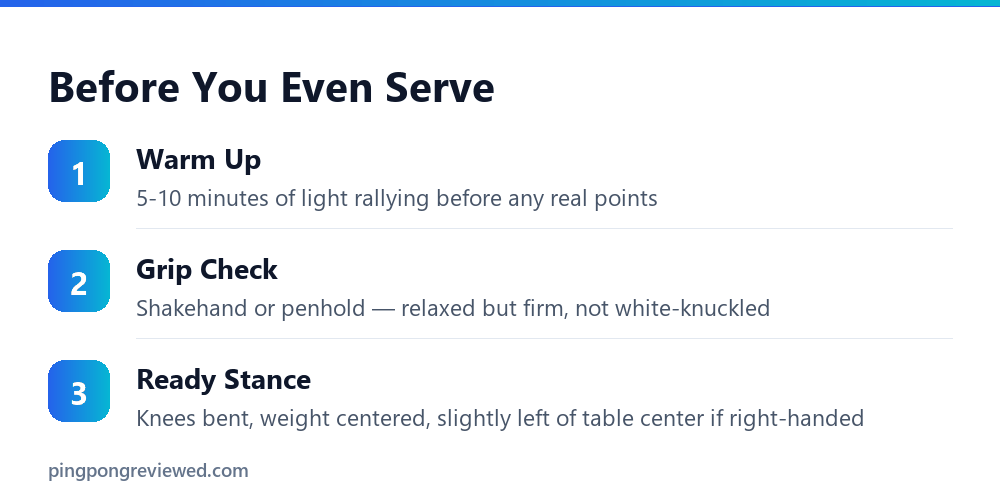
Most avoidable mistakes in a casual match happen before the first point even starts — a cold body, a grip that hasn’t been checked, or a stance that’s flat-footed instead of ready to move. These five fix the setup so the rest of your game has a fair chance.
- Warm up first. A few minutes of easy rallying prevents the stiff, mistimed shots that happen in cold first points.
- Get your grip right before anything else. See our full grip guide for the shakehand-vs-penhold breakdown and the five most common grip mistakes.
- Learn a proper ready stance. Knees bent, weight forward on the balls of your feet, not flat-footed and upright.
- Get a paddle that suits your level. A beginner paddle that’s too fast or too spinny makes every other tip on this list harder to execute.
- Keep a consistent pre-serve rhythm. Rushing your serve routine under pressure is one of the fastest ways to lose free points.
Serve and Return (Tips 6-10)
The serve is the one shot in ping pong you have total control over before your opponent touches the ball, which makes it the highest-leverage place to practice deliberately rather than just play through. These five cover both sides of that exchange — serving with intent, and reading what’s coming back at you.
- Learn more than one serve. Our serving rules guide covers the legal toss height and the spin variations worth learning first.
- Add sidespin, not just topspin and backspin. Sidespin serves are underused at the club level and cause real return errors.
- Keep your returns low over the net. A low return is far harder to attack than a high one, regardless of spin or placement.
- Watch the opponent’s racket angle at contact, not just the ball — the angle tells you the spin before the ball even reaches you.
- Compensate your racket angle for incoming spin. Heavy backspin needs an open racket face; heavy topspin needs a closed one.
Building Your Shots (Tips 11-15)
Once a rally is underway, the gap between a beginner and an intermediate player is mostly about which shots are actually reliable under pressure, not how many different shots someone knows in theory. These five prioritize the shot-building order that tends to produce the fastest real improvement.
- Master forehand and backhand separately before combining them. Rushing to a full rally before either stroke is consistent slows overall progress.
- Learn to loop, not just hit flat. See our forehand loop guide for the full swing mechanics and the Magnus-effect explanation of why it works.
- Use your whole body on the forehand, not just your arm — hip and shoulder rotation generates most of the power, not the wrist.
- Practice placement, not just power. Two well-placed corners beat one hard shot down the middle almost every time.
- Learn when to chop, not just when to attack. Our chop-vs-push guide breaks down when a defensive shot is actually the smarter choice.
Strategy and Mindset (Tips 16-20)
This is the stage most players skip past even though it decides the closest games. Two players with near-identical technique will still split results based on who reads patterns better and who stays composed when the score gets tight.
- Read your opponent’s patterns, not just their current shot. Most club players repeat the same 2-3 serve-and-attack combinations.
- Target the elbow, not just the corners. The transition zone between forehand and backhand is the hardest spot to react to.
- Stay calm at 9-9 and other close points. Mental composure at big points matters as much as technique at that stage of a game.
- Take short breaks between games, not just between matches — a tired stroke breaks down before a tired mind admits it.
- Practice alone against a wall when you can’t find a partner. Wall rallies build consistency and reaction speed without needing a second player.
How To Actually Use This List
The mistake most players make with a tips list like this one is trying to apply all 20 at once. That usually produces worse play in the short term, not better — you end up thinking about grip, footwork, spin reading, and mental composure simultaneously instead of actually watching the ball. A more effective approach is to pick one tip, or at most one section, and drill it specifically for two or three sessions before moving to the next.
A reasonable order for most players who are relatively new to the game: start with the pre-serve fundamentals in section one, since a shaky grip or stance undermines everything built on top of it. Once that feels automatic, move to serve variety in section two — a good serve wins free points even before your shot-making improves. Shot-building in section three comes next, since it takes the longest to develop and benefits most from a solid foundation already being in place. Strategy and mindset in section four matters at every stage, but pays off most once your technique is consistent enough that games actually come down to decision-making rather than execution errors.
Players who already have solid fundamentals can skip straight to whichever section addresses their specific weakness — there’s no requirement to work through this list in order once the basics are firmly and reliably in place across most situations.
Which Tips Apply at Which Stage
A long list of tips is only useful if you know which ones are for you now. Advice that helps an intermediate player can actively confuse a beginner, and vice versa.
If you are starting out, almost all of your gains come from consistency and basic positioning. Get the ball on the table repeatedly, learn to watch the opponent’s contact, and stop trying to hit winners. Serve legally and simply. Ignore anything about equipment beyond having a functional bat.
If you can rally reliably, the gains move to spin and placement. Learn to produce and read topspin and backspin, start varying where you put the ball rather than hitting everything to the middle, and develop two serves you can execute consistently rather than six you cannot.
If you play matches, the gains are tactical. Notice what your opponent struggles with and do more of it. Vary your serves. Learn what your own reliable point-winning pattern is and set it up deliberately rather than waiting for it to appear.
The mistake worth avoiding at every stage is chasing advanced techniques while basic consistency is still missing. A reliable push and a legal serve win more club points than an unreliable loop, and technique built on an unstable base has to be rebuilt later anyway.
Habits Worth Building Off the Table
Not everything that improves your game happens during a rally, and the off-table habits are both the cheapest to adopt and the most consistently ignored.
- Watch matches with a purpose. Not for enjoyment, but choosing one thing to observe, how a player recovers position, how they vary serves, where they place under pressure. Unfocused watching teaches very little.
- Record yourself occasionally. A phone propped on a chair reveals faults you cannot feel. Nearly every player is surprised by the gap between what they think their stroke looks like and what it does.
- Warm up properly. Table tennis involves fast rotational movement and sudden direction changes, and going in cold invites the shoulder and knee problems the sport is prone to.
- Keep your equipment clean. A wiped bat and undamaged balls remove a source of inconsistency that has nothing to do with your technique.
- Play people better than you. Losing to stronger opponents teaches more than beating weaker ones, provided you are paying attention to why.
The single highest-return habit of these is recording yourself. It costs nothing, takes two minutes to set up, and consistently identifies the specific fault worth working on next, which is otherwise the hardest thing for a player to determine alone.
The Tips That Matter Most, Ranked
If you only act on a few things from this page, these are the ones with the largest effect relative to effort.
- Watch the opponent’s contact, not the ball. Costs nothing, transforms how much time you have to react.
- Practise serves alone. Twenty minutes a week, no partner needed, and it is the only shot fully under your control.
- Return to a ready position after every shot. Most recreational players are still admiring their last stroke when the next ball arrives.
- Play the ball to a place, not just back. Placement beats power at every level below advanced.
- Relax your grip. Covered in our grip guide, and the fastest single fix for poor touch and a tired forearm.
None of these require new equipment, a coach, or extra table time. That is precisely why they are worth doing first, before anything on this site that involves spending money.
Frequently Asked Questions
How do I get better at ping pong?
Focus on one area at a time rather than trying every tip at once — grip and stance first, then serve variety, then shot consistency, then strategy. Our how-to-get-better guide covers this progression in more depth for players past the absolute basics.
What is the most important skill in ping pong?
Consistency beats power at every level below advanced competition. A player who can reliably return 20 balls in a row without missing will beat a harder hitter who misses every third shot, which is exactly why most of the tips on this list deliberately prioritize repeatable, consistent technique over raw hitting power alone.
How many of these tips should I try to use at once?
One or two. Trying to apply all 20 tips in a single session usually backfires — pick whichever section above matches your current weakness and drill that specifically for a few sessions before adding a second focus area.
Is this list enough on its own, or do I need more detail?
This page is intentionally a quick reference, not a tutorial. Each tip links to a dedicated guide on this site with the full technical breakdown — use this list to find your priority, then read the linked guide for the actual how-to and drilling routine.
How long does it realistically take to see improvement?
Most players notice a difference within 2-3 weeks of focused practice on a single weakness, playing or drilling at least a couple of times per week. Improvement that comes from trying to fix everything at once typically takes much longer, since no single change gets enough repetition to become automatic.
Should beginners focus on tips or just play a lot of matches?
Both, but not in equal measure early on. Pure match play without any deliberate focus tends to lock in whatever habits you already have, good or bad. A mix of a few matches plus targeted practice on one specific tip from this list tends to produce faster, more durable improvement than either approach alone.
Do these tips apply equally to penhold and shakehand grips?
Yes, with one caveat — the whole-body forehand tip and the footwork tip apply identically to both grips, but penhold players typically need a slightly different backhand approach than the one implied in general shakehand-focused tutorials, which is worth keeping in mind when applying tip 11 during actual practice.

Benjamin Fink writes and edits the table tennis equipment guides on PingPongReviewed, covering paddles, tables, robots, and training gear.