
Soccer Ping Pong (Teqball): Rules, History, and Gear (2026)

Soccer ping pong, more formally called Teqball, is a real sport played on a curved table using only feet, thighs, chest and head — no hands or arms, the same touch restriction as soccer itself. Below is what the sport actually is, where it came from, how it is scored, and a straight answer to the question most people arrive with: whether you need to buy an official Teqball table to try it.
What Soccer Ping Pong (Teqball) Actually Is
Teqball is played on a purpose-built curved table that arcs upward from the center, roughly resembling a ping pong table bent into a wide U-shape. Two players, or two teams of two, stand on opposite sides and return a soccer ball back and forth over the table using any part of the body except the arms and hands, most commonly feet, thighs, chest, and head. The curve of the table is what makes it playable at all — a flat surface would send a soccer ball bouncing unpredictably, while the curve returns it in a controlled arc similar to how a ping pong table returns a ball hit with a paddle.
Do You Need an Official Teqball Table?
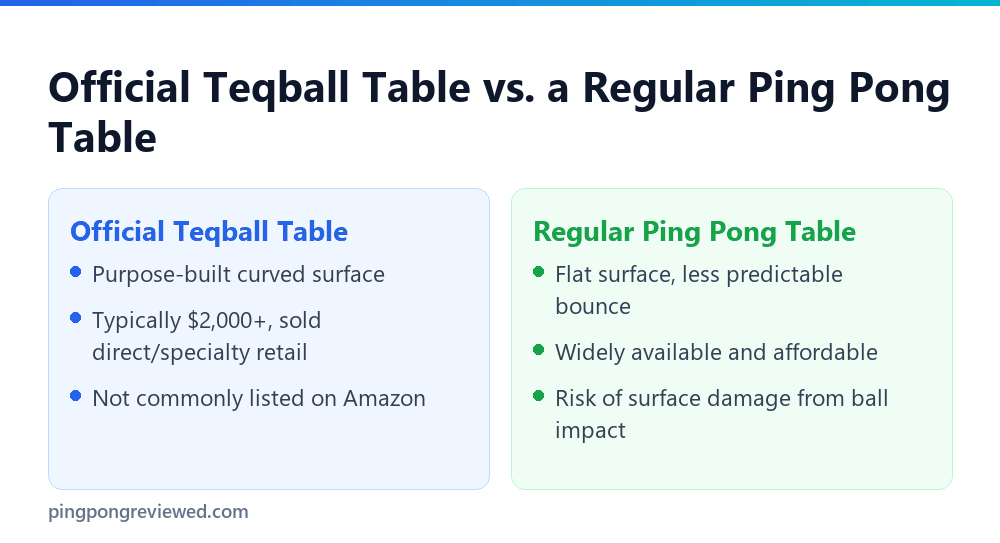
Here’s the honest answer: official Teqball tables are a specialty commercial product, typically priced well above $2,000 and sold through Teqball’s own retail channels rather than listed on Amazon, and we couldn’t find one on Amazon’s live catalog while researching this page. If you’re trying soccer ping pong casually rather than training for competition, a sturdy regular ping pong table is the realistic starting point, with the tradeoff that a flat surface won’t return the ball as predictably as a curved one, and repeated hard soccer-ball contact isn’t what most consumer tables are built to withstand long-term.
If you’re shopping for a table partly with this in mind, the EastPoint Penn Foldable is a durable budget pick we’ve verified separately in our full best ping pong table guide, and its MDF construction holds up better to casual soccer-ball impact than thinner budget alternatives. Beyond the table, all you actually need is a regulation or slightly smaller soccer ball — there’s no specialized soccer-ping-pong-specific ball required for casual play.
The Rules, Simplified
- Touch restriction: feet, thighs, chest, and head only — using your hands or arms is a fault, exactly like soccer.
- Match format: played 1v1 (singles) or 2v2 (doubles), with players alternating serves.
- Scoring: matches are typically played in sets to 12 points, win by 2, with a match usually decided over multiple sets.
- Faults: letting the ball bounce twice on your own side, hitting it out of bounds, or touching it with a hand/arm all give the point to your opponent.
- Serve rules: the serve must be played off the table’s curved surface before crossing to the opponent’s side, similar in spirit to a legal serve in table tennis.
Where Teqball Came From
Teqball was invented in Hungary in 2014 by a small group of entrepreneurs, including Gábor Borsányi and Viktor Huszár, who wanted a way for soccer players to practice first-touch control and reflexes without needing a full pitch or a training partner doing anything more than standing on the other side of a table. The International Federation of Teqball (FITEQ) followed within a few years of the sport’s creation to standardize rules and organize competition, and the sport has since spread well beyond its original use as a soccer training tool into its own competitive discipline with world championships and a growing international federation presence.
What’s notable about that growth timeline is how fast it happened compared to most invented sports, which often take decades to move from a regional novelty to organized international competition. Teqball reached a standardized rulebook, a governing federation, and world championship events within roughly its first five years, a pace that owes a lot to its direct usefulness as a soccer training tool rather than existing purely as a standalone hobby sport competing for attention from scratch.
That soccer-training origin is still visible in who plays it seriously today — professional soccer players and academies use Teqball tables as a genuine training tool for touch and reaction time, not just as a novelty, which is part of why the sport gained legitimacy quickly compared to other hybrid sports invented around the same era.
Skills Worth Practicing Early
New players consistently struggle with the same thing first: judging how the curve changes the ball’s return angle compared to a flat surface, which takes noticeably longer to adjust to than most people expect coming from either soccer or table tennis alone. Start with simple chest and thigh returns before attempting head shots, since head control requires the most precise positioning relative to the table’s curve and is where most early misses happen.
Footwork translates the most directly from soccer — staying on the balls of your feet and keeping your body square to the table gives you the same balance advantage it gives you on a pitch. Table tennis experience helps less than you’d expect, mainly because the touch mechanics are entirely different even though the table shape and scoring format feel familiar.
A useful early drill is simply rallying against the table alone rather than against an opponent, treating your own returns as the target the way a soccer player might juggle a ball solo before adding a passing partner. This lets you learn how differently the ball comes off a curved surface versus a flat one at your own pace, without also having to react to an opponent’s placement and spin at the same time, which is where most beginners get overwhelmed in their first real match.
Why Soccer Players Actually Use This
The training case for Teqball is specific: it isolates first-touch control and reaction speed in a way that’s hard to drill in a normal practice session, since every return demands an immediate, precise touch with no time to set up. That’s a genuine, measurable skill overlap with soccer itself, which is why it’s used by academies and professional players as a supplementary drill rather than purely as a separate hobby sport.
There’s a secondary fitness case worth mentioning too: rallies are short but intense, demanding constant lateral movement and quick direction changes, which makes it a genuinely useful conditioning tool even for people who have no interest in soccer specifically. It rewards balance and hip mobility more than raw strength, which is part of why it’s approachable for a wider range of ages and fitness levels than its high-intensity reputation might suggest.
How We Fact-Checked This Page
The rules, scoring format and history above were cross-checked against multiple independent sources rather than a single one, since coverage of this sport varies in accuracy. The equipment recommendation was verified against its own live listing, and we searched Amazon specifically for an official Teqball table before concluding that one is not commonly available there.
Frequently Asked Questions
What is Teqball?
Teqball is soccer ping pong — a sport played on a curved table using only feet, thighs, chest, and head to return a soccer ball, invented in Hungary in 2014.
How is Teqball played?
Two players or two teams of two stand on opposite sides of a curved table and return a soccer ball back and forth without using their hands or arms, scoring points when the opponent can’t legally return it.
Can I play soccer ping pong on a regular ping pong table?
You can, and many casual players do, but expect a less predictable bounce since regular tables are flat rather than curved. Repeated hard contact from a soccer ball also isn’t what most consumer ping pong tables are built to withstand long-term.
Do I need to buy an official Teqball table?
Not for casual play. Official Teqball tables are a specialty product typically priced above $2,000 and aren’t commonly listed on Amazon, so a sturdy regular ping pong table is the realistic starting point for most people trying the sport casually.
What equipment do I actually need?
A table (curved or regular) and a regulation or slightly smaller soccer ball. There’s no other specialized equipment required for casual play.
Is Teqball gender-equitable?
Yes, the sport is played and competed by both men and women, including separate and mixed competitive divisions at the international level under FITEQ.
Why do soccer players train with Teqball?
Because it isolates first-touch control and reaction speed in a way that’s difficult to drill in normal practice, which is a direct, genuine skill overlap with soccer rather than just a novelty crossover.
Is Teqball the same as sepak takraw?
No, though they’re often mentioned together as foot-based net or table sports. Sepak takraw is played over a net with a woven ball and different rules, while Teqball is played on a curved table with a standard soccer ball.
As an Amazon Associate, we earn from qualifying purchases through links on this page.

Ping Pong Reviewed is an equipment review site covering table tennis and baseball gear. Specifications are checked against manufacturer listings, and prices against live retail pages, before publication.