Recovery Position After a Smash in Table Tennis, Explained
A powerful smash that leaves you unable to react to whatever comes back isn’t actually a complete shot, it’s half of one. Recovery is the half that can get less deliberate practice than the smash itself, and it affects how ready you are for the next ball.
This page covers the exact mechanics of a proper recovery, why it starts before the smash even makes contact, and how to practice it as deliberately as you’d practice power itself.
Short answer: After a smash, return to a relaxed, ready stance with the racket angle roughly vertical, keeping the racket from crossing the center of your body, which would hinder your ability to react to either side. Stable recovery starts with a balanced smash in the first place, stepping to the ball rather than reaching for it. This is general coaching advice.
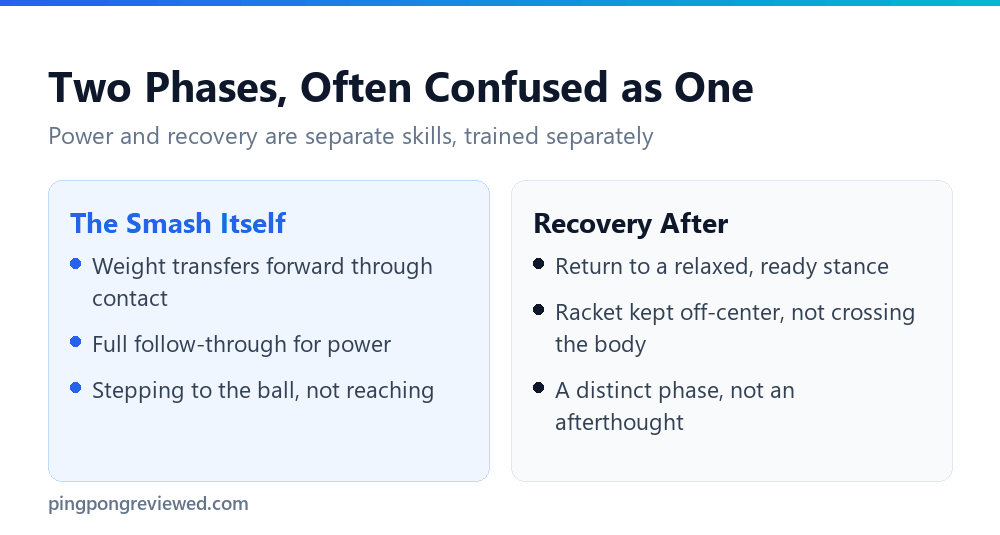
Table of Contents
Two Distinct Phases, Not One Continuous Motion
It’s worth separating the smash itself from its recovery as two distinct phases, since treating them as one continuous, unbroken motion is where a lot of the problem starts. During the smash, body weight should move forward through contact and the full follow-through, that forward weight transfer is exactly what generates the smash’s actual power. Recovery happens specifically AFTER that transfer completes, as its own distinct phase: returning to a ready stance, not an automatic byproduct of however the follow-through happens to end.
Treating recovery as a separate, deliberate phase rather than hoping it happens naturally is the actual mindset shift that improves it, since a player focused entirely on generating power through the smash itself often simply doesn’t allocate any attention to what happens in the moment immediately afterward.
The Ready Stance You’re Actually Returning To
The specific target position after any stroke, smash included, is the same general ready stance this site has already covered in detail elsewhere: a relaxed posture with the racket held at roughly a vertical angle, prepared equally for a forehand or backhand response to whatever the opponent plays next. This isn’t a different, smash-specific recovery position, it’s the same baseline ready position every shot in the sport eventually returns to, which is worth knowing since it means recovery practice and ready-position practice are, in a real sense, the same skill applied at a different moment in the rally.
The One Specific Technical Rule: Don’t Cross the Center
A precise, actionable detail worth remembering: the racket should not be allowed to cross the center of your own body during recovery. A racket that ends up crossed over to one side after a smash’s follow-through leaves you in a worse position to react quickly to a shot coming back to the OTHER side, since you’d need to travel further and reset more of your stroke mechanics before you could respond. Keeping the racket roughly centered, or at least not crossed past center, preserves your ability to react to either wing with comparable speed.
⚠️ Watch out: A smash with an exaggerated, wide follow-through that swings the racket well past your body’s center looks powerful, but it directly costs you recovery speed on the very next shot. Balance power against how quickly you actually need to be ready again.
Why Stable Smashes Recover Faster Than Reaching Ones
Recovery after a smash tends to be easier when the smash itself was balanced. A smash executed by stepping properly to the ball, with good footwork positioning your body correctly before contact, keeps you balanced throughout the stroke and its follow-through. A smash executed by reaching for the ball instead, because footwork didn’t get you into proper position in time, compromises balance from the start, which means recovery afterward has to fight against that imbalance rather than simply returning from a stable position.
Why This Matters More Against Strong Opponents
Against a weaker opponent who cannot reliably return a smash, a slow recovery may never be punished. Against a stronger opponent, a smash is more likely to come back, so your position for that next shot matters more. That is one reason recovery becomes more important as the level of competition rises, and why it is easy to under-practice at lower levels where it is tested less.
How Smash Type Changes the Recovery Challenge
Not every smash creates the same recovery challenge, and it’s worth distinguishing between a couple of common situations. A smash hit from close to the table, with a compact stroke and minimal follow-through extension, generally creates a fairly easy recovery back to the ready position, since the body never travels far from its starting stance in the first place. A smash hit off a wide ball, one requiring significant lateral footwork just to reach the shot at all, creates a meaningfully harder recovery challenge, since the player now has to both finish the follow-through AND travel back to a central, ready position before the next shot arrives.
This distinction matters practically: a player should expect and accept a slower recovery specifically after a wide-ball smash, rather than treating every smash as requiring an identically fast recovery regardless of how far they had to move to reach it in the first place. Recognizing this difference helps set realistic expectations for how quickly you can be ready again after different types of smashes.
Recovery in the Context of a Rally’s Broader Rhythm
It’s worth thinking about recovery not as an isolated technical detail but as part of the broader rhythm of an entire rally. A player who recovers well after every shot maintains a consistent, predictable positioning pattern throughout a long exchange, which in turn makes their OWN subsequent shots more reliable and better-positioned. Poor recovery on one shot doesn’t just risk that specific next point, it often creates a compounding effect where the player is now slightly out of position for the shot after that too, since they never fully returned to a proper baseline before the rally continued.
This compounding effect is one reason recovery is worth treating as a foundational skill rather than an advanced refinement: one instance of poor recovery can affect the shots that follow, not just the next one.
Practicing Recovery Deliberately
Since recovery is a distinct phase worth deliberate attention, it’s worth structuring practice specifically around it rather than only drilling the smash’s power and placement. A useful partner drill: after every smash, have your partner immediately return the ball regardless of shot quality, specifically forcing you to actually use your recovery position rather than assuming the point already ended. This trains the habit of treating recovery as mandatory after every single smash, not just the ones that happen to come back.
- ✓Treat recovery as a distinct, deliberately practiced phase after every smash
- ✓Return to the same relaxed ready stance covered in this site’s ready-position guide
- ✓Keep your racket from crossing your body’s center during the follow-through
- ✓Step to the ball for your smash rather than reaching, since stability starts there
- ✕Assume recovery happens automatically as a byproduct of a strong follow-through
- ✕Let an exaggerated, wide follow-through cross your racket well past your body’s center
- ✕Reach for a smash your footwork didn’t get you into position for
- ✕Skip recovery practice just because lower-level opponents rarely punish it
The Short Version, Restated
A smash isn’t finished when the ball leaves your racket, recovery back to a balanced, ready stance is the other half of the shot, and it starts with a stable, stepped-to smash in the first place, not with fast footwork after the fact. Keep the racket off center, return to the same ready position every shot eventually comes back to, and practice recovery as deliberately as you practice the power itself.
Mental Recovery Alongside Physical Recovery
Beyond the purely physical stance and racket positioning covered above, there’s a mental dimension to recovery worth acknowledging directly: a player who hits a powerful smash often has a brief, natural instinct to relax mentally, expecting the point is likely won. That mental relaxation, even if brief, can delay the physical recovery process just as much as poor footwork would, since a player who’s mentally already moved on to the next point is slower to actually execute the physical return-to-ready-position their body is otherwise capable of.
Treating every smash as though it will come back, regardless of how confident you feel about its quality, is an useful mental habit specifically because it keeps the physical recovery process moving immediately, rather than being delayed by a moment of premature mental relaxation.
Common Questions
What is the correct recovery position after a smash?
A relaxed, ready stance with the racket at roughly a vertical angle, prepared equally for a forehand or backhand response, the same general ready position used throughout the sport.
Why shouldn’t my racket cross the center of my body during recovery?
It leaves you in a worse position to react quickly to a shot coming back to the opposite side, since you’d need to travel further and reset more of your stroke mechanics.
Does recovery speed depend more on footwork after the shot or during it?
Both matter, but a smash played by stepping to the ball stays balanced throughout, which makes a quick recovery afterward easier.
Why does recovery matter more against stronger opponents?
Against weaker opponents a smash is more likely to end the point outright, while stronger opponents are more likely to return it, so your recovery position matters more.
How can I practice recovery deliberately?
Have a practice partner return every smash regardless of its quality, forcing you to actually use your recovery position rather than assuming the point already ended.
Does a smash off a wide ball require faster recovery than a close-to-table smash?
It requires the same target position, but expect it to take longer to reach, since you also have to travel back from wherever your footwork took you to reach the wide ball in the first place.
Can mental relaxation after a good smash actually slow my recovery?
It can. Expecting the point is already won may delay your physical return to the ready position, even if your footwork is otherwise capable of recovering quickly.
The Short Version
The smash generates the power; recovery is what actually lets you keep the point after it.
- →Recovery is a distinct phase after a smash, not an automatic byproduct.
- →Return to the same relaxed ready stance used throughout the sport.
- →Keep the racket from crossing your body’s center during follow-through.
- →Stable recovery starts with stepping to the ball, not reaching for it.
- →Recovery matters increasingly as opponent skill level rises.
- →Practice recovery deliberately with drills that force its actual use.

Ping Pong Reviewed is an equipment review site covering table tennis and baseball gear. Specifications are checked against manufacturer listings, and prices against live retail pages, before publication.