How to Play Against a Chopper in Table Tennis: 4 Steps
Losing to a chopper is a familiar frustration for attacking players, and published coaching advice on the matchup stresses patience and tactics over hitting harder against an opponent whose game is built around returning ball after ball.
This page walks through the full four-step approach, why patience specifically matters more than raw power, and how to keep adjusting as a skilled chopper adapts to whatever you try first.
Short answer: Identify the chopper’s rubber type first, vary your shot placement between deep and short to prevent them settling into rhythm, vary your spin deliberately since many inverted-rubber choppers find very heavy topspin hard to return, and above all be patient, waiting for real openings rather than forcing winners out of frustration. These are general coaching tactics, not guaranteed results against any particular opponent.
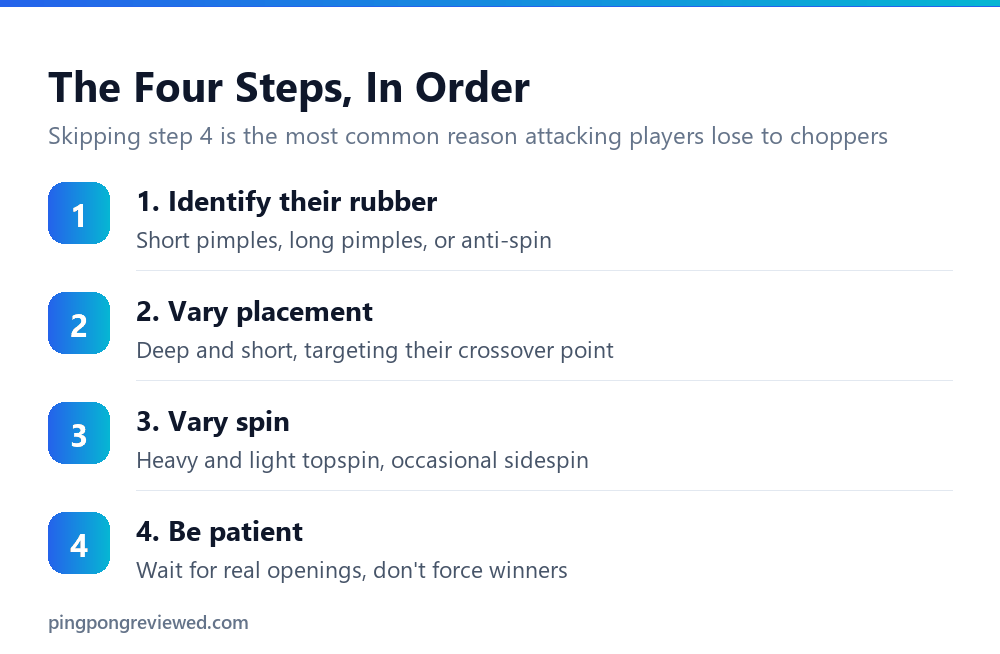
Table of Contents
Step 1: Identify What You’re Actually Facing
Not all choppers play the same way, and the correct counter-strategy depends on what rubber they’re using, something worth assessing specifically during warmup rather than guessing once the match starts. Short pimples, long pimples, and anti-spin rubber each produce meaningfully different backspin characteristics and different capacities for the chopper to vary their own spin output. A defender running long pimples, for instance, can produce unpredictable, low-effort variation just from the rubber’s own physical properties, which calls for a different reading approach than facing a chopper on conventional inverted rubber.
Step 2: Vary Placement to Break Their Rhythm
A widely taught placement strategy: alternate between long, deep shots and short balls, moving the chopper in and out relative to the table rather than settling into one comfortable rhythm. This serves two purposes simultaneously, it physically taxes a defender who has to cover more ground than an attacker standing in one general area, and it prevents them from settling into the steady, predictable chopping rhythm their entire defensive game depends on.
A related, specifically effective tactic: keeping a chopper close to the table early in a rally with short shots makes it harder for them to retreat back into their preferred, further-back chopping position later in that same rally. Choppers generally want distance from the table to have time to read and execute their defensive chop, denying them that distance early disrupts their whole game plan before it can even develop.
💡 Pro tip: Also target the chopper’s weaker side specifically, whichever wing that is, and aim at their crossover point (roughly their playing elbow) to force a difficult stroke decision, the same principle this site’s third-ball attack coverage already discusses for offensive placement generally.
Step 3: Vary Spin Deliberately, Not Randomly
Alternating between heavy and light topspin loops specifically disrupts a chopper’s rhythm and timing, since their return technique calibrates to whatever spin level they’re reading off your shot, a sudden change in that spin level, delivered with a similar-looking stroke, can catch them under- or over-compensating. Flat smashes are specifically effective against a HIGH chop return particularly, since a high, slow-arriving ball gives you the time and setup for a direct, powerful finish rather than needing to loop it. Occasional sidespin loops add a further layer of unpredictability on top of the primary heavy/light topspin variation.
Step 4: Patience, the Step That Is Easy to Skip
Coaching articles on this matchup repeatedly stress this step: the restraint to play a patient, systematic game rather than forcing winners out of frustration. A long rally against a well-executed chop can feel unproductive or even embarrassing for an attacking player used to ending points quickly, which creates real psychological pressure to force a premature, low-percentage winner rather than continuing to build toward a real opening.
⚠️ Watch out: A common way attacking players lose to choppers is impatience, forcing low-percentage winners out of frustration with a longer-than-expected rally, rather than continuing to apply placement and spin variation until a real opening actually presents itself.
Why This Requires a Different Mindset Than Attacking Play
It’s worth being explicit about why this matchup specifically demands a mindset shift for an attack-oriented player: against another attacker, rallies tend to be short and aggressive by mutual agreement, rewarding a fast, decisive playing style. Against a chopper, the entire game is structurally built around extending rallies and waiting for YOU to make a mistake first. Playing your normal, fast-paced game against that structure isn’t adapting to the actual matchup, it’s playing directly into the chopper’s own preferred conditions.
Reading Which Rubber a Chopper Is Actually Using
Since Step 1 depends on correctly identifying the chopper’s rubber before you’ve had extensive time to study it, it’s worth knowing a few practical visual cues beyond simply asking to inspect their racket during warmup, which is your own right under this site’s coverage of the racket inspection rule. Long pimples typically look visually distinct from smooth inverted rubber even from a short distance, a slightly textured, bumpy surface rather than a flat, glossy one. Watching how the ball behaves off their racket during the warmup rally itself is equally informative: unusually erratic, low-bouncing returns often indicate long pimples or an anti-spin surface, while more conventional, consistent heavy backspin suggests standard inverted rubber used in a classic chopping style.
Taking the warmup period seriously specifically for this diagnostic purpose, rather than treating it as a purely physical loosening-up period, is an underused advantage available to any player facing an unfamiliar chopper for the first time.
How Long a Rally Against a Chopper Should Actually Take
It’s worth setting a realistic mental expectation before the match starts: rallies against a skilled chopper routinely run considerably longer than rallies between two attacking players, and that’s not a sign the strategy covered here is failing, it’s the expected, normal shape of this specific matchup. A player who mentally braces for extended rallies in advance is meaningfully less likely to feel the frustration that Step 4’s patience requirement is specifically designed to guard against, simply because the longer rally length matches their own expectations rather than violating them.
What a Real Opening Looks Like
Since patience is emphasized so heavily, it’s worth being concrete about what you’re actually patient FOR, rather than treating patience as passively waiting indefinitely. A real attacking opportunity against a chopper typically shows up as a shot that comes back noticeably higher, shorter, or with noticeably less backspin than the chopper’s typical return, a sign their positioning, timing, or technique broke down slightly on that specific ball. Recognizing and immediately capitalizing on that specific moment, rather than either forcing an attack prematurely or passing up a real opening out of excess caution, is the actual skill patience is building toward.
- ✓Assess the chopper’s rubber type during warmup before the match starts
- ✓Alternate deep and short shots deliberately to prevent rhythm and force movement
- ✓Use flat smashes specifically against high chop returns, not every return
- ✓Practice patience deliberately, since it is easy to lose under frustration
- ✕Rely on raw power alone without spin variation against a defensive player
- ✕Force low-percentage winners out of frustration with a longer rally
- ✕Play the same fast, aggressive rhythm you’d use against another attacker
- ✕Let the chopper settle into a comfortable rhythm by hitting predictably to the same spot
The Short Version, Restated
Beating a chopper is a systematic process, not a single trick shot: identify their rubber, vary your placement to break their rhythm and physically challenge them, vary your spin since very heavy topspin troubles many inverted-rubber choppers, and above all stay patient enough to wait for a real opening rather than forcing one prematurely.
Approach it as an ongoing tactical conversation across the whole match, not a fixed script decided before the first serve, and the frustration that can cost attacking players this matchup becomes easier to manage.
Adjusting Strategy Mid-Match
A chopper who’s losing points to a specific tactic will often adjust their own positioning or technique partway through a match, which means the four-step strategy covered here isn’t a fixed formula to apply identically for an entire match, it needs re-evaluation as the chopper adapts. If a particular placement pattern or spin variation that worked well early in a match starts producing less effective returns, that’s a signal the chopper has adjusted to it, and it’s worth deliberately shifting emphasis to a different element of the four-step approach rather than persisting with a tactic that’s no longer producing the same results it did earlier.
This ongoing adjustment is part of what makes playing against a skilled chopper a different mental exercise than playing against another attacker, it rewards active, ongoing tactical reading throughout the match rather than executing a single fixed game plan decided before the first serve.
Common Questions
What’s the best strategy against a chopper in table tennis?
A four-step approach: identify their rubber type, vary shot placement between deep and short, vary spin deliberately (very heavy topspin troubles many inverted-rubber choppers), and stay patient. This is general coaching advice, not a guaranteed result.
Why does patience matter so much against a chopper?
Long rallies against a chopper can frustrate attacking players into forcing low-percentage winners prematurely, which coaching articles on this matchup warn against.
Does hitting harder beat a chopper?
Not on its own. Many inverted-rubber choppers struggle more against very heavy topspin than against raw power, and an unvaried hard, flat attack can be easier for them to read and return consistently.
Where should I aim my shots against a chopper?
Their weaker side, whichever wing that is, and their crossover point (roughly the playing elbow), alternating deep heavy shots with short balls to prevent rhythm.
Why does the chopper’s rubber type matter?
Short pimples, long pimples, and anti-spin rubber each produce different backspin and spin-variation behavior, requiring different reading and counter-strategy.
How long should a rally against a chopper typically last?
Considerably longer than a rally between two attackers, that’s the normal, expected shape of this matchup, not a sign your strategy is failing.
Should I keep using the same tactic if it stops working mid-match?
No, a chopper who adapts mid-match calls for you to shift emphasis to a different element of the strategy rather than persisting with a tactic that’s no longer effective.
The Short Version
- →Identify the chopper’s rubber type during warmup before the match.
- →Vary placement between deep and short to prevent rhythm and force movement.
- →Vary spin deliberately, since many inverted-rubber choppers struggle against very heavy topspin.
- →Use flat smashes against high chops, not as a default response.
- →Patience is easy to skip under frustration, and coaching articles on this matchup stress it.
- →Playing your normal fast rhythm against a chopper plays into their preferred conditions.

Ping Pong Reviewed is an equipment review site covering table tennis and baseball gear. Specifications are checked against manufacturer listings, and prices against live retail pages, before publication.