Block vs Counter-Loop in Table Tennis: When to Use Each
When an opponent’s loop comes at you fast, you have two different families of response available, and they trade off against each other in a way that’s worth understanding explicitly rather than picking whichever one happens to feel natural in the moment.
This page outlines how each shot works, the four counterloop types described by coach Larry Hodges, and how his article says a blocker can use a counterloop.
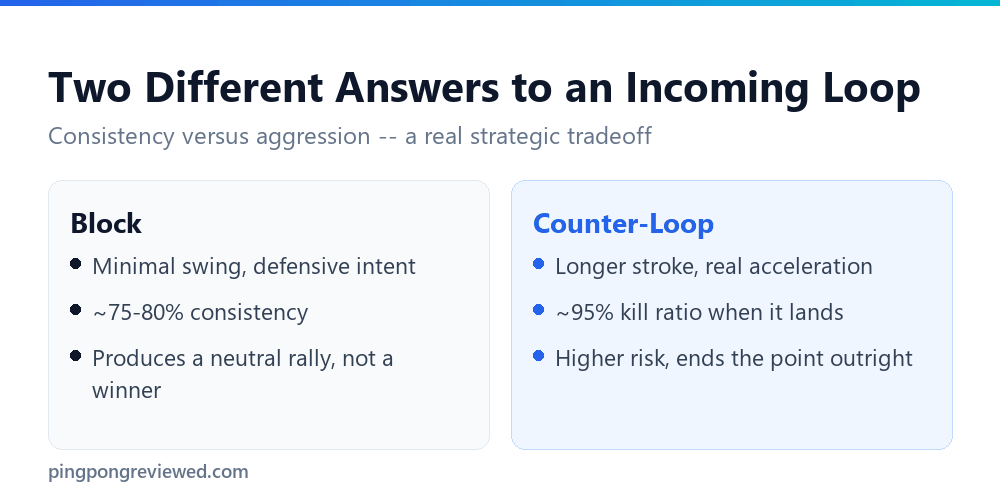
Short answer: A block is a minimal-swing shot aimed at keeping the ball in play. A counter-loop answers an opponent’s loop with a loop of your own: a longer, faster stroke that is riskier to execute but more aggressive. Choosing between them is a tradeoff between consistency and aggression.
Table of Contents
The Block: Minimal Swing, Lower Risk
A block is exactly what it sounds like: a short, controlled stroke with minimal backswing, designed to redirect an incoming loop back over the net using the incoming ball’s own speed and spin rather than generating significant new power of your own. This generally makes it the lower-risk option, but that comes at a cost: a block typically produces a neutral continuation of the rally rather than winning the point outright.
Blocking is the natural default for close-to-the-table players specifically, since its minimal swing requires less time and space to execute than a full counter-loop stroke, which matters enormously when you’re standing close enough to the table that an incoming loop leaves very little reaction time.
The Counter-Loop: Higher Risk, More Aggressive
A counter-loop takes the opposite approach: rather than simply redirecting the incoming ball, it meets an opponent’s loop with a loop of your own, requiring a longer stroke with real acceleration built into it. The payoff for that added risk and difficulty is a more aggressive shot. Larry Hodges calls counterlooping an important part of most top players’ games.
The core technical principle, from Larry Hodges at tabletenniscoaching.com, is “Stroke forward, not up!” He says many players learn to loop against backspin first and carry the upward stroke into counterlooping. Although you stroke slightly up on most counterloops, he says the primary direction is forward, with contact on the top of the ball, a little toward the back, driving mostly forward.
Four Counter-Loop Sub-Types, by Contact Timing
Counter-looping isn’t one single technique. Larry Hodges describes four types, based mainly on when in the ball’s bounce contact happens:
The source calls the off-the-bounce counterloop the most aggressive of the four and a very tricky shot that takes a lot of timing and anticipation, but one that almost always wins the point outright. The defensive type sits at the other end: played from well off the table, slow but spinny.
When to Block and When to Counterloop
The guidance in the Hodges article is situational. He says that if looping is your strength you should incorporate counterlooping into your game as much as possible, and that even a player who normally blocks close to the table benefits from a counterloop against a weak loop, rather than continuing to block or going for an erratic smash. He adds that you should only loop off the bounce when you expect a relatively weak loop. As general advice rather than something the source states, blocking is the lower-risk answer to a fast, well-placed loop.
💡 Pro tip: A useful in-match heuristic: if you’re not confident you can counter-loop a specific incoming shot safely, block it instead. A reliable neutral continuation beats a low-percentage attempt at ending the point, since a missed counter-loop simply hands the point away outright.
Why Even a Blocking-Style Player Needs a Counter-Loop
Hodges makes this point directly: even if you normally play a close-to-the-table blocking game, a good counterloop lets you counter-attack consistently against a weak loop, rather than continuing to block or going for an erratic smash.
One way to think about it is blocking as the default answer and counter-looping as an option against weaker loops.
- ✓Default to blocking against fast, well-placed, high-quality loops
- ✓Look for counter-looping opportunities specifically against weaker, less committed loops
- ✓Practice the four counter-loop contact timings separately to understand each one’s risk level
- ✓Develop both shots even if your overall style leans toward one or the other
- ✕Attempt a counter-loop against a shot you’re not confident you can handle safely
- ✕Assume counter-looping is simply a “better” version of blocking to switch to permanently
- ✕Neglect developing a counter-loop just because your game is otherwise defensive
- ✕Use the same contact timing for every counter-loop regardless of the incoming shot’s pace
The Physical Demands Behind Counter-Looping
Hodges describes counterlooping as normally a very physical shot, and says when to use it depends on your physical agility, how strong your loop is and your playing style. A block’s minimal swing asks less of the body than a longer, accelerating stroke, though the source does not quantify the difference.
The Short Version, Restated
Blocking and counter-looping answer the same problem, an incoming loop, with different risk profiles: a block is the more conservative answer and a counter-loop the more aggressive one. Neither is objectively superior, and the source says the choice depends on your loop, your physical agility and your style.
A reasonable place to start experimenting is the consistent counterloop, which Hodges calls the most common type.
Where to Start With a Counter-Loop
The Hodges article does not lay out a practice progression. It assumes the reader already has a decent forehand loop with relatively good technique, and it calls the consistent counterloop the most common type. As a general suggestion, not a claim from the source, a player could try the consistent type first, since the source describes the off-the-bounce type as very tricky and the aggressive type as one for when you have time to wind up.
Common Questions
What’s the difference between a block and a counter-loop?
A block is a short, minimal-swing shot aimed at keeping the ball in play. A counter-loop is a longer, faster stroke that answers a loop with a loop; it is riskier and more aggressive.
Which is more consistent, blocking or counter-looping?
Blocking is generally the lower-risk option, while counter-looping is more aggressive and harder to execute.
Should I always counter-loop instead of block?
No. Whether to counterloop depends on your loop, your physical agility and your style. The example the source gives is a blocker counter-attacking a weak loop.
What does “stroke forward, not up” mean for a counter-loop?
It’s the core principle in Larry Hodges’ counterlooping article: the primary direction of the stroke is forward, with contact on the top of the ball a little toward the back, rather than stroking upward as you would against backspin.
Which counter-loop sub-type should I learn first?
The source does not prescribe an order. It calls the consistent counterloop, with contact after the top of the bounce but before the ball drops below table level, the most common type.
Is counter-looping physically demanding?
Larry Hodges describes counterlooping as normally a very physical shot, and says when to use it depends on your physical agility, how strong your loop is and your playing style.
The Short Version
Consistency and aggression, in one shot each, the real skill is knowing which one a given incoming ball actually calls for.
- →A block uses minimal swing for high consistency but a neutral outcome.
- →A counter-loop uses a longer, accelerating stroke and is the more aggressive, riskier shot.
- →Larry Hodges describes four counterloop types, based on contact timing relative to the bounce.
- →The core counter-loop principle (Hodges): stroke forward, not up, contacting the top of the ball a little toward the back.
- →Even a close-to-the-table blocker can counter-attack a weak loop (Hodges).
- →Many players use both, choosing situationally.

Ping Pong Reviewed is an equipment review site covering table tennis and baseball gear. Specifications are checked against manufacturer listings, and prices against live retail pages, before publication.