Nittaku Acoustic Review: A Bare Blade, Honestly Explained
Nittaku Acoustic is the one product in this batch that’s neither a rubber nor a complete paddle, it’s a bare blade, sold without rubber, meant to be paired with a sheet the buyer chooses separately. That distinction matters enough to state directly before anything else, since a buyer expecting a ready-to-play paddle would be surprised.
What follows is independently corroborated specifications and community pairing guidance, with one honest gap disclosed directly: this review could not confirm a reliable current price for the blade itself.
📊 Note: What this review is. We have not logged hours with this blade, and we’re not going to describe a feel we haven’t felt. What follows is verified product-type classification, documented specifications, and community-sourced pairing guidance, not a claimed hands-on verdict.
⚠️ Watch out: This is a bare blade, not a complete paddle. You will need to separately purchase and mount rubber on both sides before it’s playable. If you want a ready-to-play paddle instead, see this site’s Palio Master 2.0 or STIGA Titan reviews.
Table of Contents
What Makes This a “String Instrument” Blade
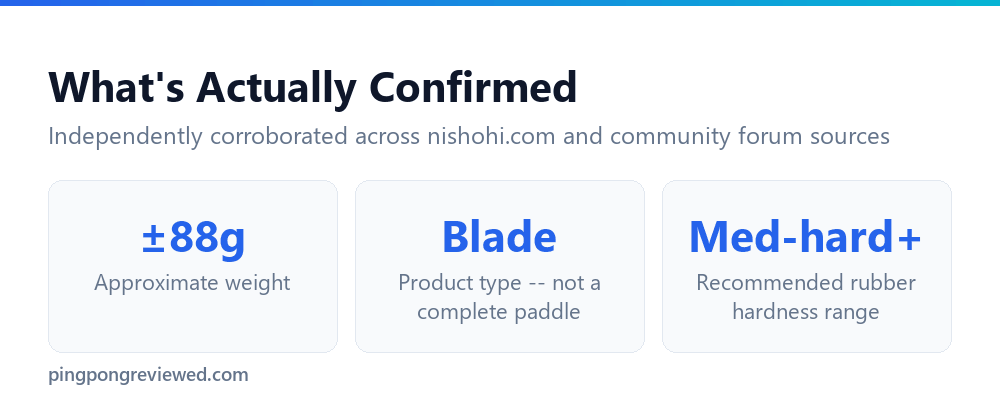
Independent sources describe Acoustic’s construction as specifically inspired by string-instrument-making principles, using materials that are thicker and softer than those in Nittaku’s own Violin blade, a related product in what appears to be an intentional, music-themed naming family within Nittaku’s blade lineup. That thicker, softer construction is credited with giving Acoustic stable characteristics for both attacking and blocking play, rather than optimizing narrowly for one style.
Weight is documented at approximately ±88g, a figure worth noting comes with an explicit tolerance range rather than a single fixed number, consistent with natural variation in wood blade construction generally, where no two blades from the same model are perfectly identical in weight.
Acoustic vs. Violin: Two Blades, One Naming Theme
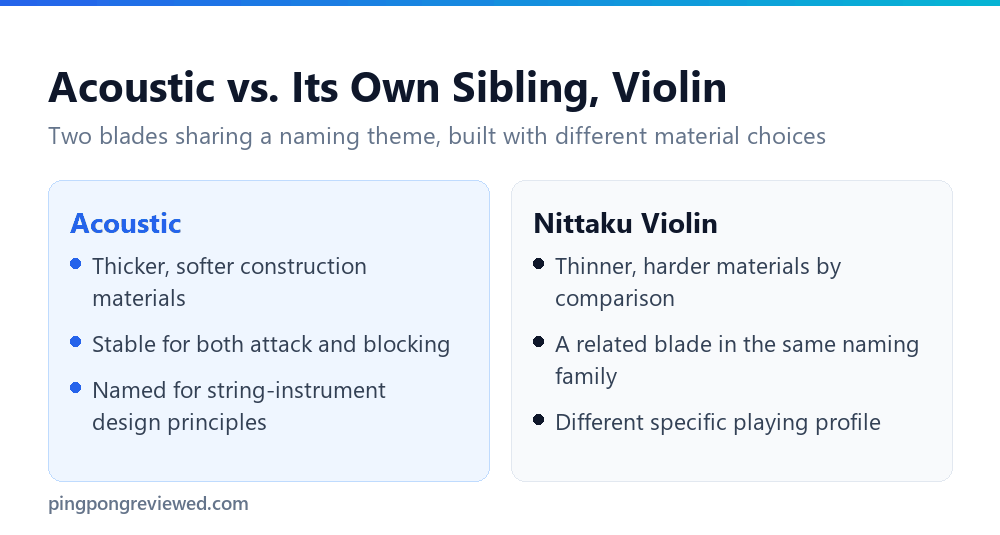
The comparison to Nittaku’s own Violin blade is directly sourced, not this site’s own invention, multiple independent sources describe Acoustic’s materials as thicker and softer specifically relative to Violin, which implies Violin is built thinner and harder within the same broad string-instrument design concept. That’s a useful reference point for a buyer trying to understand where Acoustic sits within Nittaku’s own blade family, even without this review independently verifying Violin’s own full specifications.
What Rubber Actually Pairs Well With It
Independent community sourcing, specifically forum discussion threads dedicated to this exact pairing question, consistently recommends medium-hard to hard rubbers for Acoustic, with Nittaku’s own Fastarc G-1, already reviewed on this site, specifically named as a strong match. That’s an useful, concrete recommendation rather than generic pairing advice, and it comes from the same community discussion this site’s verification discipline treats as legitimate corroborating evidence when multiple independent threads agree.
This pairing recommendation also gives this review a natural, well-grounded cross-reference: a buyer building a full setup around Acoustic has a real, community-vetted starting point rather than needing to guess at a compatible rubber from scratch.
📊 Note: Community pairing recommendations like the Fastarc G-1 match named here come from forum discussion among players who’ve actually tried the combination, which this site treats as a legitimate corroborating source when multiple independent threads agree, distinct from a single unverified claim.
Who Nittaku Acoustic Is Actually For
- ✓You want to build a custom setup with your own chosen rubber
- ✓You value a blade with a stable, all-round attack-and-block profile
- ✓You’re comfortable with the water-based gluing process rubber mounting requires
- ✓You want to pair it with Fastarc G-1 or a similarly medium-hard to hard rubber
- ✕You want a ready-to-play paddle without separate rubber shopping
- ✕You’re a complete beginner not yet ready to research rubber pairings
- ✕You need a confirmed current price before deciding, check directly first
- ✕You want a soft-sponge, control-first rubber pairing without further research
That kind of grounded, real-player pairing advice is a genuine asset for a bare-blade purchase specifically, since there’s no single manufacturer-sanctioned rubber recommendation the way a pre-assembled paddle already answers for you by default.
The Price Gap, Disclosed Directly
Unlike every other product in this site’s rubber and paddle reviews, this review could not confirm a reliable, current price for Acoustic across the sources checked. Rather than estimate or carry over a price from an unrelated product, that gap is stated plainly here: check current pricing directly with Nittaku’s distributors, Paddle Palace (which carries Nittaku’s rubber lineup and likely their blades), or established specialist retailers before making a purchase decision based on price.
⚠️ Watch out: This review does not state a price for Nittaku Acoustic because no reliably corroborated current figure was found. Confirm pricing directly with a retailer before buying.
Buying and Assembling It
As a bare blade, Acoustic requires the standard rubber-mounting process any custom setup uses: choosing rubber for each side (potentially different sheets for forehand and backhand, a common practice this site’s rubber reviews have covered repeatedly), then gluing with the modern water-based process, spread thin on both blade and rubber, let both go touch-dry, then lay the sheet down from one edge to avoid trapping air. This is a meaningfully more involved purchase process than any pre-assembled paddle in this batch, appropriate for a buyer who already knows they want that level of control over their setup.
The Amazon Listing Discrepancy, Explained
A real Amazon listing exists for a product titled “Nittaku Acoustic CBLG,” which calls itself a “Table Tennis Racket” in its own title, language that conflicts with the “blade” classification used consistently by nishohi.com and the community forum sources this review relies on for pairing guidance. Rather than pick one label and ignore the contradiction, it’s worth stating both directly: it’s plausible the Amazon listing is using “racket” loosely to describe the blade component alone, which is a common, if imprecise, habit in marketplace listings generally.
This is the same kind of labeling looseness this site flagged directly in its Sportout review, where a product listing’s own language didn’t necessarily match the more precise terminology serious players and independent reviewers use. The practical guidance is the same here: confirm directly with the seller whether a specific listing includes mounted rubber or ships as a bare blade before completing a purchase, rather than assuming either way based on a listing title alone.
Why This Site Is Reviewing a Bare Blade At All
Every other product in this site’s second-tier product-review batch has been either a rubber sheet or a complete, pre-assembled paddle. Acoustic breaks that pattern deliberately, since the content gap board’s own competitor analysis surfaced it specifically as a named product gap, and a legitimate, community-discussed blade deserves the same verification treatment as any rubber or paddle this site covers, including being upfront when its product category itself required more clarification than usual before writing anything else about it.
That’s worth stating directly because it reflects this site’s broader approach across this entire product-review campaign: verify what a product actually is before describing what it does, since getting the basic classification wrong would undermine everything built on top of it, regardless of how accurate the rest of the review turned out to be.
Understanding the Weight Tolerance
The ±88g figure, with its explicit plus-or-minus notation, is worth explaining for readers less familiar with how wood blade manufacturing actually works. Natural wood plies vary slightly in density and moisture content even within the same production batch, which means individual blades of the identical model do vary in weight by a small, expected margin rather than being manufactured to an exact, identical gram figure the way a machined metal or plastic product might be.
That’s a normal, expected characteristic of wood blade construction generally, not a quality inconsistency specific to Acoustic. A buyer purchasing from a retailer that allows weight selection can sometimes request a blade toward either end of that tolerance range if a specific target weight matters for their setup, though this review didn’t independently confirm which specific retailers offer that option for this particular blade.
How This Affects a Buyer’s Total Cost
It’s worth being direct about what buying a bare blade actually costs compared to a pre-assembled paddle like this site’s Palio Master 2.0 or STIGA Titan reviews cover. The blade itself is only one part of the total purchase, two sheets of rubber (this site’s Fastarc G-1 review confirms that specific pairing at $39.95 per sheet, meaning roughly $80 for both sides) get added on top of whatever the blade itself costs, plus glue if not already on hand. A custom build like this is very likely a larger total investment than any single pre-assembled paddle this batch has covered, which is worth budgeting for realistically before committing to the bare-blade path.
That total-cost reality is exactly why this review recommends the bare-blade path specifically for buyers who already know they want that level of control, rather than as a default starting point for anyone newer to the sport still figuring out their preferences.
None of this needs to feel discouraging if a custom build is what you’re after. It just means going in with an honest budget and a real rubber pairing plan, rather than discovering the total cost only after the blade itself has already arrived.
Common Questions
Is Nittaku Acoustic a complete paddle or a bare blade?
A bare blade. It doesn’t come with rubber, you’ll need to separately choose and mount rubber on both sides.
What rubber pairs well with Nittaku Acoustic?
Medium-hard to hard rubbers, with Nittaku’s own Fastarc G-1 specifically named as a strong pairing across independent community sources.
How much does Nittaku Acoustic cost?
This review could not confirm a reliable current price. Check directly with a Nittaku retailer or distributor before buying.
What does the ‘string instrument’ construction actually mean?
Acoustic uses thicker, softer materials than Nittaku’s related Violin blade, aimed at stable performance for both attacking and blocking play.
Is Nittaku Acoustic good for beginners?
Generally not as a first purchase, since it requires separately researching and mounting rubber, a bigger commitment than a pre-assembled beginner paddle.
That’s the real service this review can offer: not a false price figure to fill a gap, but an honest map of what this specific blade is, what it pairs with, and what deciding to buy it actually commits you to.
The Verdict
The short version: Nittaku Acoustic is a bare blade built around string-instrument construction principles, offering a stable, all-round attack-and-block profile at approximately ±88g. It pairs well with medium-hard to hard rubbers, with Fastarc G-1 specifically recommended by independent community sources. This review could not confirm a current price, check directly before buying. Verified across multiple independent sources on 6 September 2026.
- →A bare blade, not a complete paddle, rubber must be added separately.
- →Built with thicker, softer materials than Nittaku’s own Violin blade.
- →Approximate weight of ±88g, with natural per-unit variation.
- →Pairs well with medium-hard to hard rubbers, especially Fastarc G-1.
- →No reliable current price confirmed, check directly with a retailer.
- →A custom build costs meaningfully more in total than a pre-assembled paddle.
So the closing question is about readiness, not price: are you prepared to research and mount your own rubber choice, or would a complete, pre-assembled paddle serve your current stage of the game better?
Buying a bare blade is, at its core, an admission that you know specifically what you want and are willing to assemble it yourself. That’s a legitimate, common path in this sport, and Acoustic is a legitimate, community-vetted option within it, just not the simplest first purchase for someone still figuring out their own preferences.

Benjamin Fink is the Lead Equipment Analyst and Senior Contributor at Ping Pong Reviewed. A competitive USATT tournament player and table tennis technician with over 12 years of testing experience, Benjamin specializes in blade carbon composite physics, rubber sponge durometer hardness testing, ITTF equipment compliance, and table tennis robotics mechanics.