Nittaku Fastarc G-1 Review: What ‘Grip First’ Really Costs
The “G-1” in Fastarc G-1 isn’t a random model number, it stands for “Grip First,” a real, documented naming convention that tells you exactly what this rubber prioritizes before you even check a single spec. This page verifies what that priority actually costs and delivers.
What follows is Megaspin’s own published specifications, current retail pricing, and an honest comparison against this site’s reference rubber. Not a claimed hands-on verdict.
📊 Note: What this review is. We have not logged hours on this sheet, and we’re not going to describe a feel we haven’t felt. What follows is verified pricing, a retailer’s published specification numbers, and the buying decisions that follow from them.
Table of Contents
What Fastarc G-1 Costs Right Now
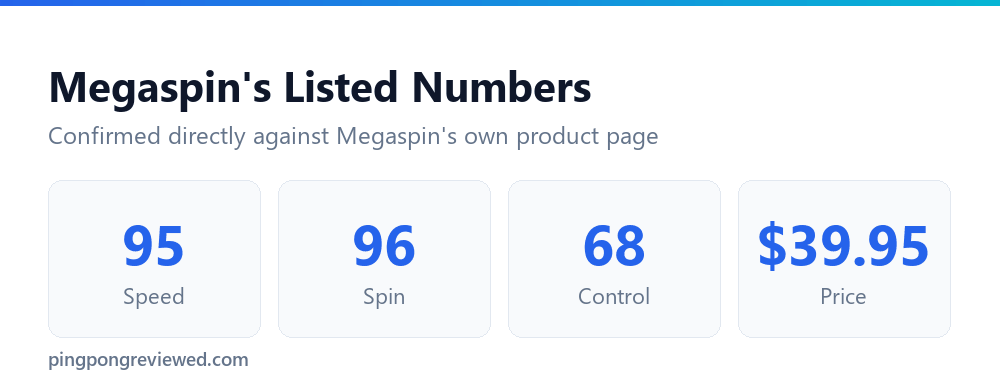
Megaspin currently lists Fastarc G-1 at $39.95, marked down from a $49.95 list price. It’s available in Red and Black, across 1.4mm, 1.8mm, 2.0mm, and Max thicknesses, though the thinner Red options show as out of stock at time of writing.
Fastarc G-1 is listed on Amazon alongside Megaspin and other established retailers.
What “Grip First” Actually Means
Nittaku’s own naming for the Fastarc series is direct and informative rather than arbitrary marketing: G-1 stands for “Grip First,” and independently corroborated sources describe it as the most direct and stable of the three Fastarc variants. The related S-1 in the same series is positioned to emphasize speed instead, which means the naming convention itself tells a buyer which trade-off each variant makes before checking a single number.
That’s an useful naming system, worth calling out directly since it’s rarer than it should be in this industry, most rubber names (Evolution, Dignics, Hybrid, Baracuda) require checking the spec sheet to learn anything about the actual playing character, while Nittaku’s Fastarc naming states the priority upfront.
The Official Specifications
The control figure is worth flagging directly: at 68, it’s the lowest among the rubbers this site has verified so far, reflecting an aggressive, output-first design rather than a balanced all-rounder. Combined with the “Grip First” naming, this paints a consistent picture of a rubber built to maximize grip-driven output at some real cost to forgiveness.
How It Actually Compares to Tenergy 05
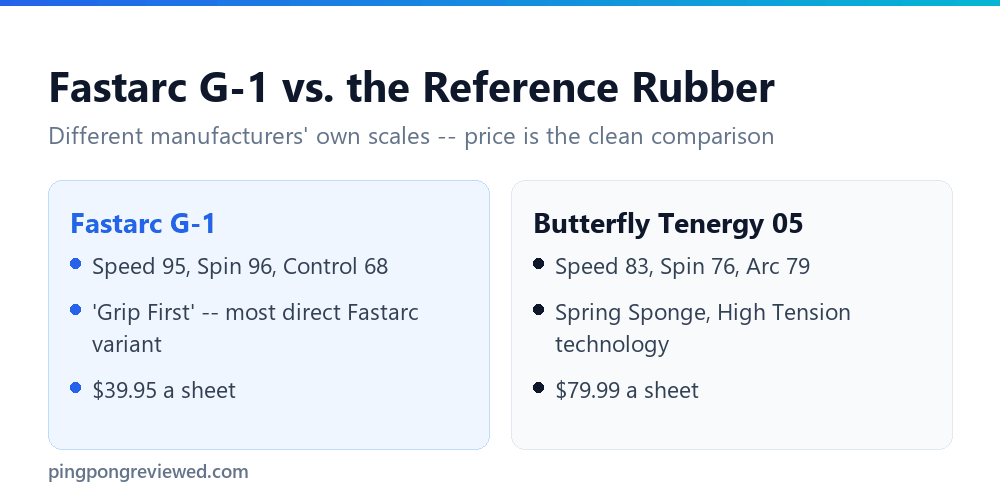
The control gap is the more informative comparison here. Fastarc G-1’s 68 control figure, on its own retailer’s scale, reads as more aggressive and less forgiving than what this site’s Tenergy 05 review would suggest for that rubber’s balance, consistent with the “Grip First,” output-focused design philosophy this specific Fastarc variant is built around.
Who Fastarc G-1 Is Actually For
- ✓You want a grip-focused, output-first rubber at a genuine discount price
- ✓You already generate real racket speed and want maximum spin and speed together
- ✓You’re comparing Japanese rubber technology against Chinese or German alternatives
- ✓You’re taking advantage of the current markdown from list price
- ✕You’re a beginner still building a consistent stroke
- ✕You want a more balanced, control-friendly all-rounder
- ✕You mostly play a controlled, defensive, or blocking game
- ✕You want the S-1 variant’s speed-first character instead
💡 Pro tip: If “Grip First” sounds right for your game but the low control figure gives you pause, consider starting at a thinner thickness like 1.8mm or 2.0mm rather than Max, to ease into this rubber’s aggressive character.
Thickness Options
Fastarc G-1 spans four thicknesses, 1.4mm, 1.8mm, 2.0mm, and Max, a wider range than several premium rubbers covered on this site offer. The thinnest 1.4mm option is unusual to see still available and suits players wanting this rubber’s grip character with meaningfully more control than the thicker options provide.
- Max maximizes the speed and spin this rubber’s sponge is built to deliver.
- 2.0mm is a reasonable middle ground for most attacking players.
- 1.8mm and 1.4mm trade real output for control, worth considering for a backhand or a player easing into this rubber’s aggressive character.
Buying It Alongside a Blade
Given Fastarc G-1’s medium-hard sponge and grip-focused design, it generally pairs well with a stiff offensive blade, following the same general principle as any hard-sponge attacking rubber covered on this site. Its notably low control figure specifically argues for a blade with reasonable inherent control of its own, to help offset the rubber’s own aggressive, less forgiving character.
How the Discount Changes the Value Picture
It’s worth being direct about the current markdown, since a reduction from $49.95 to $39.95 is a genuine, meaningful discount, roughly 20% off list, not a rounding difference. At full list price, Fastarc G-1 would sit closer to the mid-tier pricing this site has documented for rubbers like Donic Baracuda and Bluefire M2. At the current discounted price, it undercuts that tier meaningfully, which is worth knowing both because prices change and because it explains why this specific review leads with price as a genuine selling point rather than treating $39.95 as the rubber’s fixed, permanent value position.
Retailers running rubber discounts isn’t unusual, and it’s worth checking current pricing directly before assuming either the list price or the discounted price is what you’ll actually pay at checkout. This review states both figures specifically so that distinction is clear rather than presenting only the currently favorable number.
The Fastarc Family Beyond G-1
Nittaku’s Fastarc series extends beyond G-1 specifically, with the S-1 variant positioned to emphasize speed over the grip priority G-1 is built around. Independently corroborated sources describe G-1 as the most direct and stable of the series’ members, which implies at least one other variant beyond S-1 exists within the same naming convention, though this review doesn’t assert specific verified numbers for those other variants since they weren’t independently confirmed in this session.
Knowing the family exists is useful context even without full verified specs for every member: a player who tries G-1 and finds its low control figure too aggressive for their game has a documented, named alternative within the same manufacturer and core technology to investigate next, rather than needing to switch brands entirely to find a different balance point.
Why Grip-First Rubbers Trade Away Control
It’s worth explaining the actual mechanism behind Fastarc G-1’s low control figure, since it’s not simply a marketing label attached arbitrarily. A rubber prioritizing grip, maximizing how firmly the topsheet holds the ball during contact, generally produces more spin and a more dramatic, harder-to-predict trajectory than a more control-balanced rubber, precisely because that extra grip amplifies whatever spin and pace the player’s own stroke puts into the shot. More amplification of input means less margin for error if that input isn’t precise, which is the direct mechanical reason a grip-first design trades away some of the predictability a more balanced rubber offers.
This is the same underlying trade-off covered across several other rubbers on this site, Donic Baracuda’s speed-glue-effect topsheet, DHS Hurricane 3’s tackiness, expressed through Nittaku’s own specific engineering approach and stated plainly in the “Grip First” name itself rather than requiring a spec sheet to infer.
Gluing and Care
Fastarc G-1 uses the same modern, water-based gluing process as any current inverted rubber, spread thin on both blade and rubber, let both go touch-dry, then lay the sheet down from one edge to avoid trapping air underneath it. No special process applies specifically to the grip-focused topsheet.
Storage and care follow standard practice for any medium-hard tensor rubber: keep it covered with its protective film between sessions, avoid heat and direct sunlight, and expect gradual performance decline over months of regular use as the sponge and topsheet naturally age.
Counterfeits and Where to Buy It
Nittaku carries established brand recognition in the sport, particularly in Japan and among serious competitive players internationally, which makes its popular rubbers a target for counterfeiting the same way any well-known brand’s products are. Buying from Megaspin, Nittaku’s own distribution, an established table tennis retailer, or a reputable Amazon listing with genuine seller history reduces that risk meaningfully compared to an unfamiliar marketplace seller.
⚠️ Watch out: A Fastarc G-1 listing priced well below the currently discounted $39.95 is worth treating with real skepticism. Check seller reputation and packaging carefully before gluing anything to a blade.
A Worked Example
Picture two players with similar attacking styles, one on Fastarc G-1 and one on a more balanced, higher-control rubber like Tenergy 05. Against a clean, well-timed loop, the G-1 player’s shot carries noticeably more bite and pace, a direct result of the grip-first topsheet amplifying their stroke. Against a slightly mistimed or off-center contact, though, the G-1 player’s margin for error is smaller, the same amplification that rewards a clean stroke also punishes an imperfect one more severely than a higher-control rubber would.
That trade-off is exactly what the control figure of 68 is quantifying, and it’s worth weighing honestly against your own actual consistency under match pressure, not just your best-case practice-session form.
That honest self-assessment matters more here than for most rubbers this site has reviewed, precisely because Fastarc G-1’s own name already told you what it’s optimizing for before you ever checked a number.
Common Questions
How much does Nittaku Fastarc G-1 cost?
Megaspin currently lists it at $39.95, marked down from a $49.95 list price.
What does the ‘G-1’ in Fastarc G-1 mean?
It stands for ‘Grip First,’ Nittaku’s own naming for this specific variant’s priority within the broader Fastarc series.
Is Fastarc G-1’s control rating low compared to other rubbers?
Yes, at 68 it’s the lowest control figure among rubbers independently verified on this site so far, reflecting an aggressive, output-first design.
Is Nittaku Fastarc G-1 good for beginners?
Generally not. Its medium-hard sponge and grip-focused, lower-control design reward an already-developed, committed stroke.
How does Fastarc G-1 compare to Tenergy 05 on price?
At its current discounted price, Fastarc G-1 costs about half of Tenergy 05’s $79.99.
A rubber that tells you exactly what it trades away, right in its own model name, earns a level of trust most marketing copy never bothers to.
The Verdict
The short version: Nittaku Fastarc G-1 is a grip-and-output-focused attacking rubber, currently discounted to $39.95, with the lowest control figure this site has verified so far, a real, honest trade-off consistent with its own “Grip First” naming. It rewards an already-developed, committed stroke rather than a forgiving, all-around game. Verified directly against Megaspin’s own listing on 6 September 2026.
- →Megaspin’s listing: Speed 95, Spin 96, Control 68 at $39.95 (discounted).
- →‘G-1’ stands for ‘Grip First’, a documented, informative naming convention.
- →The lowest control figure among rubbers verified on this site so far.
- →About half the price of Tenergy 05 at the current markdown.
- →Available across four thicknesses, from 1.4mm up to Max.
So the closing question is direct: does your stroke already generate the speed and commitment this grip-first, lower-control rubber is built to reward, at a genuine discount price right now?
Few rubbers on this site make their intended trade-off this explicit before you’ve read a single number. That honesty in naming is worth as much as the discount itself.
As an Amazon Associate, we earn from qualifying purchases through links on this page.

Ping Pong Reviewed is an equipment review site covering table tennis and baseball gear. Specifications are checked against manufacturer listings, and prices against live retail pages, before publication.