
Are Long Pimples Necessary for Defenders? No, Here’s Proof

No, long pimples are not necessary to play a defensive, chopping style, and the sport’s own history proves it directly: successful elite defenders have built careers both with and without them. Long pimples are a strong, popular tool for the style, not a requirement baked into what it means to be a defender.
Short answer: No. Long pimples add a genuine spin-reversal and disruption effect that many defenders find valuable, but they aren’t mandatory, you can chop effectively with short pimples or even standard inverted rubber. Ding Song, an elite 1990s Chinese chopper, used short-pimpled rubber rather than long pimples, while modern elite defenders like Joo Se Hyuk and Chen Weixing do use long pimples. Both approaches have produced successful defensive careers, which is direct evidence the rubber choice isn’t what defines the style. Verified against independent sources on 5 September 2026.
Table of Contents
What Actually Defines a Defensive Style
A defensive, chopping playing style is defined by tactics and positioning far more than by any specific rubber: playing several steps back from the table, returning the ball with heavy backspin rather than attacking it, and relying on patience and consistency to force errors out of an opponent who has to repeatedly lift attacking shots against that backspin. None of those defining characteristics require a specific rubber type to execute, they’re stroke and tactical choices that can be built with different equipment underneath them.
That’s worth separating clearly from the rubber question, because it’s easy to assume “defender” and “long pimples user” are simply the same thing, when the actual defining features of the style live in footwork, positioning, and stroke selection rather than in one particular equipment choice.
What Long Pimples Add
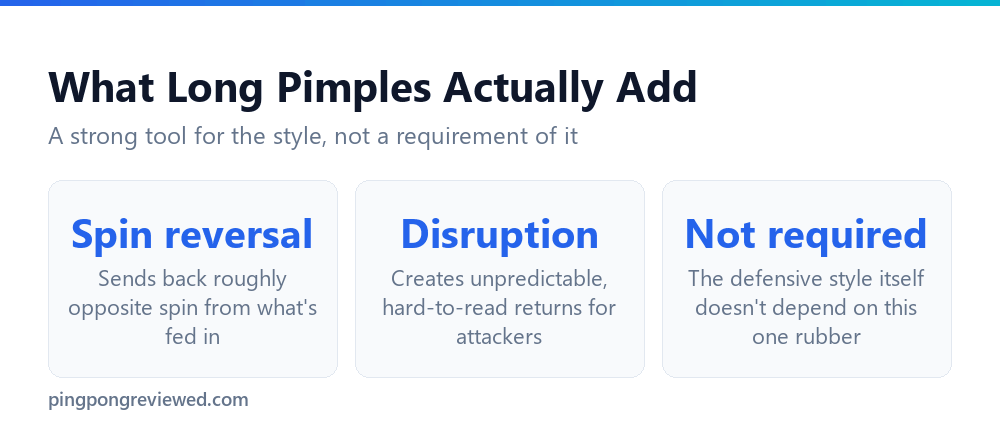
Long pimples aren’t popular among defenders by accident, though. Their pimple structure produces a real, distinctive spin-reversal effect, returning the ball with spin that tends to run roughly opposite to what was fed in, which is disruptive and hard to read for an attacking opponent expecting a more predictable response. This effect is mechanically similar in outcome to what anti-spin rubber does, though it comes from a different physical cause: pimple structure interacting unpredictably with the ball, rather than a smooth, low-friction surface.
For a defender relying on confusing an attacker into an error, that spin-reversal and general unpredictability is a valuable weapon, which is exactly why long pimples remain such a common choice among defensive specialists even though they aren’t the only viable option.
The Concrete Counter-Example: Ding Song
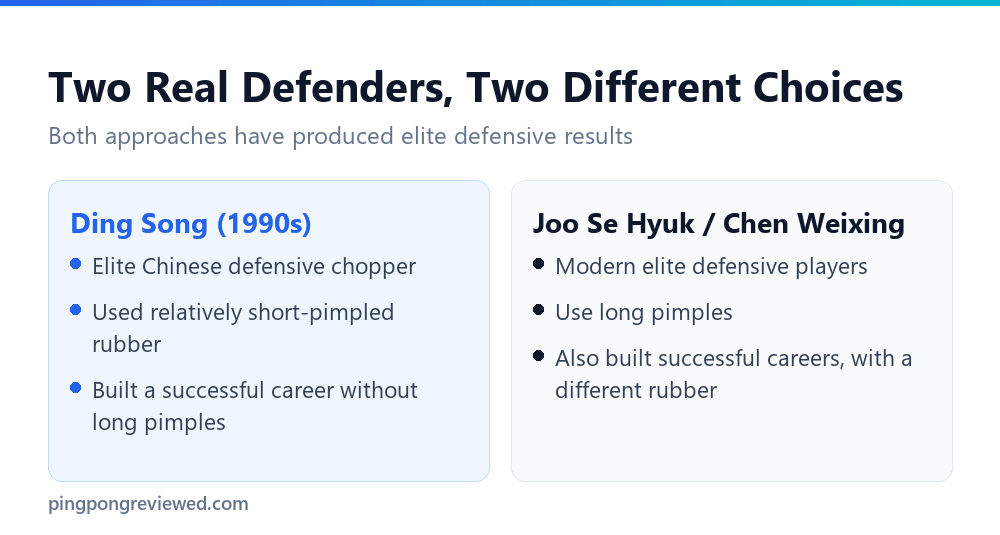
The clearest evidence against long pimples being necessary is historical rather than theoretical: Ding Song, a well-known Chinese defensive chopper active in the 1990s, played with relatively short-pimpled rubber rather than long pimples, and built an elite defensive career on that equipment. That’s not a hypothetical or a minor exception, it’s a real, documented case of the defensive style succeeding at a high level without the rubber type most people now assume is required for it.
Modern elite defenders Joo Se Hyuk and Chen Weixing, by contrast, do use long pimples, and have also built highly successful careers around that choice. Placed side by side, these examples show two different equipment paths both producing elite-level defensive results, which is a much stronger argument against necessity than a general statement alone would be.
- ✓Choose long pimples if you want the strongest spin-reversal effect
- ✓Consider short pimples or inverted rubber as genuine alternatives
- ✓Build your defensive game around footwork, backspin, and patience first
- ✓Try different rubber types before assuming one is mandatory
- ✕Assume ‘defender’ automatically means ‘long pimples user’
- ✕Buy long pimples believing they’re required to play defense
- ✕Neglect the tactical/footwork side of defense while focused on equipment
- ✕Rule out defensive play just because you don’t want to use long pimples
Why the Confusion Persists Anyway
Long pimples being the more common choice among visible, successful modern defenders creates a reasonable but incorrect impression that they’re required. When most of the defensive players a newer player watches or reads about happen to use long pimples, it’s an easy, understandable leap to assume the equipment and the style are inseparable, especially without direct exposure to counter-examples like Ding Song’s career.
That impression isn’t unreasonable given the visible evidence most players actually encounter, it’s simply incomplete, missing the historical and current examples of defenders who chose differently and still succeeded at the highest levels of the sport.
💡 Pro tip: If you’re drawn to defensive play but unsure about committing to long pimples, that hesitation doesn’t need to stop you from trying the style. Start with the tactics and footwork using whatever rubber you already have, and treat the specific pimple decision as a separate, later choice rather than a prerequisite.
Trade-Offs Worth Knowing If You Do Choose Long Pimples
None of this means long pimples are equivalent to any other choice in every respect, they come with real trade-offs alongside their disruption benefits. Long pimples generally offer less control for generating your own spin and pace compared to standard inverted rubber, which is part of why they suit a primarily defensive, disruption-focused game more than an attacking one. A player choosing long pimples is trading some active shot-making capability for the passive disruption effect the pimple structure provides.
That trade-off is exactly why the choice comes down to playing style and personal preference rather than a fixed requirement, a defender who values a more balanced, occasionally attacking game might reasonably prefer the greater control of short pimples or inverted rubber, accepting less spin-reversal disruption in exchange.
⚠️ Watch out: Switching to long pimples after building habits on a different rubber type requires real adjustment time. The spin behavior is different enough that existing timing and stroke habits often need retraining, not just a quick equipment swap.
What Coaches Actually Look For Before Recommending Equipment
A coach evaluating a player for a defensive style typically looks at footwork quality, patience under pressure, and the ability to generate consistent heavy backspin long before equipment enters the conversation at all. Those are the traits that predict whether the defensive style will actually suit a given player, and none of them are rubber-dependent. Equipment recommendations generally come after a coach has already seen these tactical traits developing, as a way to sharpen a style already taking shape rather than to manufacture one from scratch.
Short Pimples: The Middle Ground Worth Knowing About
Short pimples occupy a genuine middle ground between long pimples and standard inverted rubber, and Ding Song’s choice specifically highlights why that middle ground matters for this question. Short pimples still disrupt incoming spin more than a smooth inverted rubber does, since the pimple structure itself interacts with the ball differently than a flat surface, but they retain considerably more of the control and active shot-making ability that long pimples sacrifice.
That combination lets a defender built around short pimples play a somewhat more varied, occasionally attacking game alongside the chopping style, compared to a pure long-pimples defender leaning almost entirely on disruption and consistency. Neither approach is objectively superior, they represent different points on the same spectrum between control and disruption, and different players’ games suit different points on that spectrum.
How to Decide Which Approach Fits You
Since no single rubber choice is required, the actual decision comes down to what kind of defensive game you want to play. A player drawn to maximum disruption, relying heavily on confusing an attacker’s spin expectations and playing a more passive, consistency-first game, gets the most out of long pimples’ strongest characteristic. A player who wants defense as a foundation but still wants real attacking options mixed in benefits more from the extra control that short pimples or even standard inverted rubber preserve.
Trying each approach directly, even informally in practice sessions, tells you far more about which fits your own game than any general recommendation can. The historical examples above exist specifically to show that either path can lead to genuine success, not to suggest one is the objectively correct starting point for every defensive player.
📊 Note: Some players switch pimple lengths over the course of their development, starting with a more controllable option while learning defensive footwork and tactics, then moving to long pimples later once the fundamentals are solid. This isn’t the only valid path, but it’s a common and reasonable one.
What This Means for Someone Considering Defense
If the appeal of defensive play is the tactical patience and footwork-driven game rather than a specific attachment to how long pimples feel or behave, there’s no reason equipment should be the barrier to trying the style. The core skills, distance management, generating and reading heavy backspin, patience under pressure, transfer across rubber choices, which means starting with whatever rubber you already own is a completely valid way to begin exploring whether defensive play suits you at all.
Only once those fundamentals feel comfortable does the specific rubber choice become worth optimizing, and even then, the decision is about matching equipment to a playing style you’ve already started developing, not about acquiring a mandatory tool before you’re allowed to begin.
The Short Version, Restated
Long pimples are a popular, effective tool for defensive play, but they’re not a requirement of it. The defensive style itself is built from tactics, distance, backspin, patience, that don’t depend on any single rubber choice, and real elite defenders have proven this by succeeding with different equipment approaches.
If long pimples’ spin-reversal effect appeals to you, that’s a legitimate reason to choose them. If their reduced control doesn’t suit your game, that’s an equally legitimate reason to defend with something else.
The rubber question is real and worth answering eventually. It just isn’t the gate most players assume it is before they’re allowed to start playing defense at all.
Ding Song’s career alone should settle the question for anyone still unsure: elite-level defense has already been proven possible without long pimples, in real competition, against real opponents, decades ago.
Long Pimples Questions, Answered
Are long pimples necessary to play a defensive style?
No. The defensive style is defined by tactics, distance from the table, backspin, patience, not by a specific rubber. Successful defenders have used both long pimples and other rubber types.
Did any elite defenders succeed without long pimples?
Yes. Ding Song, a well-known 1990s Chinese chopper, used relatively short-pimpled rubber and built an elite defensive career without long pimples.
What does long pimples rubber actually add?
A spin-reversal and disruption effect, sending back spin roughly opposite to what’s fed in, which confuses attacking opponents.
What’s the trade-off with using long pimples?
Reduced control for generating your own spin and pace compared to standard inverted rubber, which is why they suit a disruption-focused defensive game more than an attacking one.
Can I start playing defensively without committing to long pimples first?
Yes. You can build the tactical and footwork foundation of a defensive style with whatever rubber you already have, and decide on long pimples separately later if you want to.
Whatever rubber ends up on your racket, the discipline that actually wins defensive points is the same one every successful chopper has shared regardless of equipment: patience, footwork, and consistent heavy backspin, applied point after point until an attacker finally breaks.
The Short Version
- →Long pimples are not required to play a defensive, chopping style.
- →The style is defined by tactics, distance, backspin, patience.
- →Ding Song built an elite defensive career on short-pimpled rubber.
- →Long pimples add spin-reversal disruption but reduce active control.
- →Choosing long pimples or not is a preference, not a requirement.
- →Short pimples offer a genuine middle ground between control and disruption.
Two elite paths, one shared discipline underneath both of them.

Ping Pong Reviewed is an equipment review site covering table tennis and baseball gear. Specifications are checked against manufacturer listings, and prices against live retail pages, before publication.