Can You Topspin All Long Serves? Not Equally, Here’s Why
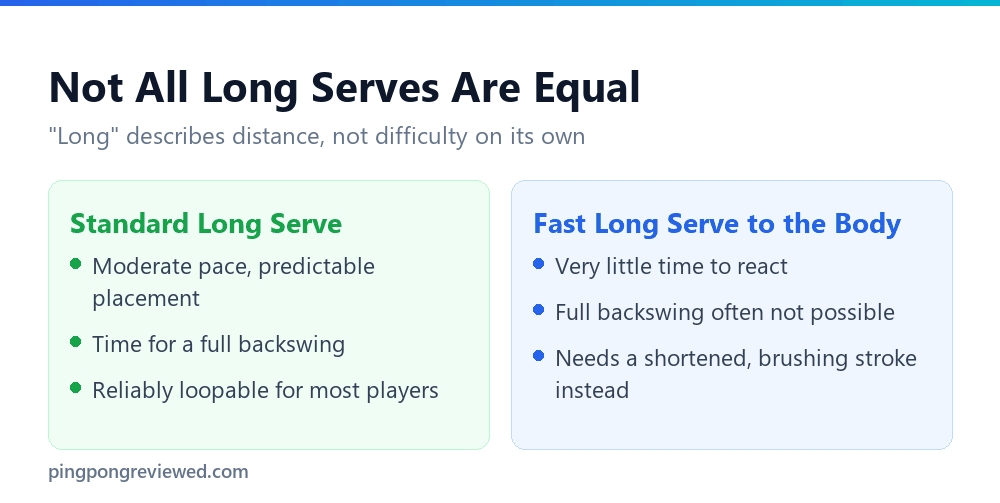
Not equally easily, no. “Long” describes how deep a serve lands, not how hard it is to loop, and treating those as the same thing is exactly where this question runs into trouble. A moderate-pace long serve and a fast one aimed at your body can both be technically “long” while being completely different problems to actually attack.
Short answer: Most long serves are loopable, but fast, well-placed long serves, especially ones aimed at the body or playing elbow, or carrying heavy disguised spin, are harder, because there’s very little time to complete a full backswing. The fix is a shortened, fast, vertical brushing stroke rather than a full loop motion, prioritizing spin and consistency over maximum power. Blocking or pushing a fast long serve is also a legitimate alternative, not a fallback for players who can’t loop. Verified against independent coaching sources on 5 September 2026.
Table of Contents
Why “Long” Doesn’t Mean “Uniform”
A serve’s length, whether it would bounce once or twice on your side if left alone, only tells you it’s landing deep enough to allow a real backswing in principle. It says nothing about how fast the ball is traveling, where exactly it’s placed, or what spin it’s carrying, and all three of those variables change how manageable a loop actually is far more than length alone does. Two long serves can require completely different responses even though both would technically be called “long” by the same definition.
Where Long Serves Actually Get Difficult
The hard case coaching sources single out is a fast long serve, particularly one aimed at the receiver’s body or playing elbow, the awkward transition zone between forehand and backhand. Speed compresses the time available to react and prepare a stroke, and body placement removes the option of simply stepping around to take the ball comfortably on one side. Combine both, and even a technically loopable long serve becomes a real problem under time pressure.
Heavy or disguised spin adds a second layer of difficulty on top of speed and placement. A fast long serve that’s also hard to read forces a receiver to solve two problems at once, figuring out the spin and finding time for a stroke, which is exactly the combination that turns a routine-sounding long serve into a tough return.
The Adjustment: A Shorter, Faster Stroke
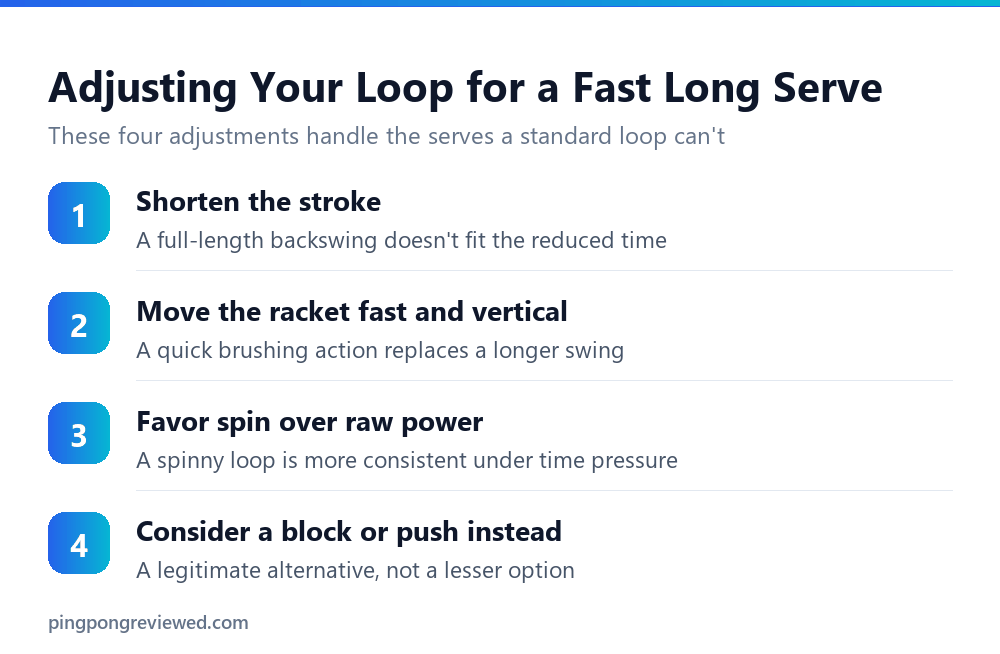
Coaching sources are specific about how to loop a fast long serve successfully, and it isn’t by trying to force a full, standard loop into a compressed window of time. The recommended adjustment is a shortened stroke, moving the racket through fast and nearly vertically, with a quick brushing action rather than a longer, more gradual swing. This trades some of a full loop’s raw power for the speed needed to actually get the racket into position before the ball arrives.
The second half of that adjustment is prioritizing spin over power specifically. A spin-focused loop is described as more consistent and easier to execute reliably under time pressure than a maximum-power attempt, since it depends less on generating force through a longer swing and more on the quality of contact during a brief, controlled brushing motion.
💡 Pro tip: Practice the shortened, vertical brushing motion specifically against fast serves in training, rather than only drilling your full loop against slower feeds. The two strokes feel different enough that one doesn’t automatically transfer into the other under match pressure.
- ✓Loop standard-pace long serves with your normal, full stroke
- ✓Shorten the backswing and brush fast and vertically against fast serves
- ✓Prioritize spin and consistency over power on rushed loops
- ✓Consider a block or push as a legitimate alternative on the hardest serves
- ✕Assume every long serve deserves the same full loop motion
- ✕Try to force a full-length backswing when time doesn’t allow it
- ✕Chase maximum power on a fast serve at the cost of consistency
- ✕Treat blocking or pushing a fast long serve as a lesser fallback option
Why Blocking or Pushing Isn’t a Lesser Option
It’s worth stating directly: choosing not to loop a fast long serve isn’t a failure or a sign of an underdeveloped game. Coaching sources point out that pushing a fast long serve is actually the riskier option in many cases, since a push against a ball already traveling fast tends to produce a return that’s easy for the server to attack, the opposite of what a push is supposed to accomplish. A controlled block, keeping the point alive without overcommitting to an attacking stroke under time pressure, is often the more reliable choice on the very hardest serves, particularly for players still developing their shortened-loop technique.
This matters because it removes an unnecessary pressure some players put on themselves to loop absolutely everything long, regardless of speed or placement, as if failing to attack a fast body serve were some kind of technical shortcoming. It’s a legitimate tactical choice, not a consolation prize.
⚠️ Watch out: Forcing a full loop swing on a serve that’s too fast for it tends to produce late contact and mishits far more often than it produces a clean attacking shot. Recognizing when to shorten the stroke, or skip the loop entirely, prevents more errors than it costs in missed opportunities.
How This Connects to Reading the Serve
Speed and placement aren’t the only variables, spin type still has to be read correctly regardless of how fast or slow the serve is, and a fast serve simply gives less time to complete that read before committing to a stroke. This is part of why heavy, disguised spin on a fast long serve compounds the difficulty rather than simply adding to it: the reduced reaction time applies to both the spin read and the stroke execution simultaneously, not just to the swing itself.
Players who’ve built a reliable, fast spin-reading habit, watching the server’s racket motion early rather than waiting for the ball’s flight, have measurably more time available to execute the shortened loop or make the block/push decision correctly, which is exactly why that reading skill pays off most on the hardest, fastest serves rather than on the easier, slower ones.
Backhand Versus Forehand on Fast Long Serves
The shortened, vertical brushing loop described above applies on both wings, but the backhand version tends to feel more natural to execute under time pressure than the forehand equivalent, since the backhand stroke is already inherently more compact. A fast serve to the backhand side often gets handled successfully with less conscious adjustment than the same serve directed to the forehand, where players are more used to a longer, fuller swing and have to actively shorten it under pressure.
This is part of why fast serves aimed specifically at the forehand side, rather than straight at the body, can feel disproportionately difficult even for players who handle body serves reasonably well, the forehand shortened-loop motion requires more deliberate practice to feel automatic than the backhand version does for most players.
Building This Skill Deliberately in Practice
Because the shortened brushing loop is a different motion from a standard full loop, it benefits from being drilled specifically rather than assumed to develop automatically from practicing the full loop alone. A common training approach has a partner or robot feed fast, long, varied-placement balls repeatedly, with the receiver focusing purely on the shortened stroke and spin-over-power priority, separate from any serve return practice against actual serve motion and disguise.
Once the shortened stroke itself feels reliable against a predictable fast feed, adding back the unpredictability of a real serve, varied placement, disguised spin, inconsistent timing, builds toward the full, match-realistic skill this article describes. Trying to develop both the stroke and the serve-reading skill simultaneously from the start makes the whole process harder to isolate and improve.
📊 Note: Robots and ball machines that can deliver fast, long feeds at controllable, repeatable settings are particularly well suited to this specific drill, since a human partner rarely serves fast long balls with the same consistency needed for focused repetition.
A Worked Example
Picture two long serves in the same match: one at moderate pace landing wide to the forehand, the other fast and aimed directly at the playing elbow. Against the first, a full, standard loop with a normal backswing works comfortably, there’s time to load the stroke and generate real power. Against the second, attempting that same full swing either arrives late or gets crowded by the ball’s proximity to the body, producing a mishit far more often than a clean attack.
Shortening the stroke for the second serve, a fast, vertical brushing motion generating spin rather than raw power, turns that same difficult serve into a manageable, if less powerful, attacking return. Same server, same basic serve length, completely different technique required, based entirely on speed and placement rather than on the length classification alone.
The Short Version, Restated
Long serves aren’t a single, uniform difficulty level just because they share a length classification. Speed, body placement, and disguised spin each independently raise the difficulty of looping a long serve, and the correct response to the hardest versions is a shortened, spin-focused stroke, or, just as legitimately, a block or push instead.
Knowing which category a given long serve actually falls into, in the moment, matters more than having one fixed answer for “long serves” as a whole.
None of this requires abandoning your normal loop, it requires adding a second, shorter version of it specifically for the serves your normal version doesn’t have time for, and knowing which situation calls for which one.
That’s the full picture: length gets you in the door, but speed, placement, and spin decide what actually happens once the ball arrives.
Long Serve Loop Questions, Answered
Can you loop every long serve the same way?
No. A standard-pace long serve is generally loopable with a full stroke, but a fast serve, especially one aimed at the body, needs a shortened, brushing stroke instead.
Why are fast long serves aimed at the body so hard to loop?
There’s very little time to complete a full backswing, and the body placement removes the option of stepping around to take the ball comfortably on one side.
What stroke adjustment works for fast long serves?
A shortened, fast, nearly vertical brushing motion, prioritizing spin and consistency over maximum power.
Is it wrong to block or push a fast long serve instead of looping it?
No. Blocking or pushing a fast long serve is a legitimate tactical choice, and pushing can actually be riskier than looping since a rushed push is easy for the server to attack.
Does spin type also affect how hard a long serve is to loop?
Yes. Heavy or disguised spin adds a second challenge on top of speed and placement, since the spin has to be read correctly in the same reduced time window.
The Short Version
- →Not all long serves are equally loopable, speed and placement matter too.
- →Fast serves aimed at the body/elbow are the hard case.
- →Shorten the stroke and brush fast and vertically for fast serves.
- →Favor spin and consistency over power under time pressure.
- →Blocking or pushing a fast long serve is a legitimate alternative, not a fallback.

Ping Pong Reviewed is an equipment review site covering table tennis and baseball gear. Specifications are checked against manufacturer listings, and prices against live retail pages, before publication.