
Can a Topspin Return Beat Spin Serves? What Actually Matters
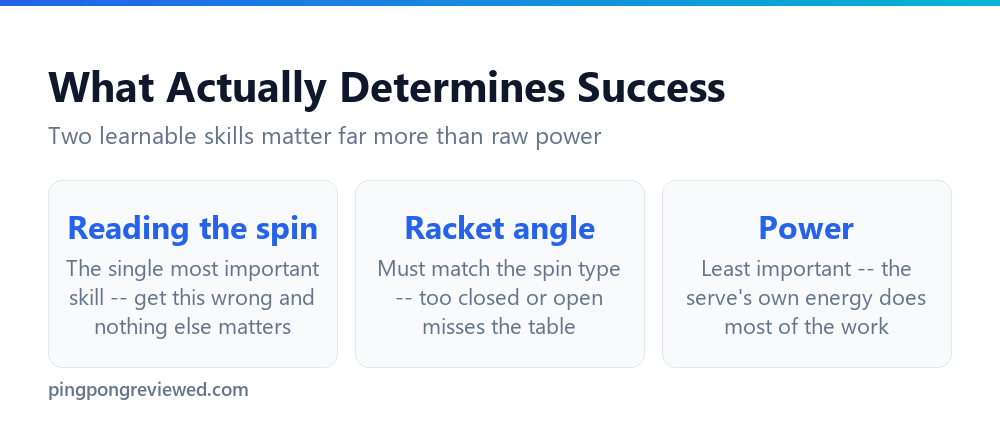
Yes, a good topspin return can overcome most spin serves, but not because topspin is simply stronger than whatever spin the serve carries. The real answer depends on two specific, learnable skills: reading the incoming spin correctly, and matching your racket angle to it. Get those two things right, and an attacking topspin return beats a surprising range of serves. Get them wrong, and no amount of extra topspin compensates.
Short answer: Yes, with qualification. An aggressive topspin-based return (a drive, flick, or loop, rather than a passive push) is the modern, coaching-recommended way to handle a topspin serve, and it also works well against many backspin and sidespin serves once the spin is read correctly and the racket angle is adjusted to match. Success depends on reading the serve accurately and setting the right racket angle, not on hitting the return harder or spinning it more than the incoming serve. Verified against independent coaching sources on 5 September 2026.
Table of Contents
Why Reading the Spin Comes Before Anything Else
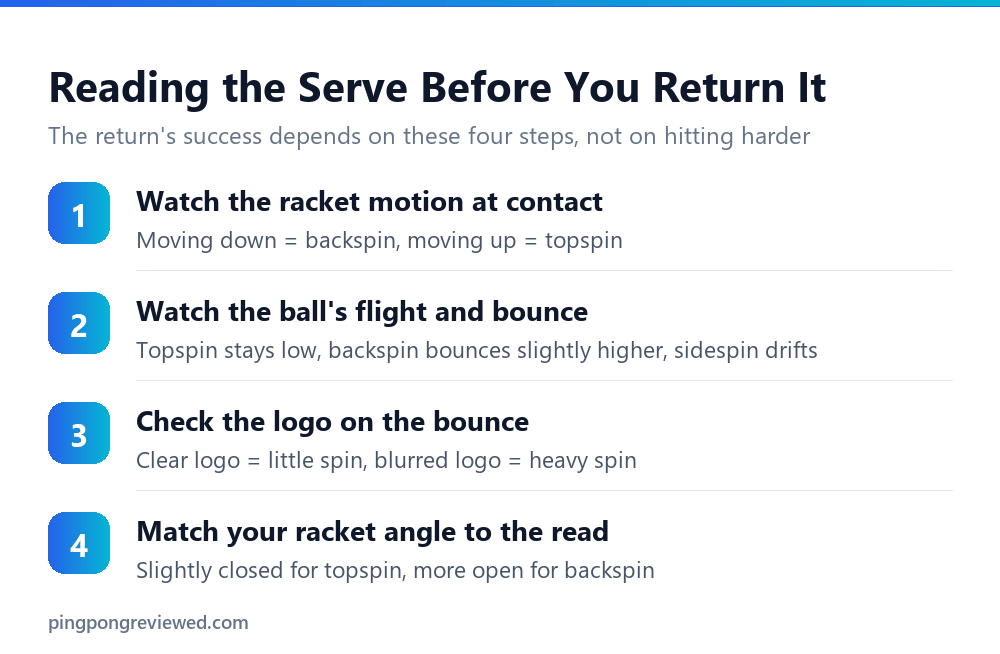
No racket angle or stroke choice matters if the spin is misread first, which is why coaching sources treat reading spin as the foundational skill this entire question rests on. The most reliable read comes from watching the server’s racket motion at the moment of contact: a racket moving downward through the ball produces backspin, and a racket moving upward produces topspin. That single observation, made in the fraction of a second before the ball arrives, is the primary signal experienced receivers rely on.
A secondary read comes from the ball’s flight and bounce once it’s already crossed the net: topspin serves tend to stay low off the bounce, backspin serves tend to bounce slightly higher, and sidespin serves tend to drift visibly left or right. Receivers also watch how clearly the ball’s printed logo is visible during the bounce, a clearly visible logo suggests little spin is on the ball, while a blurred, hard-to-track logo suggests heavy spin is present.
Matching Racket Angle to the Read
Once the spin is correctly identified, the return itself doesn’t need to be hit especially hard against a topspin serve specifically, the serve already carries plenty of its own energy, and a receiver’s job is largely to redirect that energy rather than add dramatically more of their own. Making contact toward the top of the ball with a slightly closed racket face is generally enough to send a topspin serve back accurately and with real pace, since the incoming energy does much of the work.
Half-long serves demand the most precision here. Coaching sources are specific that the racket angle window is narrow on these serves: too closed and the return goes into the net; too open and it flies long off the end of the table. Recognizing a half-long serve early, before it’s dropped too far, and taking it on the rise rather than waiting, is part of what makes the angle adjustment manageable rather than a last-second guess.
💡 Pro tip: Practice reading spin off the server’s racket motion specifically, not just off the ball’s flight. By the time the ball’s flight gives you information, you’ve already used up part of your reaction window, the racket-motion read happens earlier and gives you more time to set your own angle.
- ✓Watch the server’s racket motion at contact as your primary read
- ✓Match your racket angle to the specific spin type you’ve identified
- ✓Take half-long serves early, before they’ve dropped too far
- ✓Trust the serve’s own energy rather than trying to overpower it
- ✕Guess at spin type without watching the racket motion closely
- ✕Use the same racket angle regardless of what spin was served
- ✕Wait too long on a half-long serve and lose the timing window
- ✕Assume hitting harder compensates for an incorrect spin read
Why This Isn’t True for Every Serve, Every Time
The honest qualification in this answer matters: an aggressive topspin-style return works well against most spin serves once read and angled correctly, but it isn’t a universal solution applied identically regardless of serve quality. A very heavy, well-disguised backspin serve, read late or misread as something else, can still beat even a technically sound attacking return attempt, because the racket angle chosen was wrong for what actually arrived. The skill isn’t topspin itself, it’s the reading and adjusting process that has to happen correctly first.
This is also why elite servers invest heavily in disguise, using similar-looking racket motions to produce different actual spins. The entire purpose of serve disguise is to defeat exactly the reading process this answer depends on, which is a genuine, ongoing arms race between serving and returning skill rather than a settled question with one fixed winner.
⚠️ Watch out: A topspin return attempted against a serve you haven’t actually read correctly is a guess, not a technique. If you’re not confident in the read, a safer push return buys time to reset rather than committing to an aggressive return on a misjudged guess.
How This Connects to Serve Strategy Generally
This return skill is effectively the mirror image of what makes serve variation and disguise valuable in the first place. A server relying on a single, easily-read spin type will eventually run into a receiver who’s read it enough times to attack it reliably with exactly the technique described here. That’s part of why coaching sources consistently recommend serve variation rather than repetition, an undisguised, repeated serve gives the returning side exactly the read they need to make an aggressive topspin return the default, reliable answer.
Why Push Returns Haven’t Disappeared Either
None of this means a passive push return is obsolete or wrong to use. A push remains the safer, lower-risk option specifically when the read is uncertain, when the serve carries unusually heavy or well-disguised spin, or when the receiver simply hasn’t developed the aggressive return well enough to trust it under pressure yet. Coaching sources don’t recommend abandoning the push entirely in favor of always attacking, they recommend attacking specifically when the read and angle are confident, and falling back to a push when they aren’t.
That distinction matters because it reframes the original question slightly: the choice isn’t topspin return versus push return as competing philosophies, the way flick and loop aren’t competing philosophies either. It’s a situational decision based on how confident the read is, with the aggressive topspin return reserved for the cases where that confidence is actually earned.
Building the Reading Skill Deliberately
Because reading spin is the foundational skill this entire answer depends on, it’s worth training separately from the return stroke itself rather than expecting it to develop automatically through general match play. A common structured approach is having a training partner or coach serve a single spin type repeatedly, with the receiver calling out the read out loud before attempting any return at all, isolating the reading skill from the stroke execution entirely.
Once the read is reliably accurate in that isolated setting, adding the return stroke back in, and eventually mixing serve types unpredictably, builds toward match-realistic conditions gradually rather than trying to develop both skills simultaneously under full pressure from the start. This staged approach shows up repeatedly across coaching sources specifically because reading and stroke execution are separable skills that benefit from separate, deliberate practice.
What Changes at Higher Levels of Play
At beginner and intermediate levels, serves are often less disguised and easier to read correctly, which means the aggressive topspin return described here becomes reliably available on a larger share of serves faced. At the elite level, where serve disguise is far more developed, the reading process becomes difficult even for highly trained players, which is part of why even top players still use push and other non-topspin returns regularly rather than attacking every single serve.
This progression is worth keeping in mind so the “good topspin return beats most spin serves” answer doesn’t get overapplied. It’s most reliably true at levels where serve disguise is limited, and it becomes a genuine skill contest, not a guaranteed outcome, as the level of play and the quality of disguise both rise together.
A Worked Example
Picture a receiver facing a serve where the server’s racket clearly moves upward through contact, a strong topspin read. Rather than pushing passively, the receiver meets the ball with a slightly closed racket face, contacting near the top of the ball and using the serve’s own forward energy to drive it back with real pace. That’s the aggressive topspin return working exactly as coaching sources describe, beating the serve through correct reading and angle, not through extra force.
Now picture the same receiver facing a well-disguised serve where the racket motion looks nearly identical but the actual spin is backspin, not topspin. Using the same slightly-closed angle here sends the return straight into the net, not because topspin returns don’t work, but because the read was wrong for the actual spin delivered. Same technique, same effort, completely different outcome, entirely because of the read.
📊 Note: This is a trainable skill, not an innate talent. Structured practice specifically on reading racket motion and adjusting return angle, ideally with a coach or training partner varying serve types deliberately, builds this faster than match play alone.
The Short Version, Restated
A good topspin return can overcome most spin serves, but the word doing the real work in that sentence is “good,” and good here means correctly read and correctly angled, not simply hit hard or spun heavily. The serve’s own energy, redirected accurately, does most of the work an aggressive return needs.
Where this fails isn’t a failure of the topspin return as a technique, it’s a failure of the read that came before it, which is exactly why serve disguise remains such a valuable skill on the other side of the same exchange.
Topspin Return Questions, Answered
Can a topspin return really beat a spin serve?
Yes, generally, if the spin is read correctly and the racket angle is matched to it. The serve’s own energy does most of the work; the return doesn’t need to overpower it separately.
How do you read what spin a serve has?
Primarily by watching the server’s racket motion at contact, moving down means backspin, moving up means topspin, and secondarily by watching the ball’s flight, bounce height, and how clearly its logo is visible.
Why do half-long serves feel so hard to return?
The racket angle window is narrow on half-long serves, too closed nets the return, too open sends it long, which demands more precision than a clearly short or clearly deep serve.
Does hitting the return harder help against heavy spin?
No. Success depends on reading the spin and matching racket angle correctly, not on adding more power or spin to the return.
Why do good servers disguise their serves if topspin returns work so well?
Because disguise specifically defeats the reading process a topspin return depends on. It’s an ongoing skill exchange, not a settled contest with one fixed winner.
The Short Version
- →A good topspin return can overcome most spin serves, with qualification.
- →Reading the spin correctly matters more than power or extra spin.
- →Watch the server’s racket motion first, then the ball’s flight and bounce.
- →Racket angle must match the spin type, especially on half-long serves.
- →Serve disguise exists specifically to defeat this reading process.

Ping Pong Reviewed is an equipment review site covering table tennis and baseball gear. Specifications are checked against manufacturer listings, and prices against live retail pages, before publication.