Liang Jingkun: Four World Bronze Medals, Never Gold or Silver
Liang Jingkun has reached the World Championships singles podium four separate times, in 2019, 2021, 2023, and 2025. Every single time, he’s won bronze. Never gold, never silver.
That’s an unusually specific pattern, four trips to the same step of the podium across six years, and it’s worth examining directly rather than folding into a generic “decorated career” summary.
Short answer: Liang Jingkun was born on 20 October 1996 in Tangshan, China, and plays a right-handed shakehand grip. He has won World Championships singles bronze four times, in 2019, 2021, 2023, and 2025, but never gold or silver in that event. He reached a career-high world ranking of number 2 in July 2024 and was ranked 13th as of March 2026. In October 2022, he was suspended for the rest of the year by the Chinese Table Tennis Association after a celebration, following a win over teammate Lin Gaoyuan, was ruled inappropriate. Verified across his own tournament record on 4 September 2026.
Table of Contents
Four Bronzes, Never Higher
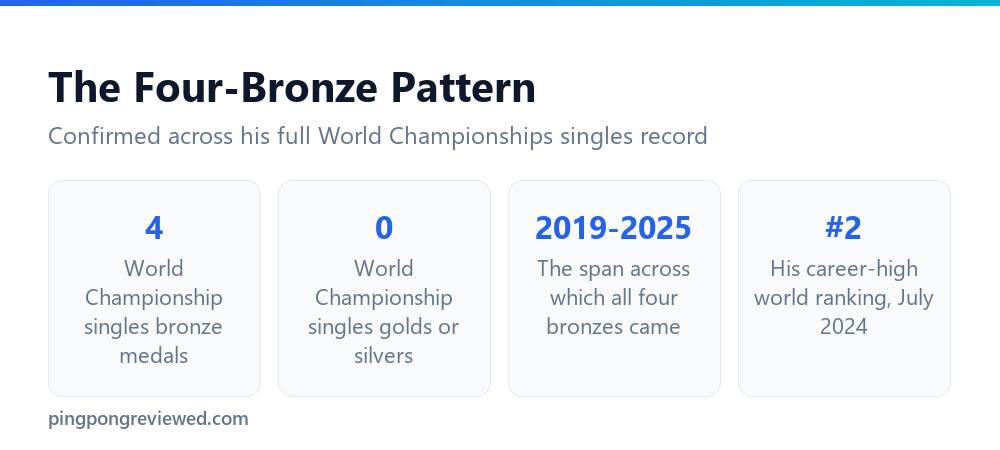
So four bronze medals at the same event, in the same format, across three separate tournament cycles, is a rare statistical pattern. Most players who reach a World Championships singles podium multiple times either break through to a higher medal at some point or fall off the podium entirely in later attempts.
His career-high ranking of world number 2, reached in July 2024, confirms the individual level was there at his peak. The singles gold at the sport’s biggest tournament is the specific line still missing from an otherwise deep résumé.
The October 2022 Suspension
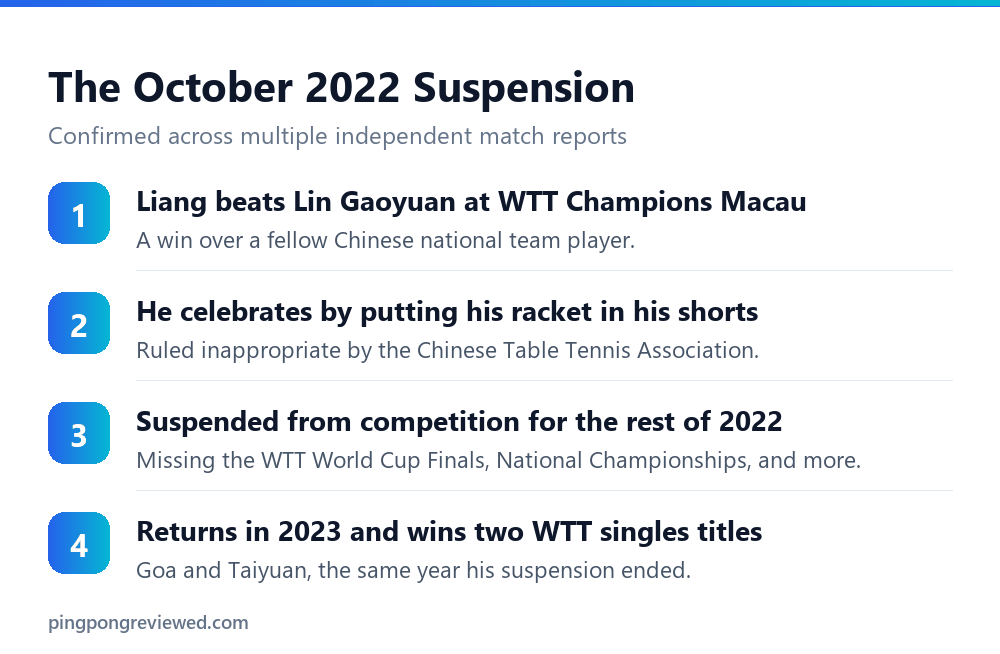
So this incident is worth covering directly and factually, since it’s confirmed consistently across multiple independent sources. At WTT Champions Macau in October 2022, Liang beat fellow Chinese national team player Lin Gaoyuan, also profiled on this site.
His celebration after the win, putting his racket in his shorts, was ruled inappropriate by the Chinese Table Tennis Association. The federation suspended him from all competition for the remainder of 2022, a penalty that cost him the WTT World Cup Finals, the National Table Tennis Championships, the Asian Cup, and the China Table Tennis Club Super League that year.
⚠️ Watch out: This article states what happened, confirmed across independent reporting, without editorializing on whether the punishment fit the offense. Reasonable people have disagreed publicly about whether the response was proportionate.
He returned to competition in 2023 and won two WTT singles titles that same year, in Goa and Taiyuan, suggesting the suspension didn’t produce a lasting dip in his individual form once he was back on tour.
📊 Note: The match itself connects directly to this batch’s Lin Gaoyuan profile, also covered on this site, since he was the opponent in the exact match that led to the suspension.
What Comes Next
So at 29 in 2026, with a career-high ranking of number 2 already banked and four World Championships bronzes on the record, the specific, nameable gap is clear: a singles medal at that event higher than third place.
Four bronzes is not a small achievement. It’s four separate confirmations that he belongs among the best in the world at that specific tournament. What’s missing is the one step further, and it’s the kind of gap that a single strong tournament could close at any point.
Comparing the Four Bronzes
So it’s worth checking whether the four bronze medals came from similar tournaments or different circumstances, since that changes how the pattern reads.
Spread across 2019, 2021, 2023, and 2025, the four results span three separate Olympic cycles and multiple generations of opposition. That’s not four near-identical results in a short window. It’s a sustained, repeated ceiling across a long stretch of his career, against different fields each time.
So the consistency itself is the notable part. A player capable of reaching a World Championships singles semifinal four separate times, across six years, has clearly solved the problem of getting that deep into the tournament. The specific step from semifinal to final has stayed unsolved across all four attempts.
💡 Pro tip: A repeated ceiling at the same exact stage of a tournament, across multiple attempts years apart, is worth distinguishing from a single unlucky loss. Liang Jingkun’s pattern is closer to the former: a specific, recurring wall rather than one bad day.
What the Suspension Reveals About the System
So beyond the specific facts of the incident, the severity of the response, a full year’s suspension for a post-match celebration gesture, says something about how the Chinese Table Tennis Association manages its top players’ public conduct.
Compared to how celebration incidents are typically handled in many other sports, often with a fine or a warning rather than a season-ending suspension, this response sits at the stricter end of the spectrum. That context matters for understanding the competitive environment top Chinese players operate within, a theme that also appears in this site’s Wang Manyu profile regarding internal selection pressure.
⚠️ Watch out: This isn’t presented as a judgment on whether the punishment was right or wrong. It’s presented as a data point about the level of conduct standards Chinese national team players are held to, verified across multiple independent reports of the same incident.
The Rest of the Résumé
So beyond the singles bronzes and the suspension, Liang Jingkun’s broader record includes a wide spread of results across formats and competitions, worth listing in full rather than letting the two headline stories crowd everything else out.
His WTT singles titles alone span seven different events across six years: Austria in 2018, Portugal in 2019, Slovenia in 2021, Muscat in 2022, both Goa and Taiyuan in 2023, and Incheon in 2024. That’s an international spread, not results concentrated in one region or one short window.
Add the Asian Games team golds from 2018 Jakarta and 2022 Hangzhou, and multiple Asian Championship team titles across 2019 and 2023 through 2025, and the picture is of a player with deep, sustained success practically everywhere except the very top step of one specific podium.
How the Suspension Fits the Broader Timeline
So it’s worth placing the October 2022 suspension inside his bronze-medal pattern specifically, since the timing is notable. His first World Championships bronze came in 2019, three years before the suspension. His second came in 2021, the year before it.
So by the time of the Macau incident, he had already reached the World Championships singles podium twice without breaking through to gold or silver. The suspension interrupted his 2022 season entirely, and his next World Championships bronze, in 2023, came the year immediately after his return to competition.
That sequence, bronze, bronze, a lost season, then bronze again right after returning, suggests the suspension didn’t meaningfully derail his singles level once he was back competing, even though it cost him an entire year of tournaments.
What to Watch For
So a few specific things are worth watching when Liang Jingkun plays, given the pattern this profile has covered.
First, watch how he performs specifically in semifinal-stage matches at major tournaments, since that’s the exact stage his four bronzes suggest is his current ceiling. A shift in that specific round would be the clearest sign of the gap finally closing.
Second, watch his on-court conduct and celebrations, not out of morbid curiosity, but because the 2022 incident shows real consequences attach to that side of his public presentation, on top of his results.
Then, in any match against a fellow member of the deep Chinese men’s roster, remember the internal competition dynamic covered elsewhere in this batch. A bronze medal at a World Championships still means beating most of the world’s best players to get there, including, in the earlier rounds, some of his own teammates.
Why the World Championships Bronze Is a Distinct Category
It’s worth being precise about what a World Championships singles bronze actually represents, because the format matters for reading Liang Jingkun’s record correctly. The event runs as a straight knockout with no third-place playoff: both players who lose in the semifinals are awarded bronze, full stop, with no additional match to separate them or to decide a true number three.
That means Liang Jingkun has reached the final four at a World Championships four separate times without it ever converting into a place in the final itself. He has beaten a semifinal-caliber field of opponents on four different occasions, across three Olympic cycles, and been stopped at that exact stage every time. It’s a narrower, more specific kind of ceiling than simply ‘medaled four times’ suggests on its own.
Reading This Alongside the Rest of the Batch
So Liang Jingkun’s profile sits at an interesting intersection of several themes already covered elsewhere in this batch of profiles: a specific, repeated statistical ceiling similar in shape to Harimoto’s singles gap, a disciplinary incident that stands apart from anything else covered here, and a direct link to Lin Gaoyuan’s own profile through one specific match.
Taken together, these threads paint a fuller picture than any single fact could on its own: a player who has repeatedly proven himself among the world’s best, hit the same specific wall four times running, and weathered an unusual disciplinary chapter without it derailing his career.
So the next World Championships is worth watching for one specific reason above all others: whether the four-bronze pattern finally breaks, in either direction. A fifth bronze would confirm just how consistent the ceiling really is. A gold or silver would close the gap this profile has spent the most time on.
Either outcome updates this page. Neither outcome changes what’s already true: four trips to an Olympic-cycle-spanning podium is a record most players in the sport’s history never come close to matching, regardless of the specific color of the medal.
So that’s the full picture this profile set out to cover: a specific, checkable statistical pattern, an unusual disciplinary chapter, and a broader résumé that holds up under scrutiny well beyond either headline detail on its own.
Liang Jingkun Questions, Answered
How many World Championships medals does Liang Jingkun have in singles?
Four bronze medals, in 2019, 2021, 2023, and 2025. He has never won gold or silver in the singles event at a World Championships.
What is Liang Jingkun’s highest world ranking?
World number 2, reached on 9 July 2024. He was ranked 13th as of March 2026.
Why was Liang Jingkun suspended in 2022?
The Chinese Table Tennis Association suspended him for the rest of 2022 after a celebration, putting his racket in his shorts following a win over teammate Lin Gaoyuan at WTT Champions Macau, was ruled inappropriate.
Did the suspension affect Liang Jingkun’s form afterward?
He returned in 2023 and won two WTT singles titles that year, in Goa and Taiyuan, suggesting no lasting decline in his individual results.
Has Liang Jingkun won World Championship team gold?
Yes, three times: 2022 Chengdu, 2024 Busan, and 2026 London.
Where is Liang Jingkun from?
Tangshan, China, born 20 October 1996. He plays a right-handed shakehand grip.
The Short Version
- →Born 20 October 1996 in Tangshan, China; right-handed shakehand grip.
- →Four World Championships singles bronze medals: 2019, 2021, 2023, 2025, never higher.
- →Reached a career-high world ranking of number 2 in July 2024.
- →Suspended for the rest of 2022 after a celebration following a win over Lin Gaoyuan.
- →Returned in 2023 to win WTT singles titles in Goa and Taiyuan.
- →Three World Championships team gold medals: 2022, 2024, and 2026.

Ping Pong Reviewed is an equipment review site covering table tennis and baseball gear. Specifications are checked against manufacturer listings, and prices against live retail pages, before publication.