Xu Xin: Ten World Championship Golds, Zero in Singles
Xu Xin won ten World Championship gold medals across team, doubles, and mixed doubles play. He was world number one. He never once won a World Championships singles title.
That’s the specific, checkable gap behind one of the most decorated careers in the sport’s history, and it’s worth naming directly rather than letting the gold medal count speak for the whole record.
Short answer: Xu Xin was born on 8 January 1990 in Xuzhou, China, and plays a rare left-handed penhold grip. He reached world number one in January 2013 and won ten World Championship gold medals across team, doubles, and mixed doubles events, plus two singles bronze medals, but never a singles gold. He won Olympic team gold at both Rio 2016 and Tokyo 2020, and Olympic mixed doubles silver at Tokyo 2020 with Liu Shiwen. He is effectively retired from international competition, now running his own table tennis club. Verified across his own tournament record on 4 September 2026.
Table of Contents
Ten Golds, One Specific Gap
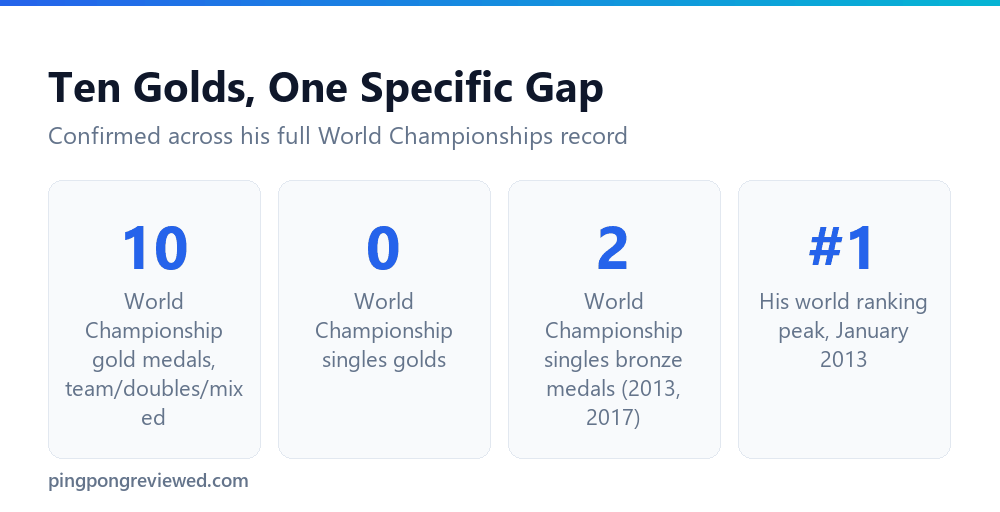
So ten World Championship golds is an enormous total by any standard in the sport. But singles, the format that usually defines a player’s individual legacy most directly, produced only two bronze medals across his entire career.
⚠️ Watch out: None of this diminishes ten World Championship gold medals. It’s simply the honest, complete shape of an elite career, stacked in team and doubles formats specifically rather than evenly across every format the sport plays.
The Rare Grip
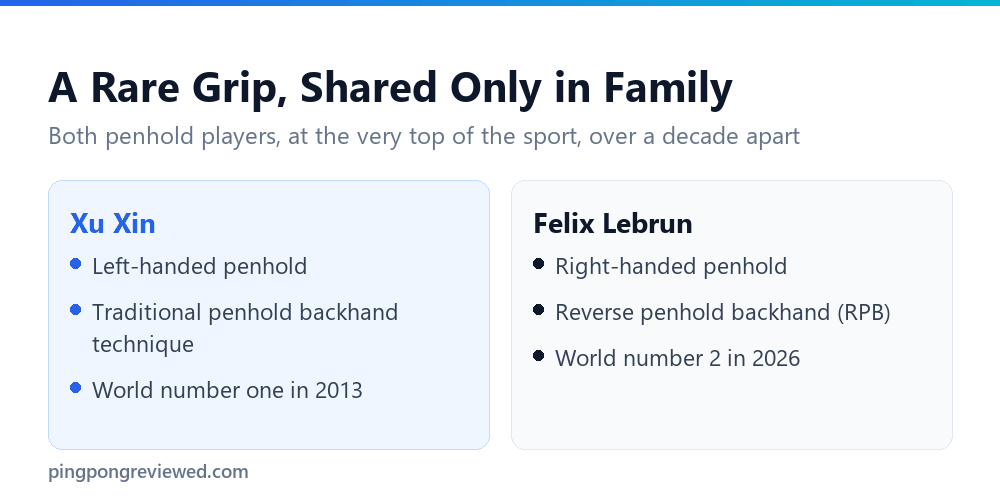
So Xu Xin plays left-handed penhold, a specific combination rare enough at elite level that it’s worth comparing directly to Felix Lebrun, also covered on this site, who plays right-handed penhold with a reverse backhand technique.
Both players show that penhold, often treated as an older or fading style at the top of the sport, can still produce a world number one and a world number two, over a decade apart. The specific techniques differ, Xu Xin’s traditional penhold backhand against Lebrun’s reverse penhold backhand, but both prove the grip family remains viable at the very highest level.
💡 Pro tip: Watching Xu Xin’s old match footage alongside Felix Lebrun’s current matches is a useful way to see how differently two penhold players can construct their backhand side, despite sharing the same basic grip family.
The Partnership With Liu Shiwen
So the 2019 World Championships mixed doubles title, won with Liu Shiwen, also profiled on this site, sits alongside their Tokyo 2020 Olympic mixed doubles silver as the clearest evidence of a sustained partnership rather than a one-off pairing.
The same year, 2019, the pair achieved what’s been described as a “triple crown” at the Japan Open, with Xu Xin winning singles, men’s doubles, and mixed doubles at the same tournament. That’s an unusually complete showing across three separate formats in one event.
📊 Note: Reading this profile alongside Liu Shiwen’s own page on this site covers their partnership from both sides, including her own extensive singles and doubles record beyond what they achieved together.
Life After Competition
So Xu Xin’s competitive career wound down without a single formal retirement announcement, based on available sourcing. He was absent from WTT competition through 2022, and his last recorded world ranking was 103rd, in May 2023, before dropping off the active list entirely.
Since then, multiple independent sources confirm he launched his own table tennis brand and club, Xuperman Sports, officially on 8 February 2023, and has shifted his focus to coaching and teaching rather than competing.
So this profile describes him as effectively retired from international competition, based on the available evidence, rather than asserting a specific, formally announced retirement date that doesn’t appear to exist in the public record.
The 51 Titles Behind the Ten Golds
So beyond the World Championships specifically, Xu Xin’s full World Tour record includes 51 total titles: 18 in singles, 28 in doubles, and 6 in mixed doubles.
That breakdown matters for understanding the shape of his career. Eighteen singles titles on the broader World Tour is a substantial individual record, even though none of them came at a World Championships specifically. So the singles gap covered earlier in this profile is specific to that one tournament, not a sign he couldn’t win singles titles at all.
💡 Pro tip: When a player’s biggest gap is specific to one tournament rather than one format entirely, checking their broader tour record, not just the headline event, usually gives a fairer picture of their actual singles ability.
The 2019 Japan Open, in Detail
So the 2019 Japan Open triple crown deserves more than a passing mention, since winning singles, men’s doubles, and mixed doubles at the same tournament is a rare feat, requiring both individual dominance and successful partnerships in two separate doubles formats in the same week.
That tournament also fell in the same year as his and Liu Shiwen’s World Championships mixed doubles title, making 2019 the clear peak year of that specific partnership, layered on top of what was already a deep career by that point.
Coaching the Next Generation
So Xu Xin’s transition into running his own club and coaching represents a common path for retired elite players, but his specific case carries extra weight given the scale of his own competitive record.
A coach who reached world number one and won ten World Championship gold medals brings direct, personal experience of exactly what it takes to compete and win at that level, not secondhand knowledge. Whatever comes next for Xuperman Sports, that foundation is a genuine asset rather than a marketing claim.
📊 Note: This profile focuses on Xu Xin’s playing career specifically, since that’s the verified, checkable record. Details about his current coaching business beyond its existence and launch date weren’t independently confirmed to the same standard as his competitive results.
Comparing Two Generations of Chinese Men’s Team Depth
So Xu Xin’s career overlapped directly with Ma Long’s, also profiled on this site, both winning multiple Olympic team golds as part of the same generation of Chinese men’s dominance.
Their specific records diverge in a way that’s worth naming plainly: Ma Long built the deepest individual singles record in the sport’s history, while Xu Xin built his legacy primarily in team and doubles formats. Both were teammates and both were, at various points, world number one. But the shape of what each left behind is different.
So reading their two profiles together illustrates something real about depth: a single generation of Chinese men’s table tennis produced multiple different, non-overlapping paths to elite status, not one repeated template.
Why the Singles Gap Doesn’t Diminish the Legacy
So it’s worth closing on this directly, since a headline like “never won singles gold” can read more negatively than the full record actually supports.
Ten World Championship gold medals is a total most players in the sport’s history never approach in any combination of formats. Two singles bronze medals at that same event confirm he was a genuine individual threat, not simply absent from singles competition entirely.
So the honest framing isn’t “Xu Xin fell short in singles.” It’s “Xu Xin built one of the most decorated team and doubles careers in the sport’s history, with a competitive but ultimately gold-medal-less singles record at the World Championships specifically.” That’s a complete, accurate picture, not a diminished one.
💡 Pro tip: When a headline achievement gap shows up in an otherwise stacked record, checking the full breadth of that record, as this profile does with Xu Xin’s 51 World Tour titles, usually reveals a fuller and fairer picture than the single missing credential suggests on its own.
So that’s the record worth carrying forward: ten World Championship golds, a former world number one ranking, 51 total World Tour titles, and a rare left-handed penhold grip that made his game visually distinct from most of his generation. The singles gold is the one line missing from an otherwise complete résumé, not the defining fact of the whole career.
So whether he’s remembered first as a penhold pioneer, a doubles and team specialist, or the coach now passing that record on to a new generation, the underlying record supports all three framings at once, which is itself a marker of how complete a career it actually was.
Ten World Championship golds, a rare grip that stayed competitive at the very top, and a partnership that produced titles both before and carried forward after his own most decorated years, that’s the fuller version of the record this page set out to cover.
So the next time his name comes up mainly for the singles gap, it’s worth pointing to the ten golds, the 51 titles, and the students now training under a coach who actually did all of it himself, at the highest level the sport has, penhold grip and all.
Xu Xin Questions, Answered
How many World Championship titles does Xu Xin have?
Ten gold medals: five in the team event, three in doubles, and two in mixed doubles. He also won two singles bronze medals, in 2013 and 2017, but never singles gold.
Was Xu Xin ever world number one?
Yes, reaching the top ranking in January 2013.
What grip does Xu Xin use?
A left-handed penhold grip, a rare combination at elite level, sharing the broader penhold family with Felix Lebrun, also profiled on this site, though the two use different backhand techniques.
Is Xu Xin still competing?
He is effectively retired from international competition. He was absent from WTT events through 2022 and now runs his own table tennis club, Xuperman Sports, launched in February 2023.
What did Xu Xin and Liu Shiwen achieve together?
They won the 2019 World Championships mixed doubles title and Olympic mixed doubles silver at Tokyo 2020. In 2019, Xu Xin also won singles, men’s doubles, and mixed doubles at the same Japan Open tournament.
What equipment did Xu Xin use?
A Stiga Dynasty Carbon blade, with TG2 Skyline Blue rubber on the forehand and DHS Neo Hurricane 3 custom sponge on the backhand.
The Short Version
- →Born 8 January 1990 in Xuzhou, China; rare left-handed penhold grip.
- →Reached world number one in January 2013.
- →Ten World Championship gold medals, but never singles gold, only two singles bronzes.
- →Two Olympic team golds (2016, 2020) and mixed doubles silver with Liu Shiwen (2020).
- →Won a rare singles/doubles/mixed doubles ‘triple crown’ at the 2019 Japan Open.
- →Effectively retired from international competition; now runs his own club, Xuperman Sports.
So that’s the whole picture, told straight rather than reduced to one missing trophy: a career built on volume, versatility, and a grip few others could make work at the very top, still passing that knowledge forward to students today, one lesson at a time, one rally at a time.

Ping Pong Reviewed is an equipment review site covering table tennis and baseball gear. Specifications are checked against manufacturer listings, and prices against live retail pages, before publication.