Hugo Calderano: The First South American to Reach a World Final
Hugo Calderano has been one match away from the top of table tennis twice, in two different competitions, against two different players already profiled on this site. Both times, he lost. Both times, the result made history anyway.
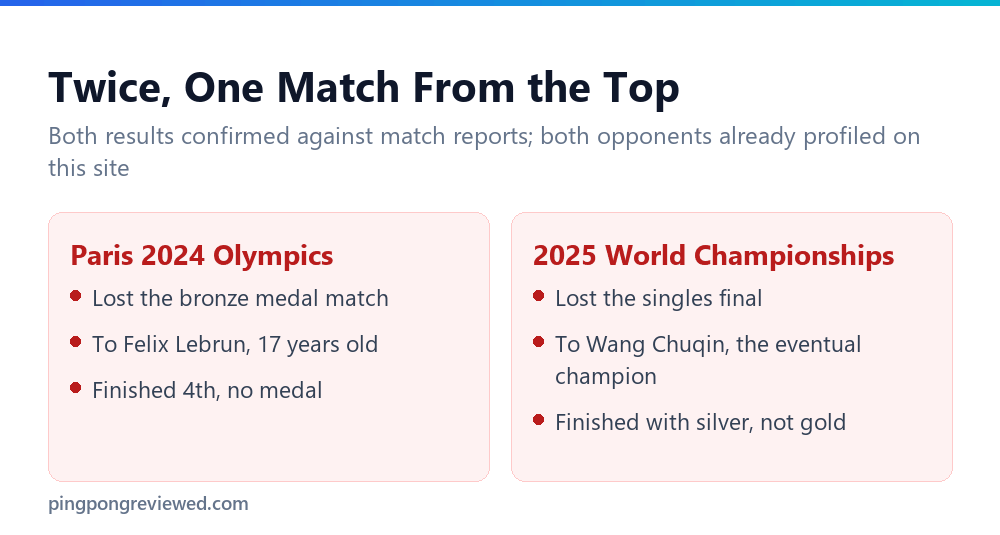
At Paris 2024, he lost the Olympic bronze medal match to a 17-year-old Felix Lebrun. At the 2025 World Championships, he lost the final to Wang Chuqin. In between those two losses sits a historic career.
Short answer: Hugo Calderano was born on 22 June 1996 in Rio de Janeiro, Brazil, and plays a right-handed shakehand grip. In 2025, he became the first player from South America ever to reach a World Championships men’s singles final, losing to Wang Chuqin and taking silver. At Paris 2024, he reached the Olympic semifinals before losing the bronze medal match to Felix Lebrun, finishing fourth. He reached a career-high world ranking of number 2 in February 2026 and was ranked number 7 as of September 2026. Verified across his own tournament record on 4 September 2026.
Table of Contents
The First South American to Reach a World Final
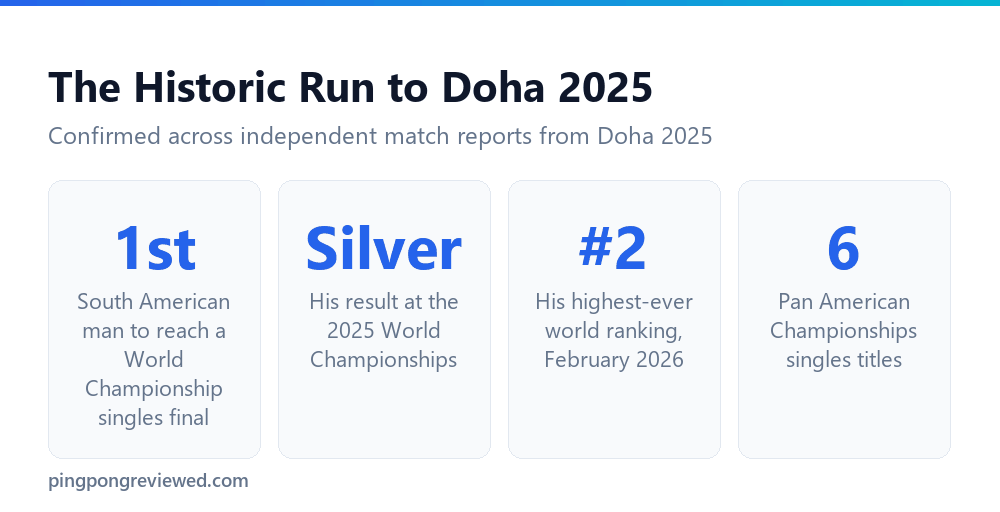
So this is the specific, checkable historical marker: no player from South America had ever reached a World Table Tennis Championships men’s singles final before Calderano did it in Doha in 2025.
He lost the final to Wang Chuqin, the eventual champion and world number one, also profiled on this site. A silver medal from an unprecedented run is still the best World Championships singles result any South American man has ever produced.
The 2025 World Cup title, beating Lin Shidong 4-1 in the final, came the same year as the Doha silver. Two of the sport’s biggest individual results, a World Cup and a World Championships final, in the same twelve-month stretch.
Twice, One Match From the Top
So it’s worth naming both near-misses plainly, since together they say more about his level than either result alone.
At Paris 2024, he reached the Olympic semifinals, then lost the bronze medal match to Felix Lebrun, who was 17 at the time and playing in front of a home French crowd. Calderano finished fourth, the position with the least to show for a strong tournament run.
At the 2025 World Championships, he went one round further than any South American man ever had, and still finished as the runner-up rather than the champion.
⚠️ Watch out: Both losses were to players covered elsewhere on this site. Reading Calderano’s profile alongside the Felix Lebrun and Wang Chuqin profiles gives a fuller picture of both matches than either page does alone.
Continental Dominance Away From the Very Top
So outside the very biggest global stages, Calderano’s record in the Americas is close to total. Six Pan American Championships singles titles and three Pan American Games titles span nearly a decade of continental dominance.
That’s the part of his record that gets less attention than the Doha final specifically, but it’s the foundation underneath it: sustained, repeated championship-level results across years, not a single standout tournament.
💡 Pro tip: A six-time continental champion reaching a genuine world final isn’t a surprise result from nowhere. It’s the expected next step for a player who had already established total continental dominance well before 2025.
His Ranking Peak and Where It Stands Now
So Calderano reached his career-high world ranking, number 2, in February 2026, in the months following his Doha final run. By September 2026, he had settled to world number 7.
A gap between a career-high ranking and a current one is normal for any player, since ranking points earned from a specific tournament run eventually roll off the calculation as newer results replace them. It doesn’t undo the historical marker the Doha run itself set.
The Paris 2024 Bracket in Detail
So it’s worth tracing exactly how Calderano’s Paris 2024 tournament unfolded, since the semifinal loss connects directly to two other players covered on this site.
He lost his semifinal to Truls Moregard, 4-2, in a genuine six-game battle. That sent him into the bronze medal match against Felix Lebrun, where he lost again, finishing fourth. Moregard went on to lose the final to Fan Zhendong, taking silver.
So two of the tournament’s four semifinalists, Calderano and Moregard, both ended up with nothing to show for deep runs relative to gold, one finishing empty-handed at fourth and the other with silver rather than gold.
📊 Note: This site’s Truls Moregard profile covers the same bracket from the winning side of that semifinal, including his own win over Wang Chuqin earlier in the tournament.
What the Doha Final Actually Looked Like
So the 2025 World Championships run deserves more than a single sentence. Reaching a World Championships singles final requires winning six or seven rounds against the deepest men’s singles field in the sport, not one standout match.
Calderano’s opponent in the final, Wang Chuqin, was already the reigning world number one at the time. Losing to the best-ranked player in the sport, in the final itself, is a different outcome than losing earlier to an unseeded upset. It’s the two best remaining players in the tournament, and Calderano was one of them.
⚠️ Watch out: A silver medal at a World Championships is sometimes undersold in casual coverage simply because it isn’t gold. For context, most national federations, including ones with far larger table tennis programs than Brazil’s, have never produced a men’s singles World Championships finalist at all.
Why the Historical Marker Matters
So it’s worth being specific about why “first South American finalist” is a meaningful marker rather than a minor trivia note. Men’s international table tennis at the elite level has been dominated overwhelmingly by Asian and European players for essentially the entire modern history of the World Championships.
A finalist from outside those two continents breaking through isn’t just a personal achievement. It’s evidence that the sport’s competitive base is capable of producing elite-level players from regions that historically haven’t produced them, which matters for the sport’s development well beyond Calderano’s own career.
Building a Program From Outside the Traditional Base
So it’s worth asking what made a Brazilian breakthrough possible in a sport this concentrated in Asia and Europe. Calderano’s continental record answers part of that question directly: six Pan American singles titles across nine years shows a program capable of producing sustained dominance regionally, well before the global breakthrough.
That regional base matters because elite table tennis, more than many individual sports, depends heavily on training partners and infrastructure concentrated in a small number of countries. A player from outside that traditional base has to solve a logistics and training-partner problem that a player from China or Germany simply doesn’t face.
💡 Pro tip: When evaluating a breakthrough result from a player outside table tennis’s traditional powerhouse countries, checking their domestic and continental record first usually explains more about how the breakthrough became possible than the headline result alone.
The Semifinal Rematch Angle
So one detail connects Calderano’s two biggest losses in an interesting way: at Paris 2024, he lost his semifinal to Truls Moregard, also covered on this site. At the 2025 World Championships, he beat his way through to the final without facing Moregard at all, since Moregard didn’t make that specific final.
So the two tournaments took different paths to a similar outcome for Calderano: agonizingly close, twice, against different opposition each time.
How the World Cup Win Fits
So the 2025 World Cup title deserves separating from the World Championships silver, since the two events test something slightly different. The World Cup uses a smaller, invitation-based field of the world’s top-ranked players, decided in a single tournament rather than the full qualification structure the World Championships uses.
Beating Lin Shidong 4-1 in that final meant beating one of the tournament’s other top seeds directly, in a straightforward, comfortable scoreline rather than a nail-biter. That’s a different kind of statement than a close final loss: a dominant win against elite opposition, decisively rather than narrowly.
So between the World Cup title and the World Championships final appearance, 2025 stands as the best individual year of Calderano’s career by a clear margin, and it happened at age 29, well into what many players would consider a settled, mature career rather than a rapid rise.
What Comes Next
So at 30 in 2026, ranked seventh in the world with a career-high of second, Calderano’s window for an Olympic medal or a World Championships title is still open, not closing.
Two near-misses at the very highest level, an Olympic fourth-place finish and a World Championships silver, tend to sharpen a player’s focus rather than discourage it. Both results prove the level is already there. What’s missing is specific and nameable: the single match that turns a near-miss into the title itself.
So the next Olympics and the next World Championships are both worth watching specifically for whether that gap finally closes, and this profile will get updated the moment it does.
Hugo Calderano Questions, Answered
Is Hugo Calderano the first South American to reach a World Championship final?
Yes, in 2025 in Doha, becoming the first player from South America ever to reach a World Table Tennis Championships men’s singles final. He lost the final to Wang Chuqin and won silver.
What happened to Hugo Calderano at the Paris 2024 Olympics?
He reached the semifinals, then lost the bronze medal match to Felix Lebrun, finishing fourth without a medal.
What is Hugo Calderano’s highest world ranking?
World number 2, reached in February 2026. He was ranked world number 7 as of September 2026.
Has Hugo Calderano won a World Cup title?
Yes, the 2025 Table Tennis World Cup, beating Lin Shidong 4-1 in the final.
How many Pan American Championships has Hugo Calderano won?
Six singles titles: 2017, and every year from 2021 through 2025. He has also won three Pan American Games singles titles, in 2015, 2019, and 2023.
Where is Hugo Calderano from?
Rio de Janeiro, Brazil, born on 22 June 1996. He plays a right-handed shakehand grip.
The Short Version
- →Born 22 June 1996 in Rio de Janeiro; right-handed shakehand grip.
- →First South American man ever to reach a World Championships singles final, 2025 Doha.
- →Lost that final to Wang Chuqin; lost Paris 2024 Olympic bronze to Felix Lebrun.
- →Won the 2025 World Cup, beating Lin Shidong 4-1 in the final.
- →Six-time Pan American Championships singles champion, 2017 and 2021-2025.
- →Reached a career-high world ranking of number 2 in February 2026; ranked number 7 in September 2026.
Until then, the record already stands on its own: the best men’s singles result any South American player has produced, twice over, at the sport’s two biggest individual stages. That’s true regardless of how the next chapter of his career unfolds, and it’s a standard no player from his continent had even approached before him, which is worth restating plainly rather than treating as a footnote to two runner-up finishes.

Ping Pong Reviewed is an equipment review site covering table tennis and baseball gear. Specifications are checked against manufacturer listings, and prices against live retail pages, before publication.