Palio Legend 2 Review: Still on Sale, and the Real Bargain

The Palio Legend 2 is the attacking bat at the top of Palio’s pre-assembled range. It is still on sale, it is in stock, and it costs $54.99. That is exactly what the Legend 3.0 costs too.
So this is not a question of old versus current. Both generations sit on the shelf at the same price. And the older one holds the better customer rating, which makes the choice more interesting than it first looks.
Short answer: the Palio Legend 2.0 is rated speed 10, spin 9 and control 6 out of 10, with Palio Hadou rubbers on a harder sponge. It is $54.99 and holds 4.3 stars from 429 ratings. The 3.0 costs the same, adds one point of control, drops 59 grams, and rates slightly lower at 4.1. Buy either. But if you need two bats, the two-racket set works out cheaper per racket than a single.
Table of Contents
Palio Legend 2.0 and 3.0, Side by Side

Palio kept both generations in the catalogue, which is unusual. Most manufacturers retire the old model when a new one arrives. Here they sit at an identical price.
Two things separate them. The 3.0 gains a point of control, moving from 6 to 7. And it sheds roughly 59 grams, which is a substantial weight change on a bat.
Everything else matches. Same speed rating of 10. Same spin rating of 9. Same Palio Hadou rubbers. So the playing character is closely related rather than reinvented.
The customer ratings run against the newer bat, though. The Palio Legend 2 holds 4.3 stars across 429 ratings. The 3.0 sits at 4.1 across 256. Neither sample is small, and the older bat is ahead on both count and average.
📊 Note: Do not over-read a 0.2 star gap. It is a real signal but a soft one, and it may reflect the 3.0 being newer rather than worse. What it does rule out is any claim that the 3.0 is a clear upgrade, because buyers are not rating it as one.
The 59 Gram Difference Matters More Than the Control Point
A 59 gram swing is large in a table tennis bat. For comparison, that is roughly what a whole sheet of rubber weighs. So this is the change most likely to be noticeable in the hand.
A heavier bat carries more momentum through the ball. That suits a looping game played away from the table, where you want the mass behind the stroke. It also steadies the head through contact.
A lighter bat changes direction faster. That matters close to the table, where you are switching between forehand and backhand quickly and recovery time decides whether you get the next ball.
So the Legend 2.0 at 259 grams leans toward power away from the table. Then the 3.0 at 200 grams leans toward speed of handling. Neither is better in the abstract, and that is genuinely a preference rather than a version upgrade.
💡 Pro tip: If you have played with a bundled bat, those are usually light. Moving straight to a 259 gram paddle can feel like swinging a brick for the first week. The 3.0 is the gentler transition, even though both are aimed at advanced players.
Palio Legend 2 Specifications
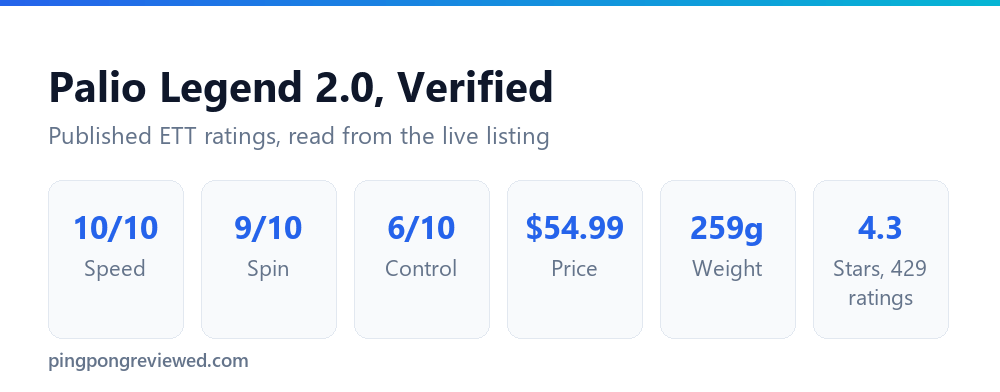
The Hadou rubber is what separates the Legend from the cheaper bats in the range. Palio describes it as featuring a harder sponge, and a harder sponge is what lets a bat generate real pace when you swing fast at it.
That also explains the control rating of 6. A harder sponge gives less dwell time, so the ball leaves quicker and you get less feedback on touch shots. You are buying speed and paying for it in feel.
How the Legend Compares With the Expert and Master

The Palio range is unusually easy to read, because the Legend inverts the numbers of the cheaper bats rather than simply improving them.
Notice that spin stays at 9 across every model. Palio does not sell you more spin as you move up. What changes is the balance between speed and control, and the Legend sits at the far end of it.
So the Legend is not the top of a quality ladder. It is a different tool. If you cannot yet finish points with pace, the extra speed will produce errors rather than winners, and the Expert at $39.99 will teach you more.
The Two-Racket Set Is Cheaper Per Bat
This is the pricing detail worth knowing before you order. A single Legend costs $54.99. But Palio also lists a set of two rackets at $99.99.
That works out at just under $50 each, so the pair is cheaper per bat than buying one. If you play at home with a partner, or want a spare, the set is the better purchase by a clear margin.
⚠️ Watch out: Check what you are adding to the basket. The $99.99 listing is a set of two, and the $54.99 listings are single rackets. The titles are near-identical, and the price is the main clue that you are looking at a different quantity.
Who the Palio Legend Suits
- ✓You already attack with pace and want a bat that keeps up
- ✓You play away from the table and want mass behind the ball
- ✓You want ITTF-approved rubber on a pre-assembled bat
- ✓You need two bats, where the set makes the price work harder
- ✕You are still learning strokes, where the Expert is the better teacher
- ✕You want maximum control, since 6 out of 10 is the range’s lowest
- ✕You want to pick your own blade and rubber separately
- ✕You are moving from a light bundled bat, where 259 grams is a jump
The honest ceiling on any pre-assembled bat applies here too. You cannot change one side without replacing the whole thing. At $54.99 that is a reasonable trade while you work out what you want. It stops being reasonable once you can name the change you would make.
Hadou Against CJ8000, the Rubber That Defines Each Bat
Palio uses two rubbers across the range, and the choice explains nearly all of the difference between models. The Expert and Master both use CJ8000. The Legend uses Hadou.
CJ8000 is a Chinese-style sheet. It grips through surface tack, so it produces spin on slow, brushing contacts. That is why the Expert can be rated control 10 and spin 9 at the same time. The ball stays on the bat and stays on the table.
Hadou runs a harder sponge, which Palio states directly. A harder sponge compresses less on light contact and more on a fast swing. So it stores and returns more energy when you commit to a stroke, and comparatively little when you do not.
That is the whole trade. Speed climbs from 6 to 10. Control falls from 10 to 6. And spin stays at 9, because the topsheet is still doing that job. So the Palio Legend 2 is not a spinnier bat than the Expert. It is a faster one.
⚠️ Watch out: A hard sponge punishes a slow swing. If you are not yet generating racket speed, a Hadou bat gives you less than a CJ8000 one, not more. The sponge never compresses, so the energy it could return is simply never stored.
Why the All-Wood Blade Is Worth Noticing
Most pre-assembled bats aimed at attacking players add carbon or another composite layer to the blade. Carbon stiffens the blade, which raises speed and widens the sweet spot. The Palio Legend 2 does not use it.
The blade is all wood, and the speed comes from the Hadou rubber instead. That is a deliberate choice with real consequences, and it cuts both ways.
- Wood gives more feedback. You feel where on the blade you struck the ball, which a stiff carbon blade tends to flatten out.
- Wood flexes more. That helps on touch shots near the net, where a carbon blade can feel numb and unpredictable.
- Wood has a smaller sweet spot. An off-centre hit costs you more than it would on carbon.
- Wood caps the top speed. A carbon blade with the same rubber would be faster still.
So the Legend is a fast bat built the traditional way. For a player developing attacking strokes, that is arguably the better order to learn in. You get pace from the rubber while the blade still tells you what you did.
Looking After a Hadou Bat
Hard-sponge rubbers do not fail in the way soft ones do. The sponge outlasts the topsheet comfortably. So the surface is what you are protecting.
- ✓Wipe the rubber after sessions with a proper rubber cleaner
- ✓Use protective film on both sides between sessions
- ✓Keep the bat in the supplied case rather than loose in a bag
- ✓Check the edge tape, since a lifting edge peels the rubber away
- ✕Use household cleaners or alcohol, which strip the topsheet
- ✕Leave the bat anywhere hot, which kills a topsheet faster than play does
- ✕Try to re-glue lifting rubber on a pre-assembled bat
- ✕Assume a dead-feeling bat needs replacing before you have cleaned it
You will notice the topsheet going first on serve return. Heavy backspin is the shot with the least margin, so it is where lost grip shows up soonest. If serves you used to read start finding the net, clean the rubber before blaming your technique.
When Buying Two Makes Sense
The two-racket set changes the maths in a way worth thinking through, because it is cheaper per bat than a single.
- Playing at home. Two matched bats mean both players get the same equipment, which makes practice more useful than mismatched paddles do.
- Keeping a spare. Rubber dies gradually. Having a fresh bat to compare against is the easiest way to notice.
- Doubles. A matched pair is genuinely useful if you play doubles regularly with the same partner.
- Coaching or clubs. Spare bats for guests are worth more than most people expect, and these are ITTF-approved rather than toys.
Against that, two advanced bats is the wrong purchase if only one of you attacks. A Legend and an Expert is a better household pair than two Legends, because it matches each bat to the player rather than to the discount.
When to Stop Buying Pre-Assembled
The Palio Legend 2 sits close to the ceiling of what a pre-assembled bat can sensibly be. So it is worth knowing where the format runs out.
You cannot change one side independently. If the forehand rubber wears out first, which it usually does, you replace the whole bat including a perfectly good backhand sheet and a blade that would have lasted years.
You also cannot tune the setup. Most improving players eventually want something specific: a softer backhand, a faster forehand, a different handle shape. A custom build lets you change one variable at a time. A pre-assembled bat does not.
The signal to move on is being able to name the change you want. Until then, a custom build mostly buys choices you are not yet equipped to make, and the Legend at $54.99 remains good value.
One practical check before ordering either generation. Both listings show near identical titles and the same 4.99 price, and the generation number sits well into the product name. So read the title carefully rather than trusting the thumbnail. Buyers regularly order the wrong one, then assume the bat is faulty when it simply weighs 59 grams more than the review they read described.
Palio Legend Questions, Answered
Is the Palio Legend 2 still available?
Yes. It is in stock at $54.99 with 4.3 stars from 429 ratings, and it sells alongside the Legend 3.0 at the same price. Several reviews wrongly describe it as discontinued.
What is the difference between the Palio Legend 2 and 3.0?
One point of control, from 6 to 7, and about 59 grams of weight. The 2.0 is roughly 259 grams and the 3.0 is 200. Speed, spin and the Hadou rubbers are identical, and both cost $54.99.
Which Palio Legend is better rated?
The 2.0, at 4.3 stars from 429 ratings against the 3.0’s 4.1 from 256. Neither sample is small, and the older bat leads on both average and count.
Is the Palio Legend good for beginners?
No. Its control rating of 6 out of 10 is the lowest in the Palio range, and speed is maxed at 10. A beginner learns faster on the Expert 3.0, which is rated control 10 and speed 6 for $39.99.
What rubber does the Palio Legend use?
ITTF-approved Palio Hadou, which Palio describes as having a harder sponge. That is what produces the speed rating of 10, and also why control drops compared with the CJ8000 rubbers on the cheaper models.
How much does the Palio Legend cost?
$54.99 for a single racket in either generation. A set of two Legend 3.0 rackets is $99.99, which works out just under $50 each and is cheaper per bat than a single.
How heavy is the Palio Legend 2?
About 259 grams, listed as 9.12 ounces. That makes it considerably heavier than the 200 gram Legend 3.0, and heavier than most bundled bats people upgrade from.
Is the Palio Legend ITTF approved?
The Hadou rubbers are ITTF approved, which the listing states. As with any bat, one side must be black and the other red, pink, purple, green or blue for sanctioned play.
The Verdict on the Palio Legend 2
- →It is still on sale at $54.99, in stock, and rated higher than the 3.0 that followed it.
- →Speed 10, spin 9, control 6. The fastest and least forgiving bat Palio makes pre-assembled.
- →The 3.0 differs by one control point and 59 grams, at the same price.
- →Spin is rated 9 across the entire Palio range, so moving up does not buy more of it.
- →The two-racket set at $99.99 is cheaper per bat than either single.
The Palio Legend 2 does one thing the cheaper bats in the range deliberately will not. It lets you hit through the ball. That is worth $54.99 if your technique is ready for it. But if it is not, the Expert costs fifteen dollars less and will make you better faster.
As an Amazon Associate, we earn from qualifying purchases through links on this page.

Ping Pong Reviewed is an equipment review site covering table tennis and baseball gear. Specifications are checked against manufacturer listings, and prices against live retail pages, before publication.