Does Playing Ping Pong Help Tennis? The Honest Answer

Does playing ping pong help tennis? Yes and no, and the two halves are specific enough to be worth separating rather than averaging into a verdict. Ping pong genuinely transfers in a few areas — reaction time, hand-eye coordination, reading spin off a racket face — and transfers barely at all in others, including the footwork, swing length and physical demands that decide most tennis points. Sources that answer this with a flat yes or a flat no are both wrong, which is why so many of them manage to contradict themselves within a few paragraphs.
Table of Contents
What Actually Transfers, and What Doesn’t
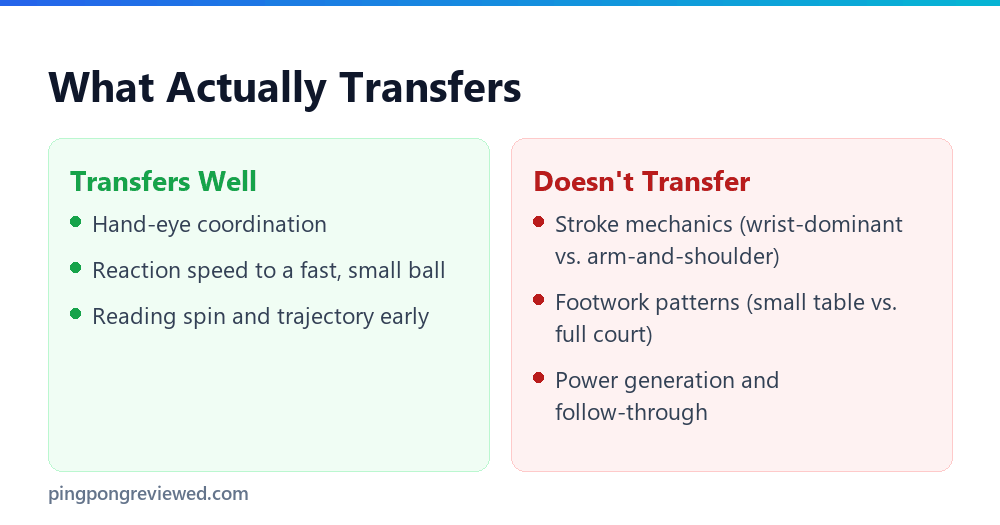
Ping pong and tennis share a fundamental structure — a net, a ball, alternating shots, points scored on errors — but the physical execution is different enough that most stroke mechanics don’t transfer directly. A ping pong forehand is largely wrist- and forearm-driven because the paddle is light and the ball travels a short distance; a tennis forehand relies on full arm extension, shoulder rotation, and a much longer swing path because the racket is heavier and the ball has farther to travel. Someone who tries to hit a tennis forehand with ping-pong-style wrist snap will generally produce a weak, inconsistent shot.
What genuinely does transfer is perceptual, not mechanical. Ping pong’s ball travels faster relative to the playing area than almost any other racket sport, which trains faster visual tracking and quicker decision-making under time pressure. Players who grow up playing ping pong tend to pick up a tennis ball’s spin and trajectory faster than complete beginners, because the underlying skill of reading a spinning ball early is genuinely shared between the two sports even though the swing itself isn’t.
The Specific Skills That Carry Over
Hand-Eye Coordination
This is the clearest, most well-supported transfer. Tracking a small, fast-moving ball and making split-second contact decisions is a skill that generalizes across racket sports more than stroke mechanics do. Regular ping pong play measurably sharpens this kind of tracking.
Reaction Speed
Ping pong rallies happen at a faster reaction pace, relative to the distance the ball travels, than tennis rallies typically do. Players who train that faster reaction window often find tennis reactions feel comparatively more manageable, simply because their baseline reaction speed has been pushed higher.
Reading Spin Early
Ping pong’s tighter margins mean players learn to read spin off the opponent’s paddle angle at contact, before the ball’s flight even confirms it. That early-read habit transfers usefully to tennis, where topspin and slice are also read partly from racket preparation rather than only from ball flight.
Where Ping Pong Won’t Help — And Can Even Hurt
A few habits that work in ping pong actively work against a tennis player, and are worth being aware of rather than assuming all crossover is positive:
- Wrist-dominant strokes. Ping pong rewards wrist snap; tennis strokes built around wrist snap instead of shoulder rotation tend to be weak and inconsistent.
- Compact footwork. A ping pong table is a fraction of the size of a tennis court — the small, quick shuffle-steps that work at the table don’t prepare you for full-court lateral coverage.
- Short backswings. Ping pong’s short table distance rewards a compact swing; tennis generally needs a longer backswing to generate comparable power.
- Grip habits. A shakehand or penhold table tennis grip doesn’t map cleanly onto a tennis continental, eastern, or western grip — expect to relearn grip entirely, not adapt one.
Who Gets the Most Out of This Crossover
Junior Players Building General Athleticism
Young players who haven’t yet specialized tend to benefit most from mixing ping pong into their training, since the reaction-speed and coordination gains happen faster in younger athletes and the risk of ingraining bad tennis-specific habits is lower before those habits are fully set.
Tennis Players in an Off-Season or Injury Recovery
Ping pong is lower-impact than tennis — smaller movements, less running, less joint stress — which makes it a reasonable way to maintain hand-eye sharpness and reaction speed during an off-season or a return from a lower-body injury, without the full physical demand of on-court tennis training. Always check with a physical therapist or physician before resuming any racket sport activity during an active injury recovery period.
Complete Beginners to Racket Sports in General
Someone with zero racket-sport background picks up basic tracking-and-contact skills faster through ping pong than through tennis, simply because the table tennis learning curve for making consistent contact is shorter — a smaller paddle, a shorter distance, and a lighter ball all make that first month of contact-making noticeably easier than tennis’s steeper initial learning curve. That head start in raw hand-eye ability can make the first few tennis lessons feel less overwhelming, even though the actual tennis stroke still has to be learned from scratch regardless of prior ping pong experience.
What the Research Actually Shows
Sports science on cross-sport skill transfer generally supports the specific-not-general pattern described above rather than a blanket “racket sports all help each other” claim. Reaction time and visual tracking are classified as generalizable perceptual-motor skills that transfer reasonably well across different sports involving fast-moving small objects. Stroke mechanics, by contrast, are classified as sport-specific motor patterns that transfer poorly or not at all between sports with meaningfully different equipment and biomechanics — exactly the pattern this page describes between ping pong and tennis.
This is also why serious tennis academies that do use table tennis in training almost always frame it explicitly as a reaction-and-coordination drill, with a time limit and a specific purpose, rather than as open-ended free play meant to build tennis skill directly. The distinction matters in practice, not just in theory — a coach who understands which specific skills genuinely transfer gets more value out of a short structured session than one who just adds unstructured table tennis time and hopes it generally helps.
Frequently Asked Questions
Does playing ping pong help tennis?
Yes, but only for specific skills — hand-eye coordination, reaction speed, and early spin-reading all transfer well. Stroke mechanics, footwork patterns, and power generation don’t transfer and can even work against a tennis player if leaned on too heavily.
Can ping pong hurt my tennis technique?
It can, specifically around wrist-dominant contact. Ping pong rewards wrist snap because the paddle is light and the distance is short; carrying that habit into a tennis stroke, which needs shoulder-and-arm-driven power, tends to produce a weaker, less consistent shot.
Is ping pong good cross-training for tennis players?
Yes, specifically as a reaction-speed and coordination supplement, not as a substitute for stroke practice. Many tennis coaches use quick-reaction table tennis drills for exactly this reason, while still keeping all actual stroke development work on the tennis court itself where it belongs.
Which sport is harder to learn first?
Neither is objectively harder, but they develop different base skills first. Ping pong builds faster hand-eye reflexes early; tennis builds full-body coordination and footwork over a larger space. Players who learn both report the transition easier in the reaction-speed direction than in the stroke-mechanics direction.
Should a tennis coach recommend ping pong to students?
As a supplementary reaction and coordination drill, yes — many tennis academies already do exactly this. As a substitute for actual stroke practice on a tennis court, no — the mechanical differences described above mean ping pong time can’t replace genuine tennis-specific swing development on real courts.
Does the same logic apply to badminton or squash?
Broadly yes — the pattern of perceptual skills transferring while stroke mechanics don’t generalize holds across most racket sport pairings, not just ping pong and tennis specifically. The exact details of which mechanics clash more or less depend heavily on the specific pair of sports being compared in any given case.
How much ping pong practice actually produces a noticeable effect?
There’s no precisely established threshold, but coaches who use it as a supplementary drill typically program short, focused sessions — 15 to 20 minutes of genuine reaction-speed work — rather than long, unstructured casual play, on the reasoning that focused practice transfers noticeably better than casual volume alone ever does.
Can playing too much ping pong actually make tennis worse?
It’s possible if a player leans on wrist-dominant contact out of habit rather than deliberately switching to proper tennis mechanics on the court. This is more a matter of not consciously separating the two skill sets than an inherent problem with playing both sports regularly side by side.

Ping Pong Reviewed is an equipment review site covering table tennis and baseball gear. Specifications are checked against manufacturer listings, and prices against live retail pages, before publication.