Ping Pong Serving Rules: The Official ITTF Requirements
Ping pong serving rules are widely discussed and rarely stated. What follows is what the ITTF rulebook actually requires for a legal serve — the toss, the palm, the visibility requirement and what separates a fault from a let — along with why the rules changed into their current form, which explains several of the requirements that otherwise look arbitrary.
Serving matters more in table tennis than in most racket sports because the server has near-total control over the shot before the opponent touches the ball — placement, spin, speed, and deception are all decided before the point even truly begins. That’s exactly why the ITTF has tightened these rules over the decades: a serve that’s too deceptive or too hard to read turns the sport into a serving contest rather than a rally-based game.
The Actual Serving Rules
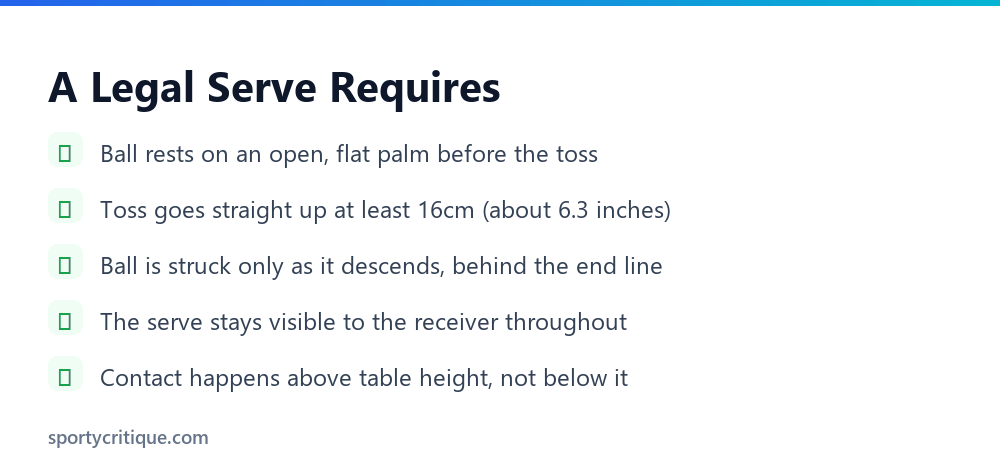
Rule 2.6 of the ITTF handbook governs serving, and it’s more specific than most players realize. The ball must rest on an open, flat palm — not a cupped or closed hand — before the server tosses it. The toss itself has to go nearly vertically upward at least 16cm above the point it left the palm, roughly 6.3 inches, and the server can only strike the ball as it falls, never on the way up or at the peak.
The contact point matters too: the ball has to be struck behind the server’s own end of the table (or its extension), and the entire serve — toss, ball, and paddle — has to stay visible to the receiver the whole time. A serve struck from below table height, or hidden behind the server’s body or free arm, is illegal regardless of where it lands.
Why the Rules Changed

Serving used to be a much bigger advantage than it is today. Elite players in the 1990s developed serves where the ball and paddle were briefly hidden behind the server’s body or free arm during the toss, making the spin nearly impossible for an opponent to read in time. The ITTF banned this outright in 2002, requiring the serve to stay visible to the receiver from toss to contact — the same visibility rule still in effect today.
The 16cm minimum toss height exists for a closely related reason: without any minimum height requirement at all, a server could barely lift the ball and strike it almost immediately, giving the receiver even less time to read and react to the serve. Combined, the visibility rule and the toss-height rule are what keep a modern legal serve honest — fast and spin-heavy, but not deceptive in the way it once was.
Common Serving Faults
A few mistakes account for most illegal serves called at the club level, most of them unintentional rather than a deliberate attempt to cheat. Being aware of these before they become ingrained habits saves the frustration of relearning your serve later if you ever move into officiated or tournament play, where every one of these gets called consistently:
- Tossing at an angle instead of straight up — even a slight forward toss to add deception is technically illegal under the vertical-toss requirement.
- Tossing below 16cm — a barely-lifted toss is one of the most common faults at casual and club level, often unnoticed until pointed out.
- Striking the ball on the way up — legal contact only happens as the ball descends, not during the rise.
- Hiding the ball with the free arm or body — even accidental, this recreates the pre-2002 hidden serve and is called as a fault.
- Serving from in front of the end line — contact has to happen behind your own end of the table, not over it.
Serving Rules Are Different in Doubles
For court markings, diagonal delivery, and team rotation details, read our complete guide to Ping Pong Doubles Rules & Rotation.
Singles serving rules allow the ball to land anywhere on the opponent’s side of the table, but doubles adds a diagonal restriction: the serve must bounce once on the server’s own right half of the table, cross the net, and land on the receiver’s right half diagonally opposite — see our doubles rules guide for the full rotation and serving-order breakdown. A serve that lands on the left half in doubles is illegal even if every other requirement — toss height, visibility, contact point — is met correctly.
This diagonal rule is why doubles serves tend to look more conservative than singles serves at first glance: the legal target area is smaller, roughly a quarter of the table instead of half, which naturally limits how aggressive a doubles server can be with placement compared to singles. Players who switch between formats often need to consciously adjust their target zone rather than relying on the wider singles habit.
Let Serves Aren’t Faults
A let serve — where the ball clips the top of the net during the serve but still lands legally in the correct area — isn’t an illegal serve and doesn’t cost the server a point. It’s simply replayed with no penalty, unlimited times if it keeps happening. This is different from a serve that hits the net and doesn’t clear it, or one that clears the net but lands outside the legal area — both of those are point-ending faults, not lets.
Distinguishing a let from a genuine fault trips up a lot of newer players, since both situations involve the net in some way. The deciding factor is simple: did the ball still land in the correct legal area after touching the net? If yes, it’s a let and gets replayed with no consequence. If the ball fails to clear the net entirely, or lands outside the legal target area even after clipping the net, it’s a fault and the point ends immediately in the receiver’s favor.
The Equipment Rules That Affect a Legal Serve
Equipment regulations play a massive role in legal play. For a complete overview of table, ball, and racket specifications, see our comprehensive Ping Pong Rules Guide and our breakdown on why ping pong paddles must be red and black.
Serving legally depends partly on equipment meeting specification, and a few of these come up in practice more often than players expect.
- The ball must be 40mm, spherical, and of an approved material and colour, white or orange, matte rather than shiny. Current sanctioned play uses plastic 40+ balls.
- The racket must have two clearly different coloured sides so the receiver can see which surface struck the ball. This exists specifically to stop deception via surface swapping, and it makes two same-coloured sheets illegal.
- The rubber must be ITTF-approved for sanctioned play, and the combined rubber and sponge thickness is capped.
- The table and net must meet standard dimensions, with the net at 15.25cm and extending 15.25cm beyond each side.
Most of this is invisible in recreational play, where nobody checks. It becomes immediately relevant the first time you enter an organised event, and the equipment rule that catches people out most often is the two-colour requirement, because a bat with two black sides is perfectly usable at home and simply not permitted in competition.
Scoring and Match Format
Serving rules only make sense alongside the scoring structure they sit in, since service rotation is defined by the score.
A game is played to 11 points and must be won by 2. At 10-10, known as deuce, play continues until one player leads by two clear points, and there is no upper limit on how long that can take.
Service alternates every 2 points. At deuce, service alternates every single point instead, which prevents a strong server dominating an extended finish. This is the rule most casual players have never adopted, and it changes deuce noticeably.
Matches are typically best of five or best of seven games. Players change ends after each game, and in the final game they change again when one player reaches 5 points, which balances any environmental advantage such as lighting or a distracting background on one side of the table.
The choice of who serves first is decided by lot, commonly a coin toss or hidden-ball guess. The winner may choose to serve, to receive, or to pick an end, and the opponent takes the remaining choice.
Faults Beyond the Serve Itself
Serving rules sit inside a broader set of rules about how points are lost, and knowing the neighbouring ones prevents most on-table disputes.
- Touching the ball with anything other than the racket hand below the wrist loses the point. A ball off your body or your non-playing hand is your point lost, not a let.
- Moving the table during a rally, or touching it with your free hand, loses the point.
- Touching the net or its supports with your body, racket, or clothing during play loses the point.
- Double bounce on your own side, or failing to return the ball over the net, loses the point in the obvious way.
- Edge balls count. A ball striking the top edge of the playing surface is in. A ball striking the vertical side is not, and this distinction causes more arguments than any other single rule.
The edge-ball rule is worth being clear on because casual players frequently believe edges are automatically out or automatically in. Neither is correct: the top surface is in play right to its edge, and the vertical side face is not part of the playing surface at all.
Lets: When a Point Is Replayed
A let is not a fault and not a point, it is a replay, and confusing the three is a frequent source of disagreement in casual games.
- The serve clips the net and still lands legally in the correct area. Replayed, with no penalty and no limit on how many times it can occur.
- The receiver was not ready and made no attempt to play the ball. Replayed, provided they genuinely did not attempt it.
- Play is disturbed by something outside the players’ control, such as a ball arriving from another table.
- The umpire interrupts to correct a service order or ends error.
The one worth being clearest about is the net serve. It is replayed rather than lost, which surprises players who have absorbed the tennis convention of a limited number of let serves. In table tennis there is no such limit, and a genuinely unlucky server can clip the net repeatedly with no penalty at all.
Serving Misconceptions Worth Clearing Up
- “You get two serves like tennis.” No. Table tennis has one serve, and a serve that fails is a lost point, not a second attempt. Only a net-clipping serve that otherwise lands legally is replayed.
- “The serve must go diagonally.” Only in doubles. In singles the serve may land anywhere on the opponent’s half.
- “You cannot serve into the net.” A serve that hits the net and does not land legally is a lost point, not a replay. The replay only applies when it clips the net and still lands correctly.
- “Hiding the serve is just good technique.” It is explicitly illegal, and has been for many years.
- “The ball has to bounce before you can hit the serve.” The ball is tossed and struck in the air on its descent, not bounced first.
Most of these come from tennis, which shares vocabulary and very little else in its service rules. Worth unlearning deliberately if you came to table tennis from a racket sport, because tennis intuitions are wrong here more often than they are right.
The Expedite System
A rule most recreational players have never encountered but which is worth knowing exists, since it shapes how defensive play works at higher levels.
If a game has not finished within a set time, or if both players request it, the expedite system comes into force. Under expedite, the receiver wins the point if they make a set number of successful returns, which removes the incentive for both players to simply keep the ball in play indefinitely.
Once expedite is invoked in a match, it applies for the remainder of that match, and service alternates every point rather than every two. The practical effect is to force attacking play, since a purely defensive strategy now loses points automatically.
This exists because table tennis, before the rule, could produce extremely long defensive rallies between two players unwilling to take a risk. It is rarely triggered in modern play, partly because modern equipment favours attacking, but it remains part of the rulebook.
Why the Serving Rules Are This Strict
The service rules look fussy until you know what each one was introduced to prevent, at which point they read as a series of closed loopholes.
The open-palm requirement exists because servers used to impart spin with the fingers during the toss, producing a ball whose rotation the receiver had no way of reading. Requiring a flat, stationary palm removes that entirely.
The 16cm minimum toss exists because a serve struck almost immediately off the hand gives the receiver essentially no time to observe the contact. Forcing a genuine toss creates a visible window in which spin can be read.
The visibility requirement is the most recent of the major changes and closed the largest remaining loophole. Servers had developed sophisticated methods of hiding contact behind the free arm or torso, which made high-level serves nearly unreadable and distorted the balance between server and receiver.
Taken together, the rules exist to keep the serve an advantage rather than a winning shot in itself. Understanding that makes them easier to remember, because each requirement is answering the same question: can the receiver actually see what is being done to the ball?
Conduct and Interruptions
Several rules govern what happens around the play rather than during it, and they arise more often than newcomers expect.
- Timeouts. Each player or pair may take one timeout per match, of a limited duration. It is a tactical tool for breaking an opponent’s momentum as much as a rest.
- Towel breaks. Players may towel down at set intervals, commonly every 6 points and at the end of each game, rather than whenever they choose.
- Damaged equipment. If a ball or racket is damaged in play, there are defined procedures for replacement rather than simply swapping at will.
- Coaching. Rules on when advice may be given vary by competition level, and are stricter than recreational players generally assume.
None of this matters at home. All of it matters the first time you play in a structured event, and being unaware of the towel and timeout conventions specifically is a common way for a first-time competitor to feel out of place unnecessarily.
Legal Serve Variations Worth Developing
Within the rules there is a great deal of room, and knowing which variations are legal is what turns rule knowledge into an advantage rather than a constraint.
- Backspin serve. Brushing under the ball at contact. Lands short and stays low, and makes an attacking return difficult. The most useful first serve to develop properly.
- Topspin serve. Brushing up the back of the ball, producing a longer, faster serve that pushes the receiver back.
- Sidespin serve. Brushing across the ball, curving its path and kicking it sideways off the receiver’s bat if they meet it square.
- Combination serves. Backspin-sidespin and topspin-sidespin are extremely common at club level and above, because they are harder to read than either component alone.
- No-spin serve. Contacting near the handle where racket speed is lowest, producing a serve that looks like a spin serve and carries almost nothing. Highly effective against players who read the motion rather than the contact.
The tactical principle underneath all of these is that variation matters more than any single serve’s quality. Two serves that look identical and do different things beat one exceptional serve used repeatedly, because a receiver adapts to anything predictable within a few points.
Placement is the other half and gets far less attention than spin. Short serves to the middle restrict the angles a receiver can create; long serves to the corners force movement. Varying length and width is at least as disruptive as varying spin, and it is considerably easier to learn.
Rules From the Receiver’s Side
Serving rules define what the receiver may expect, and knowing them from that side is how you recognise an illegal serve rather than assuming you simply read it badly.
The receiver is entitled to see the ball from the moment it leaves the server’s hand until contact. If the server’s body or free arm obscures it, the serve is illegal regardless of how effective it was. Similarly, a toss that is visibly short of 16cm, or that travels backwards rather than near-vertically, is a fault.
In practice, calling this in a friendly game is awkward and often not worth it. In an umpired match it is the umpire’s job. In a club league without umpires the convention is usually to mention it politely between games rather than mid-point, and to accept that many players serving illegally are doing so unknowingly rather than deliberately.
The more useful response for most players is defensive rather than procedural: if you cannot see the contact, assume you cannot read the spin, and play the safe controlled push described earlier rather than guessing at an aggressive return.
🏓 Looking for Maximum Spin & Control on Your Serves?
A legal high-toss serve relies on heavy friction and consistent contact. If you’re practicing with slick, worn-out pre-assembled rubber, your spin serves will slide off the blade instead of gripping. Find the right racket matched to your style:
Practising a Legal Serve
Knowing the rules and executing them under match pressure are different skills, and the serve is where illegal habits form most easily because they usually go uncorrected in casual play.
The two requirements that slip most are toss height and visibility. A short toss and a serve partially hidden behind the body or free arm both develop gradually, feel normal to the player doing them, and get called immediately in an umpired match. Filming your own serve from the receiver’s position is the fastest way to find out whether yours is legal, because you genuinely cannot see this from your own side.
- Ball resting on a flat, open palm, stationary, above the table level and behind the end line before the toss.
- Toss at least 16cm near-vertically, with no imparted spin.
- Strike the ball as it descends.
- Keep the ball visible to the receiver from the moment of the toss until contact, moving the free arm clear.
Practising deliberately legal serves from the start is far easier than correcting an illegal habit later, because by then the illegal element is usually load-bearing, the serve works partly because it is hidden, and making it legal means rebuilding its effectiveness from something else.
The Rules in One Place
Reduced to what you actually need at the table, a legal serve requires all of the following, and a serve failing any one of them is a fault rather than a replay.
- Ball resting on a flat, stationary, open palm, above table level and behind the end line.
- Toss at least 16cm, near-vertical, with no spin imparted by the hand at any point during it.
- Struck on the descent, after the toss has peaked, rather than on the way up or straight out of the hand.
- Visible to the receiver throughout, with the free arm moved clear.
- Bounces once on the server’s side, then once on the receiver’s side, going over or around the net assembly.
- In doubles only, travelling diagonally from the server’s right half-court to the receiver’s right half-court, which is what the centre line on the table is for.
Everything else on this page is context for those six points: what happens when a serve clips the net, what the receiver may object to, how service rotates with the score, and what the surrounding faults are. If you remember the list and nothing else, you will serve legally in any setting, whether that is a club league, a tournament, or simply a game where someone knows the rules well enough to notice. The list is short and the individual requirements are not difficult; what makes serving illegally so common is simply that nobody corrects it in casual play until the habit is already established. Correcting a serve you have used for years is considerably harder than learning a legal one from the outset, which is the main argument for reading a page like this one early rather than after someone finally objects.
Frequently Asked Questions
What happens if a serve is called illegal?
The point automatically goes to the receiver — there’s no warning or do-over for a genuinely illegal serve, unlike a let serve (where the ball clips the net but still lands legally), which is simply replayed.
How high does the ball need to be tossed?
At least 16cm (about 6.3 inches) above the point it left your open palm. There’s no maximum height at all — tossing higher than the required minimum is perfectly legal, just less common in practice since it gives the receiver more time to prepare.
Can you serve with a closed fist?
No — the ball must rest on an open, flat palm before the toss begins. A closed or cupped hand is an illegal starting position under current ITTF rules, called as a fault if noticed.
Is the hidden serve completely banned?
Yes, since 2002. The serve must stay visible to the receiver at every stage, from the toss through contact, which eliminated the behind-the-body hidden serves that were legal and common before that rule change.
Do these rules apply in casual, non-tournament play?
Technically only tournament play is officiated closely enough to enforce every detail, but learning the official rules from the start avoids building illegal habits that become hard to unlearn if you ever move into competitive play.
Why is the serving rule about visibility so strict?
Because before the 2002 ban, elite players used hidden serves to make spin nearly unreadable, which turned matches into a serving contest rather than a skill-based rally sport. The ITTF tightened the rule specifically to restore fairness to the return of serve, not to make serving harder in general.
Can the receiver stand anywhere they want?
Yes — unlike the server, the receiver has no positional restriction and can stand wherever gives them the best chance to read and return the serve, as long as they don’t interfere with the server’s legal toss and swing.
Does the serve alternate every point?
In singles, yes — service alternates every two points (except during deuce, when it alternates every single point) rather than staying with one player for an entire game, which keeps the serving advantage balanced across a full match.
What’s the penalty for repeatedly serving illegally?
Each illegal serve simply costs the point immediately — there’s no escalating penalty for repetition in casual or club play the way there might be in some other sports. In sanctioned tournament play, an umpire may issue a warning for a suspected deliberate pattern of illegal serves, but the core penalty is always the lost point itself.
Do I need to toss the ball on every single serve?
Yes — the toss and the 16cm minimum height are mandatory on every serve without exception, not just the first serve of a game or match. Skipping the toss and striking directly from a resting position is illegal regardless of how many times it’s repeated during a match.

Ping Pong Reviewed is an equipment review site covering table tennis and baseball gear. Specifications are checked against manufacturer listings, and prices against live retail pages, before publication.