How to Put Spin on a Ping Pong Ball, Correctly (2026)
Putting spin on a ping pong ball is widely explained badly, so it is worth starting with what spin does not do. It is not “a force that keeps the ball in the air and slows its descent” — that description turns up often and describes nothing that happens on a table tennis table. Nor is there a third main spin type called “Corkspin”; the term does not appear in any legitimate coaching resource. What follows is the actual mechanics: what spin genuinely does to a bounce, the real spin types, and how to produce each one.
Getting the underlying mechanics right matters more than it might seem for a technique page like this one, since practicing a genuinely wrong mental model of what you’re trying to achieve can actively slow down how quickly you develop real spin. A player trying to “keep the ball in the air” is optimizing for the wrong outcome entirely, compared to a player deliberately brushing the ball to create a bounce their opponent will misjudge.
Table of Contents
What Spin Actually Does
Spin doesn’t keep the ball in the air longer or slow its descent in any way that matters practically. What it actually does is change how the ball behaves on bounce, both off the table and off your opponent’s paddle. A spinning ball grips the table surface asymmetrically on contact, which alters its bounce angle and trajectory in a way that’s hard to read and react to correctly. That unpredictability, not airtime, is spin’s entire practical value: it makes your shot genuinely harder for your opponent to judge and return cleanly.
This works through friction, specifically. Your paddle’s rubber grips the ball’s surface momentarily on contact, and a brushing motion, rather than a flat, direct hit, converts some of your swing’s forward energy into rotational energy instead. That rotation then interacts with the table on bounce: a topspin ball’s rotation, moving forward-and-down at the contact point, grips the table surface and gets pulled downward faster than a non-spinning ball would, while a backspin ball’s rotation does the opposite, resisting forward momentum on bounce and sometimes even pulling slightly backward. Neither effect has anything to do with airtime; both are entirely about what happens at the bounce.
The Real Spin Types
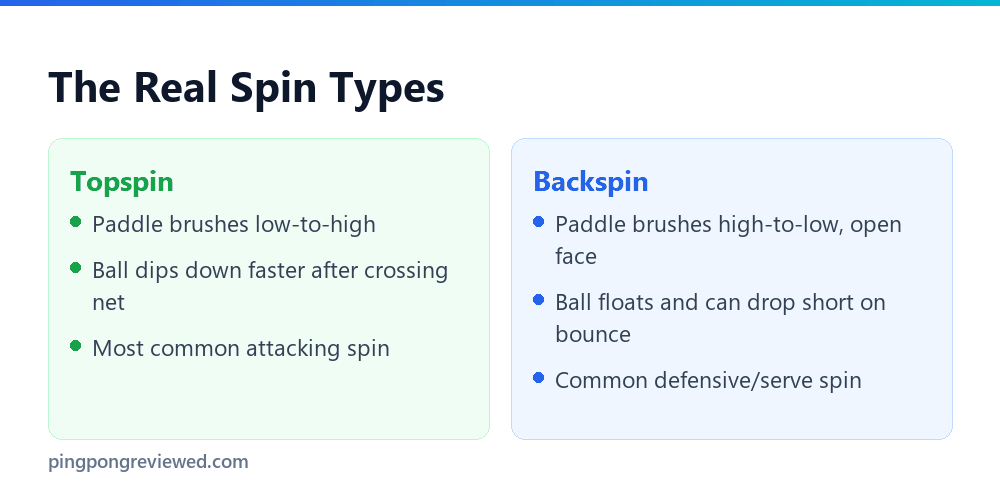
There are three genuine spin types, plus combinations of them. Topspin, produced brushing the paddle from low to high across the ball’s back-top surface, makes the ball dip downward faster after crossing the net, the spin used most in aggressive, attacking play. Backspin, produced with an open paddle face brushing from high to low under the ball, makes it float longer and drop short or even backward slightly on bounce, common in defensive play and many serves. Sidespin, produced brushing across the ball’s left or right side, curves its bounce direction sideways rather than affecting depth. Real shots frequently combine two of these, topspin-sidespin or backspin-sidespin being genuinely common combinations, rather than each type existing purely in isolation.
The Actual Technique
Topspin
Start with your paddle below and slightly behind the ball, then swing forward and upward in a brushing motion, grazing the ball’s surface rather than hitting it flat-on. The brushing contact, not raw swing speed, is what actually generates spin; a slower brush with good contact angle produces more spin than a fast, flat hit.
Backspin
Open your paddle face slightly and swing from above the ball downward and forward, brushing the underside. This requires more precise control than topspin since the margin for a clean brushing contact is narrower, which is part of why backspin generally takes longer for new players to develop consistently.
Sidespin
Brush across the ball’s left or right side with a horizontal paddle path rather than the vertical brushing used for topspin and backspin. Pure sidespin is less common in casual play than topspin-sidespin or backspin-sidespin combinations, which most players develop naturally once they’ve built consistent topspin and backspin technique individually.
A common early mistake worth naming directly: swinging harder to try to generate more spin. Raw swing speed increases ball speed, not spin, and a fast, flat contact actually reduces spin compared to a slower, well-angled brushing motion, since flat contact grips the ball less and for less time than a genuine grazing brush does. If your shots feel powerful but your opponent isn’t struggling to read them, that’s often a sign you’re generating speed without much real spin, worth deliberately slowing down and focusing on brush angle instead of trying to swing harder.
How to Actually Practice This
- Shadow swings without a ball first — building the correct brushing motion before adding ball contact removes one variable while you learn the feel.
- Multiball practice with a partner or coach feeding balls consistently lets you repeat the same spin motion many times in a row, faster than rally-based practice allows.
- A ball machine or robot serves the same repetition purpose solo, worth considering if you don’t have a regular practice partner; our robot guides cover verified options.
- Rubber quality genuinely matters here — higher-grip rubber generates more spin from the same brushing technique, covered in our rubber buying guides.
How We Corrected This Page
The spin mechanics, technique descriptions and terminology on this page are checked against standard table tennis coaching sources. That check matters more here than on most topics, because spin explanations online contain a high proportion of invented terminology and physics that does not survive contact with how the ball actually behaves.
The friction and brushing mechanics described here reflect the actual physical principle every legitimate table tennis coaching resource explains spin through, contact quality and angle, not force or airtime. We’d rather present a shorter, accurate explanation of the real mechanism than a longer one built around an inaccurate model that would actively mislead a reader trying to develop real spin technique.
The Bottom Line
Real spin comes from brushing contact converting swing energy into rotation, and that rotation’s entire practical value lies in making your opponent misjudge the bounce, not in keeping the ball airborne longer. Start with topspin, the most forgiving type to learn cleanly, add backspin once that feels consistent, and treat sidespin combinations as a natural extension of both rather than a separate skill to chase first. Be sceptical of any source describing spin types you cannot find in a coaching manual.
Frequently Asked Questions
How do you spin the side of a ping pong ball?
Brush across the ball’s left or right side with a horizontal paddle path rather than the vertical brushing motion used for topspin or backspin, curving the ball’s bounce direction sideways.
How do you return a spinning ball correctly?
Read the spin from your opponent’s paddle angle and swing path before contact, then adjust your own paddle angle to counteract it accordingly, closing the face against heavy topspin and opening it against heavy backspin to compensate.
How do you get more spin on a ping pong paddle?
Focus on brushing contact rather than flat, hard hits, and use rubber with higher grip characteristics, which generates more spin from the same brushing motion.
Can you put spin on a serve in ping pong?
Yes, and serve spin is genuinely one of the most tactically important skills in the entire sport, since a well-disguised spin serve is difficult for an opponent to read correctly before it even bounces on their side.
How do you do a spin serve specifically?
Toss the ball per the legal serve requirements, then use a brushing paddle motion during contact, the same brushing principle as topspin, backspin, or sidespin in a rally, applied to the serve motion specifically.
How can I practice my spin serves effectively?
Practice the serve motion in isolation repeatedly, ideally with feedback from a coach or more experienced player who can tell you whether the spin is actually reading as intended, since it’s hard to judge your own serve’s spin quality without outside feedback.
Does spin actually keep the ball in the air longer?
No, this is a common misconception. Spin changes how the ball behaves on bounce, off the table and off a paddle, not how long it stays airborne. Its practical value comes entirely from making bounce trajectory harder to read.
Is there a spin type called corkspin in table tennis?
No — this isn’t a genuinely recognized term anywhere in the sport. The real, standard spin types are topspin, backspin, and sidespin, along with real combinations of these three.
Why is topspin easier to learn than backspin?
Topspin’s brushing motion has a wider margin for error during contact, while backspin requires a more precise, controlled grazing angle underneath the ball, which takes most players longer to develop consistently.
As an Amazon Associate, we earn from qualifying purchases through links on this page.

Ping Pong Reviewed is an equipment review site covering table tennis and baseball gear. Specifications are checked against manufacturer listings, and prices against live retail pages, before publication.