Can You Hit a Ping Pong Ball with Your Body or Chest? ITTF Obstruction Rules
Table of Contents
Quick Answer: Can You Hit a Ping Pong Ball with Your Body or Chest?
No, you cannot intentionally or unintentionally hit a ping pong ball with your chest, torso, arm, or leg to return it over the net. Under ITTF Law 2.5.7, a legal stroke can only be executed by the racket or the racket hand below the wrist. If the ball touches your chest or clothing during an active rally while the ball is over the table, you forfeit the point immediately.
The Critical Exception: If your opponent hits the ball completely past your endline or sidelines without it touching your table half first, and it strikes your chest in mid-air outside the court perimeter, YOU WIN THE POINT. Once the ball crosses the boundary of the table without bouncing, it is legally dead and “out”; your body merely stopped an out-of-bounds ball.
Few situations cause more heated arguments in basement matches, office leagues, and club tournaments than a ping pong ball striking a player’s body. A fast drive ricochets off the table, glances off your shirt, and lands on the opponent’s side—is the rally still alive? Or an aggressive smash sails completely past the table, hits you in the chest, and your opponent shouts: “Point to me, it hit you before touching the floor!”
To eliminate ambiguity, the International Table Tennis Federation (ITTF) Handbook governs every conceivable body-contact permutation under precise codifications: Law 2.5.7 (Striking the Ball), Law 2.5.8 (Obstruction), and Law 2.10.1 (Awarding Points). Below is the definitive legal breakdown of body contact, hand rules, obstruction geography, and the 2010 double-hit amendment.
1. Master Decision Matrix: Body Contact Scenarios & Official Rulings
Whether you win or lose the point depends on three specific factors: (1) Did the ball bounce on your side of the table first? (2) Where was the ball located in 3D airspace when contact occurred? (3) Which anatomical body part was touched?
| Scenario Description | Ball Location at Contact | Official ITTF Ruling | Governing ITTF Rule |
|---|---|---|---|
| Opponent hits ball; ball has NOT bounced on your table; strikes your chest above the playing surface. | Above playing surface / Table perimeter | OPPONENT WINS POINT Illegal Obstruction |
Law 2.5.8 & 2.10.1.5 |
| Opponent hits ball long; ball flies completely past your endline/sideline without bouncing; hits your chest in mid-air. | Beyond endline / Out of bounds | YOU WIN POINT Ball was already dead |
Law 2.10.1.2 |
| Opponent hits ball; ball bounces legally on your side; bounces up and hits your chest/shirt; lands on opponent’s table. | In play (post-bounce) | OPPONENT WINS POINT Illegal body strike |
Law 2.5.7 & 2.10.1.4 |
| Ball strikes the fingers or knuckles of your racket hand below the wrist joint, and returns over the net. | Post-bounce or legal volley position | 100% LEGAL STROKE Rally continues |
Law 2.5.7 |
| Ball strikes your non-racket hand (free hand), wrist, forearm, or wristwatch. | Anywhere during live play | OPPONENT WINS POINT Fault |
Law 2.5.7 & 2.10.1.4 |
| Ball grazes your racket finger and immediately deflects into the rubber face in one continuous forward swing. | Strike zone | LEGAL (2010 Amendment) Unintentional double contact |
Law 2.10.1.6 (Amended) |
2. ITTF Law 2.5.7: What Legally Constitutes a “Racket Hand”?
The definitive rule regarding what parts of the body can strike the ball is found in ITTF Law 2.5.7:
“A player strikes the ball if he or she touches it in play with the racket, held in the hand, or with his or her racket hand below the wrist.”
This single sentence answers the most common hand questions in competitive table tennis:
The Fingers and Knuckles of the Racket Hand
If you hold a shakehand racket, your index finger rests naturally along the bottom of the backhand rubber, and your thumb braces the forehand shoulder. If an incoming ball strikes your index fingernail, your knuckles, or the fleshy pad of your palm below the wrist joint, that contact is legally recognized as identical to striking the rubber blade face. If the ball returns over the net and lands on the opponent’s side, play must continue. You do not need to apologize, and the umpire will not call a fault.
The Wrist and Forearm: The Cut-Off Threshold
The wrist crease is the strict physiological cutoff. If the ball contacts your wrist bone, your watch strap, your sweatband, or your forearm—even by a millimeter—it is an immediate fault under Law 2.10.1.4, and your opponent is awarded the point.
The Free Hand (Non-Racket Hand)
The hand not holding the paddle is designated as the “free hand.” Under no circumstances may the free hand touch the ball in play. Even if your free hand is positioned near your paddle for balance, any ball contact with the free hand forfeits the rally instantly.
3. The Obstruction Myth (ITTF Law 2.5.8): When Hitting Your Chest WINS You the Point
In recreational clubs and garages across the world, players frequently invoke a fabricated rule: “If the ball hits your body before it bounces on the ground, you lose the point!” This is completely false under official ITTF regulations.
The official definition of Obstruction under ITTF Law 2.5.8 is strictly geographic:
“A player obstructs the ball if he or she, or anything he or she wears or carries, touches it in play when it is above the playing surface or traveling towards the playing surface, not having touched his or her court since last being struck by the opponent.”
Let’s dissect this rule into real matchplay geometry:
Case A: Obstruction Above the Table (Opponent Wins Point)
Imagine your opponent hits a drive. The ball is traveling over your court. Before the ball has a chance to bounce on your table half, it strikes your shirt, chest, or stomach while hovering directly above the playing surface. You have committed an obstruction fault. Because your body intercepted the ball where it could potentially have landed on the table, the opponent is awarded the point.
Case B: Out of Bounds Contact (You Win the Point)
Now consider the exact opposite scenario: your opponent swings aggressively and hits a long topspin drive. The ball travels over the net, sails completely over your endline into the airspace behind the table, and strikes you square in the chest while you are standing three feet behind the court. You win the point!
Why? Because as soon as the ball passed over your endline without bouncing on your table court, the opponent failed to make a legal return under Law 2.10.1.2. The ball became legally “dead” the instant it crossed the plane of your endline. Whether it hit your chest, ricocheted off your knee, or was caught in mid-air by your hand behind the table, the point was already completed in your favor. You do not need to let the ball bounce on the floor!
4. The 2010 Unintentional Double-Hit Rule Change
Prior to 2010, if an incoming ball struck your finger and then deflected into your racket rubber, umpires called an illegal “double hit,” awarding the point to the opponent. Because table tennis exchanges happen at lightning speeds (often exceeding 100 km/h with ball contact lasting less than 0.001 seconds), determining whether contact was single or double caused endless disputes.
In 2010, the ITTF amended Law 2.10.1.6. Under current rules, an unintentional double contact made during a single, continuous stroke motion is 100% legal. If the ball clips your index finger on the racket hand and immediately glances off the rubber face onto the opponent’s side, play continues without stoppage. Only deliberate double hits—such as intentionally juggling or scooping the ball twice—are penalized.
5. Moving the Table with Your Body: ITTF Laws 2.10.1.8 & 2.10.1.9
Another common body-contact dispute arises when a player dives forward over the table to retrieve a short drop shot:
If your free hand touches the playing surface at any point during a rally, you lose the point automatically. You cannot place your palm on the table to steady yourself while reaching for an angled return.
Your body (hip, thigh, chest, or shirt) may brush against the side of the table, provided the table does not physically move. However, if your body contact shifts the table even a fraction of an inch while the ball is in play, you immediately lose the point.
6. Matchplay Checklist: How Umpires Adjudicate Body Contact
When an umpire or tournament referee evaluates a body contact complaint, they run through this rapid diagnostic checklist:
- Did the ball cross the vertical plane of the table endline? If YES → Ball is dead and out. Opponent committed an error. The player who was struck wins the point.
- Was the ball above the court surface without having bounced? If YES → Obstruction occurred. The player whose body was struck forfeits the point.
- Did the ball bounce legally on the player’s court first? If YES, but it then struck the torso, face, or free arm → Illegal strike. Opponent wins the point.
- Did the ball touch only the racket hand below the wrist? If YES → Legal stroke. Rally continues.
Frequently Asked Questions (FAQ)
What happens if a ping pong ball hits your head or face?
If the ball hits your head or face while it is in play (whether before or after bouncing on your side), it is treated identically to hitting your chest: it is an illegal body contact under Law 2.5.7, and your opponent wins the point. However, if the opponent’s shot had already flown past your baseline without bouncing on your court and struck you in the head out-of-bounds, you win the point because the ball was already out.
Can you catch an out-of-bounds ping pong ball with your hand?
Yes, provided the ball has completely crossed the plane of your table endline or sidelines without bouncing on your court first. Once the ball travels past the boundary lines of your table without touching the surface, it is legally dead. You can catch it in mid-air with your free hand or let it bounce off your body; you win the point in either case.
What if the ball hits your watch or wrist sweatband?
Under ITTF Law 2.5.7, a legal strike is restricted strictly to the racket and the racket hand below the wrist joint. A wristwatch, wristband, or the wrist itself is anatomically at or above the joint. Any ball contact with a watch or sweatband is a fault, resulting in a lost point.
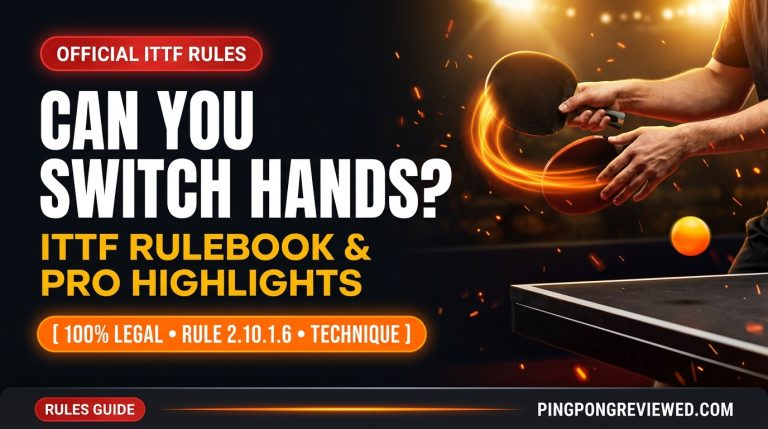
Can you switch hands during a rally in table tennis?
Yes! Under ITTF rules, switching your racket from your right hand to your left hand mid-rally is 100% legal. The hand currently holding the racket instantly becomes designated as the “racket hand,” and the empty hand becomes the “free hand.” World-class players like Timo Boll have famously switched hands mid-point to return wide shots.

Benjamin Fink is the Lead Equipment Analyst and Senior Contributor at Ping Pong Reviewed. A competitive USATT tournament player and table tennis technician with over 12 years of testing experience, Benjamin specializes in blade carbon composite physics, rubber sponge durometer hardness testing, ITTF equipment compliance, and table tennis robotics mechanics.