The Third-Ball Attack in Table Tennis, Explained
The third-ball attack is one common way to attack first in table tennis. It is a basic tactical concept in offensive play.
Short answer: The third-ball attack is a service-based sequence: ball 1 is the server’s serve, ball 2 is the receiver’s return, and ball 3 is the server’s attacking shot on that return (in singles). It exploits the server’s built-in tactical initiative, and the goal isn’t necessarily to win the point outright on that third shot, it’s to set up domination on the shots that follow.
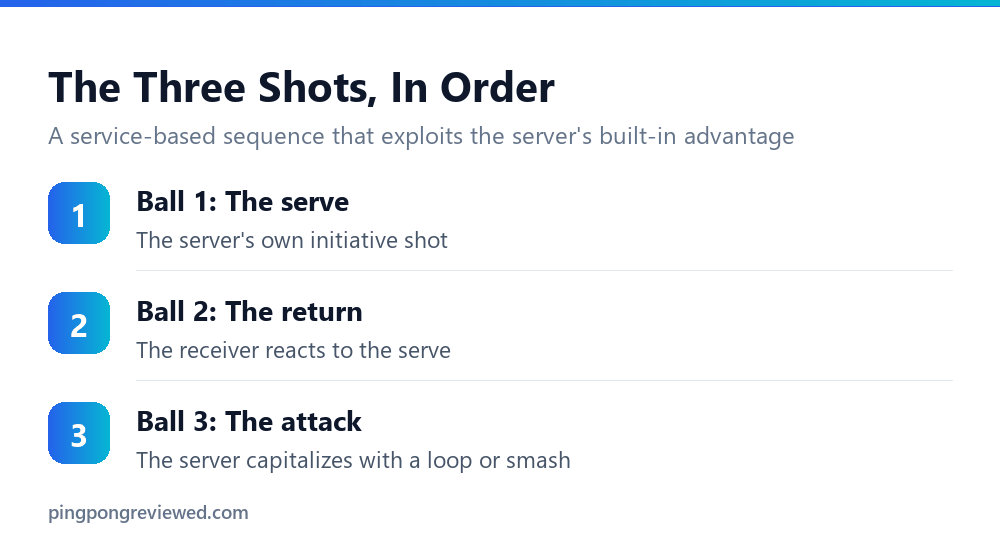
Table of Contents
Why the Server Has Built-In Initiative
The core reason this concept matters so much: the player serving has complete, unopposed control over the first shot of any point, the toss, the spin, the placement, all chosen freely before the opponent has to react to anything. That is a structural advantage the server holds on that specific point. The third-ball attack is the strategic framework for actually converting that structural advantage into points, rather than serving well and then playing the rest of the rally neutrally.
The Wikipedia Glossary of table tennis notes that the third ball is frequently the first strong attacking stroke in a rally, because the serve can be used to make attacking difficult for the opponent. The third-ball attack is the structured way a server uses that opening.
The Most Common Concrete Pattern
The most basic and common version of this strategy, as described on tabletenniscoaching.com: serve short backspin, then loop the receiver’s push return as the third ball. A short backspin serve is difficult for a receiver to attack directly, so it often draws a defensive push return, predictable enough in its general trajectory and spin that the server, already anticipating it, can loop it aggressively as soon as it comes back.
This pattern is a reasonable one to learn first: a short backspin serve limits the range of likely returns, which can make the server’s anticipation and preparation for the third-ball loop more accurate than against a serve that invites a wider range of returns.
The Serve-Variation Layer
Beyond the basic short-backspin pattern, a more advanced version, as a general coaching idea, layers in deliberate serve variation: serving underspin most of the time, then mixing in occasional sidespin or topspin serves specifically to catch a receiver who’s gotten comfortable reading the predominant underspin pattern. A receiver who expects underspin and gets topspin may pop the return up higher than intended, which can give the server an easier third-ball finish.
💡 Pro tip: Don’t randomize your serve variation without a pattern in mind. The tactic specifically depends on establishing a predominant pattern first (mostly underspin) so the occasional variation actually surprises the receiver, rather than mixing spins so unpredictably that no real pattern, and therefore no real surprise, ever forms.
Quality Over Power
A general coaching principle for this strategy is that the third-ball attack itself does not need to win the point outright. It needs consistency, spin and accurate placement, enough quality to put the server in a dominant position for the shots that follow, rather than a single high-risk attempt to end the rally immediately on ball three.
Where to Aim: the Crossover Point
A placement tactic worth knowing is aiming the attack at an opponent’s “crossover point”, where a player has to change from a forehand stroke to a backhand stroke. Coaching sites describe it as roughly the area around the playing elbow or armpit. The Wikipedia Glossary of table tennis notes that this area is often a target for attack, since it is difficult to return balls aimed there.
A faster attacking shot also leaves the receiver less time to decide between a forehand and a backhand.
Why This Concept Applies Even Below Elite Level
It’s tempting to assume a strategy this structured only matters at the professional level, where players have the technical consistency to execute a planned three-shot sequence reliably. In practice, the underlying principle, exploit the serve’s built-in initiative rather than treating it as just a way to start the point neutrally, can apply at many skill levels, even if the execution looks less polished. A club-level player who consciously serves short backspin specifically anticipating a push return, rather than serving somewhat randomly and reacting to whatever comes back, is already applying the core third-ball attack concept, regardless of how clean their actual loop technique is yet.
This reframes the strategy as something worth adopting conceptually from a fairly early stage of development, rather than treating it as an advanced technique to defer until stroke mechanics are already polished. The anticipation and intentional planning matter as much as the execution quality, and the former can be developed well before the latter fully catches up.
What Happens When the Receiver Anticipates the Pattern
Since the short-backspin-into-loop pattern is so common, it’s worth addressing directly what happens once an opponent has seen it enough times to anticipate it themselves. A receiver who expects a server’s short backspin serve to set up a third-ball loop can specifically prepare a stronger, more controlled push, or occasionally flick or attack the short serve directly instead of pushing it back at all, disrupting the server’s anticipated third-ball setup before it even happens.
This is exactly why the serve-variation layer covered above matters beyond just catching a receiver off-guard on spin, it also prevents an opponent from settling into comfortable anticipation of the basic pattern over the course of a match. A server who never varies from the same short-backspin serve eventually faces an opponent who’s adapted specifically to counter it, so varying the serve helps.
How to Actually Practice This
Since this strategy depends on anticipating a specific, likely return before it happens, practicing it effectively means drilling the full three-shot sequence repeatedly with a partner, rather than practicing the serve and the loop as separate, unconnected skills. A partner-based drill where one player consistently serves short backspin and the other consistently pushes it back lets the server groove the anticipation and timing of the third-ball loop specifically against that expected return pattern, building the reflexive recognition the live strategy depends on.
- ✓Start with the short-backspin-into-loop pattern before adding serve variation
- ✓Establish a predominant serve pattern before mixing in occasional variation
- ✓Judge third-ball success by whether it set up dominance, not just whether it won outright
- ✓Practice the full three-shot sequence together, not the serve and loop separately
- ✕Randomize serve spin without an underlying predominant pattern
- ✕Treat a returned third-ball attack as a failed strategy
- ✕Aim exclusively for outright winners on the third ball at the cost of consistency
- ✕Practice serving and looping as disconnected skills rather than one linked sequence
The Short Version, Restated
The third-ball attack is the structured way a server converts their built-in serving advantage into real point-winning pressure: serve, anticipate the likely return, attack it with quality rather than raw power, and aim for dominance over the following shots rather than an immediate winner.
Third-Ball Attack in Doubles
In doubles the players hit in turn (Law 2.8.2): the server serves, the receiver returns, then the partner of the server plays the next return, followed by the partner of the receiver, and then each player in turn in that sequence. So the third ball is played by the server’s partner, and the server plays the fifth ball. The same logic of attacking with quality rather than power applies, but the player who attacks on ball three is not the one who served.
A Related Concept: the Fifth-Ball Attack
A related concept is the fifth-ball attack. The coaching site tabletenniscoaching.com defines it this way: the server serves, the opponent receives, the server attacks with the intent of setting up a ball to put away, the receiver returns the attack, usually with a block, and the server attacks again. So in singles the fifth-ball attack is the server’s second attack in the rally.
Common Questions
What is a third-ball attack in table tennis?
A service-based sequence: ball 1 is the serve, ball 2 is the receiver’s return, and ball 3 is the server’s attacking shot on that return (in singles).
What’s the most common third-ball attack pattern?
Serve short backspin, then loop the receiver’s likely push return as the third ball.
Does the third ball need to win the point outright?
No. A general coaching view is that consistency, spin, and placement quality matter more than an immediate winner, since the goal is dominance on the following shots.
Where should a third-ball attack be aimed?
The opponent’s crossover point, roughly their playing elbow, forcing a difficult forehand-or-backhand decision under time pressure.
Why does serving give the third-ball attacker an advantage?
The server has complete, unopposed control over the serve’s toss, spin, and placement, which is a structural advantage the third-ball attack is specifically designed to convert into points.
What is a fifth-ball attack?
The server’s second attack in the rally: the server serves, the receiver returns, the server attacks, the receiver blocks or returns the attack, and the server attacks again.
Does the third-ball attack work the same way in doubles?
The core logic carries over, but the players hit in turn (Law 2.8.2), so the server’s partner plays the third ball and the server plays the fifth.
The Short Version
- →Ball 1 is the serve, ball 2 the return, ball 3 the server’s attack.
- →The most common pattern: short backspin serve into a push return, finished with a loop.
- →Serve variation (mostly underspin, occasional topspin/sidespin) exploits predictable returns.
- →Quality and consistency matter more than winning outright on the third ball itself.
- →Aim at the opponent’s crossover point to force a difficult stroke decision.
- →Practice the full three-shot sequence together, not the serve and attack separately.

Ping Pong Reviewed is an equipment review site covering table tennis and baseball gear. Specifications are checked against manufacturer listings, and prices against live retail pages, before publication.