Lin Gaoyuan: World Number 2, Zero Singles Medals at Worlds
Lin Gaoyuan reached world number 2. He won three World Championship gold medals. He has never once won a World Championships medal in singles.
That’s a specific, checkable gap in an otherwise deep career, and it’s the same shape of gap this site has already covered in Xu Xin’s profile, a player from an earlier generation with a strikingly similar record.
Short answer: Lin Gaoyuan was born on 19 March 1995 in Shenzhen, China, and plays a left-handed shakehand grip. He reached a career-high world ranking of number 2 in May 2019 and has won three World Championships team gold medals, plus doubles and mixed doubles bronze medals, but no singles medal at that event. He was ranked world number 29 as of July 2025. He was the opponent in the October 2022 match that led to Liang Jingkun’s suspension, also covered on this site. Verified across his own tournament record on 4 September 2026.
Table of Contents
World Number 2, Zero Singles Medals
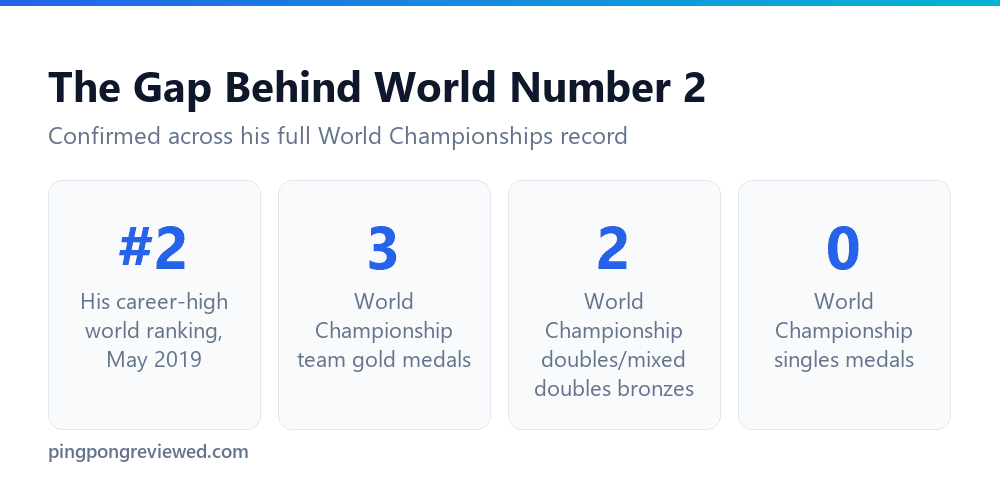
So three World Championship team golds and two doubles-format bronzes make for a strong résumé. But at the sport’s biggest individual stage, the singles event at a World Championships, he has never reached the podium at all.
📊 Note: This is the same shape of gap covered in this site’s Xu Xin profile, another left-handed-adjacent player (Xu Xin plays penhold, Lin Gaoyuan shakehand) with a deep team and doubles record but no individual World Championships singles medal.
The Match That Connects Two Profiles
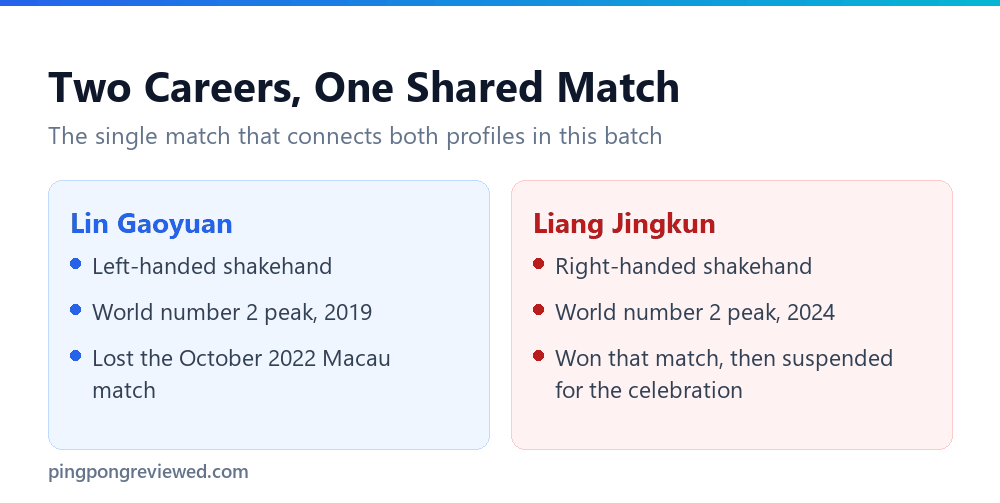
So in October 2022, at WTT Champions Macau, Lin Gaoyuan lost to teammate Liang Jingkun, also profiled on this site. That result itself was routine. What followed wasn’t.
Liang’s celebration after the win, putting his racket in his shorts, was ruled inappropriate by the Chinese Table Tennis Association, which suspended him from all competition for the rest of 2022. Lin Gaoyuan was simply the opponent on the other side of the net for the match that triggered it.
💡 Pro tip: Reading this profile alongside the Liang Jingkun page on this site covers the same October 2022 tournament from both sides, one player’s suspension and the other’s role as the match opponent.
Equipment
Lin Gaoyuan plays a Yuanjian Moye Sword blade, with DHS H3 National Blue sponge, black, on the forehand and Dignics 05, red, on the backhand, a mixed setup pairing a Chinese national-team-grade sheet with a Japanese rubber on opposite wings.
A Left-Handed Shakehand Player in a Right-Handed Field
So left-handed players remain a minority at the top of men’s table tennis, and the tactical advantages of that are covered in more detail in this site’s Wang Chuqin profile, another left-handed player. Lin Gaoyuan’s case adds shakehand technique specifically to that comparison, distinct from Xu Xin’s left-handed penhold style.
So across this batch of profiles, left-handedness shows up in two different technical packages, shakehand and penhold, both reaching the individual world number 2 ranking at different points. That’s a useful reminder that “left-handed” describes only one part of what makes a player’s game distinctive.
The 2017 Asian Cup and Early Promise
So Lin Gaoyuan’s 2017 Asian Cup singles title came two years before his ranking peak, part of a rise that looked, at the time, like it was building toward exactly the kind of individual World Championships breakthrough that never arrived.
Reaching world number 2 in 2019 confirmed the individual level was elite. What followed instead was a career built primarily on team success, three World Championship golds, rather than the singles breakthrough his ranking suggested was possible.
Doubles and Mixed Doubles: Where the Individual Success Came
So it’s worth being precise about where Lin Gaoyuan’s individual-format success actually landed, since it wasn’t singles, but it also wasn’t nothing.
His 2019 doubles bronze and 2021 mixed doubles bronze, both at World Championships level, show real results in formats that require a different kind of partnership-based play than singles does. So the individual talent translated into doubles success even without a singles medal to match it.
That’s a meaningfully different shape of career than a player who simply never converts high rankings into any individual-format medals at all. Lin Gaoyuan’s doubles results confirm the talent was real and productive, just not in the specific format that usually defines a player’s individual legacy most directly.
💡 Pro tip: When a player’s singles results lag behind their ranking, checking their doubles and mixed doubles record often reveals where that individual talent actually showed up in tournament results, rather than assuming the ranking was somehow inflated or misleading.
Team Success as the Career’s Real Foundation
So three separate World Championship team gold medals, across 2018, 2022, and 2024, spanning six years and multiple generations of Chinese men’s team rosters, is the clearest throughline in Lin Gaoyuan’s career.
Being selected for, and contributing to, three different championship-winning team rosters across that span requires sustained relevance to the program well beyond any single peak season. That’s a different kind of accomplishment than an individual title, but a genuine one.
⚠️ Watch out: It’s easy to undervalue team-format success relative to singles titles when summarizing a career. Three World Championship team golds across three separate tournament cycles represents real, sustained excellence, not a lesser consolation prize next to an individual medal that never came.
The Ranking Decline From His 2019 Peak
So it’s worth being direct about the gap between his 2019 peak, world number 2, and his more recent ranking of 29th as of July 2025. That’s a significant decline, though a less severe one than some other players covered in this batch of profiles.
Unlike a career that ends in outright retirement, Lin Gaoyuan’s continued participation on the 2024 and 2026 World Championship team rosters shows he remained a valued contributor to the national program well after his individual ranking peak had passed.
That distinction matters. A declining individual ranking doesn’t automatically mean a declining role on the team, particularly in a sport where team selection weighs doubles ability, match experience, and squad chemistry alongside pure singles ranking.
Comparing Two Left-Handed Careers, One Generation Apart
So it’s worth putting Lin Gaoyuan’s career next to Wang Chuqin’s directly, since both are left-handed players covered on this site, but at very different career stages.
Wang Chuqin, the current world number one, represents the peak outcome for a left-handed player at the top of the men’s game today. Lin Gaoyuan’s career, reaching number 2 but settling into a team-and-doubles-focused role afterward, represents a different, more common outcome: genuine elite status without ultimately becoming the generation’s defining left-handed star.
Both outcomes are worth recording. Not every left-handed player who reaches world number 2 goes on to define an era, and Lin Gaoyuan’s career is a clear, honest example of what a very strong but not sport-defining peak actually looks like in practice.
💡 Pro tip: When comparing two players with a similar rare trait, like a left-handed grip, resist collapsing their careers into one storyline. Wang Chuqin and Lin Gaoyuan share a grip, not a career arc.
What a Team Gold Actually Requires
It’s worth being specific about what winning three World Championships team titles actually involves, because the format means Lin Gaoyuan’s golds weren’t earned by riding alongside stronger teammates. Each team tie is contested as a best-of-five series of singles matches between the two squads, and a player who doesn’t perform in their individual matches costs the team the tie regardless of how the rest of the roster plays.
China’s national team selects only its strongest available players for these ties, and coaches rotate the singles-match lineup based on form and matchup, not seniority. Being selected and winning individual matches across three separate World Championships campaigns, 2018, 2022, and 2024, means Lin Gaoyuan delivered real, individually-attributable wins each time, not a passive share of a team result.
A Career Worth Recording in Full
So Lin Gaoyuan’s page closes this batch of profiles on a fitting note: an accomplished career that doesn’t fit neatly into either a triumphant or a tragic storyline, just an honest, specific record.
Three World Championship team golds. Two doubles-format bronzes. A career-high ranking of world number 2. No singles medal at the sport’s biggest event. A connection, through one specific match, to another player’s very different, more dramatic story. That’s the complete picture, and it stands on its own without needing to be dramatized in either direction.
Reading this profile alongside every other one covered in this batch, from the Lebrun brothers’ contrasting rises to Mattias Falck’s decline to Wang Manyu’s internal-competition dominance, gives a far more complete picture of the current state of international table tennis than any single career could tell on its own.
So that’s the batch in full, one connected map of the sport’s current landscape rather than a scattered set of unrelated names, and Lin Gaoyuan’s own record, honest and specific, is a genuine part of that larger picture.
A world number 2 ranking, three team golds, two doubles bronzes, and a career built on real, sustained contribution rather than one singular breakthrough. That’s the record, told in full, and it earns its place here on its own terms.
None of it depends on the singles gap being resolved to matter. A player can spend a decade near the top of a deep field, contribute directly to three World Championship titles, and build a résumé worth documenting accurately, without that résumé ever needing an individual gold to justify the coverage.
That’s the standard this profile has tried to hold to throughout: state what’s confirmed, name the specific gap rather than talk around it, and let the full record, strengths and limits together, speak for itself, without inflating or downplaying either side of it for the sake of a tidier story.
Lin Gaoyuan Questions, Answered
Has Lin Gaoyuan won a World Championships singles medal?
No. Despite reaching world number 2, he has never won a singles medal at a World Championships. His three golds there are all in the team event, with two additional doubles-format bronzes.
What is Lin Gaoyuan’s highest world ranking?
World number 2, reached in May 2019. He was ranked 29th as of July 2025.
What grip does Lin Gaoyuan use?
A left-handed shakehand grip.
How is Lin Gaoyuan connected to Liang Jingkun’s suspension?
He was the opponent in the October 2022 match at WTT Champions Macau after which Liang Jingkun’s celebration was ruled inappropriate, leading to Liang’s suspension for the rest of that year.
How many World Championship team titles has Lin Gaoyuan won?
Three: 2018 Halmstad, 2022 Chengdu, and 2024 Busan.
What equipment does Lin Gaoyuan use?
A Yuanjian Moye Sword blade, with DHS H3 National Blue sponge on the forehand and Dignics 05 on the backhand.
The Short Version
- →Born 19 March 1995 in Shenzhen, China; left-handed shakehand grip.
- →Reached a career-high world ranking of number 2 in May 2019.
- →Three World Championship team golds, but no singles medal at that event.
- →Also holds doubles and mixed doubles World Championship bronzes.
- →Was the opponent in the October 2022 match linked to Liang Jingkun’s suspension.
- →2017 Asian Cup singles champion.

Ping Pong Reviewed is an equipment review site covering table tennis and baseball gear. Specifications are checked against manufacturer listings, and prices against live retail pages, before publication.