Best Ping Pong Rubber for Spin (5 Real Rubbers, 2026)
The best ping pong rubber for spin is a tacky inverted rubber sheet, not a cleaning kit, a complete paddle, or an anti-spin rubber. DHS Hurricane 3 is the best-known high-spin choice among serious players, prized specifically for its tacky surface and strong grip on the ball.
- →A spin rubber is a sheet you glue onto your own blade — not a cleaning kit, not a complete pre-assembled paddle, and not an anti-spin rubber (which does the opposite job on purpose).
- →DHS Hurricane 3 is the most recognized high-spin rubber among serious players, known specifically for its tacky Chinese-style surface.
- →Tackiness and sponge hardness both affect spin — a tacky surface grips the ball longer at contact, while a harder sponge needs more swing speed to activate fully.
- →Cleaning kits and activator sprays matter for maintaining a spin rubber’s performance, but they’re accessories, not rubber picks in their own right.
A genuine spin rubber is a thin sheet of rubber, usually paired with a sponge layer, that you glue onto a blade yourself. Its whole job is grip: a tacky surface holds the ball fractionally longer at contact, letting you impart more rotation per stroke. That’s a completely different product from a complete paddle (which comes with rubber already attached) or a cleaning kit (which maintains rubber you already own) — both get miscategorized as “rubber” surprisingly often in buying guides.
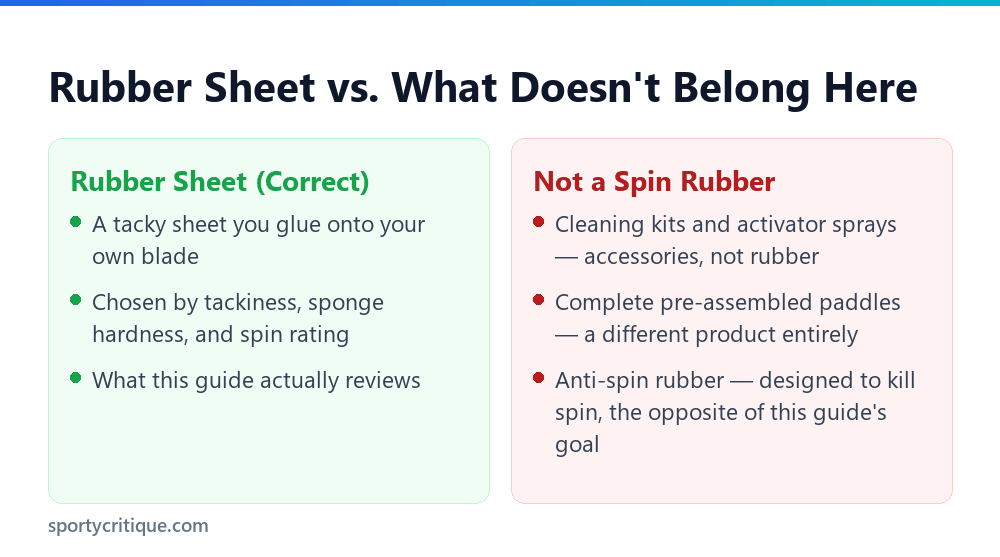
Table of Contents
Best Overall: DHS Hurricane 3

DHS Hurricane 3 is the rubber most serious loopers reach for first, and it’s earned that reputation over decades of use at every level of the sport. Its Chinese-style tacky surface grips the ball unusually well, translating directly into strong topspin on forehand loop drives. It rewards an aggressive, committed swing — players used to a springier European-style rubber often find it feels stiff and unforgiving until they adjust their stroke to match it.
- ✓Exceptional tackiness for strong topspin generation
- ✓Proven at every level, from club players to professionals
- ✓Rewards an aggressive, committed loop stroke
- ✕Needs real swing speed to activate fully — not ideal for slower, softer play
- ✕Less forgiving than a springier European-style rubber for beginners
Best for Fast Attackers: Yasaka Rakza Z

The Yasaka Rakza Z takes a different approach to spin than the Hurricane 3 — a springier, more elastic sponge that generates spin from a faster, more explosive stroke rather than pure surface tack. It suits players with a fast, attacking style who want spin combined with real pace, rather than the slower, heavier loop game the Hurricane 3 rewards.
Budget Pick: Counterstrike Spin Mystic

The Counterstrike Spin Mystic delivers genuine spin performance at a fraction of the price of the premium Chinese and Japanese rubbers above. It won’t match the Hurricane 3’s tack or the Rakza Z’s elasticity at the highest level of play, but for club players and intermediates, it’s a real, functional spin rubber rather than a compromise pick.
💡 Pro tip: If you’re new to tacky rubber, start with a budget option like the Spin Mystic or the 729 Cross before spending premium money on a Hurricane 3 — tacky rubber rewards a specific stroke technique, and it’s worth confirming you like that style before committing to the pricier options.
Best for Beginners: 729 Cross

The Friendship 729 Cross is a more forgiving tacky rubber, ITTF-approved and built to introduce players to Chinese-style tack without demanding the swing speed the Hurricane 3 needs to perform well. It’s a sensible entry point for a player moving from a general-purpose rubber toward a dedicated spin setup for the first time.
Best Value Chinese Rubber: Loki RXTON 1

The Loki RXTON 1 rounds out this list as another ITTF-approved tacky rubber aimed at players who want a genuine Chinese-style feel without paying Hurricane 3 prices. Its 2.1mm sponge is tuned for quick attacking play, giving it a slightly different feel from the thicker sponge options above.
Forehand vs. Backhand: Do You Need Different Rubber?
Many intermediate and advanced players run different rubbers on each side of the blade — a tackier, higher-spin rubber like the Hurricane 3 on the forehand for attacking loops, paired with a faster or more control-oriented rubber on the backhand for quicker blocking and counter-hitting. Beginners generally don’t need this distinction yet; running the same rubber on both sides while you’re still developing basic stroke technique keeps things simpler and cheaper without meaningfully limiting your progress.
Red vs. Black Rubber: Does the Color Matter?
ITTF rules require one black rubber and one clearly different colour on any legal paddle, specifically so opponents can tell which side just hit the ball and adjust to that side’s spin characteristics. Since 1 October 2021 the second colour may be red, pink, purple, green or blue. The color itself has no effect on performance — a red Hurricane 3 and a black Hurricane 3 play identically. What matters is that both sides of your paddle are clearly differentiated by color, not which specific color goes on which hand.
A Note on Anti-Spin Rubber
Some “best rubber for spin” lists online include anti-spin rubber in their picks — that’s a genuine mistake worth flagging. Anti-spin rubber is built to do the opposite job: it has a slick, low-friction surface specifically designed to neutralize incoming spin rather than generate outgoing spin. It’s a legitimate, useful rubber for defensive players who want to frustrate an opponent’s spin, but it has no place in a guide about maximizing your own spin — including it here would be actively misleading.
Climate and Storage Effects on Rubber Life
Heat and humidity accelerate a tacky rubber’s decline faster than normal use alone would — leaving a paddle in a hot car or a humid bag for extended periods breaks down the surface tack noticeably faster than storing it somewhere cool and dry between sessions. A basic paddle case, even an inexpensive one, meaningfully extends rubber life just by keeping it away from direct heat and moisture when it’s not in your hands.
Maintaining Your Spin Rubber
A tacky rubber’s performance degrades with dust and oil buildup faster than a harder, less tacky surface does, since the tackiness itself is what collects grime from the air and the ball. A dedicated rubber cleaner and sponge, wiped across the surface after each session, meaningfully extends how long a rubber holds its peak grip. This is genuinely worth budgeting for alongside the rubber itself — it’s maintenance for the product you bought, not a substitute for it.
Tackiness vs. Sponge Hardness: What Actually Drives Spin
Two separate properties determine how much spin a rubber produces, and it’s worth understanding both before choosing. Surface tackiness controls how long the rubber grips the ball at contact — more grip time means more rotation transferred per stroke. Sponge hardness controls how much the rubber compresses and rebounds during that same contact — a harder sponge needs more swing speed to fully engage but rewards that speed with more explosive spin and power once it does.
How Blade Choice Affects Rubber Performance
The same rubber sheet performs differently depending on the blade underneath it. A stiffer, faster blade lets a tacky rubber like the Hurricane 3 generate even more spin from the same stroke, since less energy gets absorbed by the wood itself before reaching the ball. A softer, more control-oriented blade tames an aggressive rubber slightly, which can actually help newer players manage a tacky rubber’s learning curve while they build up the stroke technique it rewards.
Sponge Thickness and What It Changes
Sponge thickness, usually measured in millimeters under the rubber’s top sheet, is a separate variable from both tackiness and hardness. A thicker sponge stores and releases more energy on contact, adding speed and power alongside spin, but it also demands more precise timing and control from the player. Thinner sponges trade some of that power for a more controllable, defensive-friendly feel. Most of the rubbers on this list are available in a range of thicknesses — picking the right one for your level matters as much as picking the right rubber itself.
Gluing Your Rubber to a Blade
A rubber sheet arrives unattached — gluing it to your blade is a separate step, and getting it right affects performance meaningfully. Modern water-based glues are the standard choice, applied in thin, even coats to both the blade and the rubber’s underside, then pressed together once both surfaces are tacky but not wet. A rushed or uneven glue job can introduce air bubbles that dampen the rubber’s spring and spin response, so it’s worth taking the extra few minutes to do it carefully rather than rushing straight to play.
When to Replace a Spin Rubber
A tacky rubber loses its edge well before it looks visibly worn — the surface tackiness that generates spin degrades gradually with use and air exposure, typically over a few months of regular play even with good maintenance. A rubber that once grabbed the ball firmly but now feels slick or produces noticeably less spin than it used to is telling you it’s due for replacement, regardless of how clean or undamaged it looks on the surface.
What is the best ping pong rubber for spin?
DHS Hurricane 3 is the most recognized high-spin rubber among serious players, known for its tacky Chinese-style surface.
Is a cleaning kit a type of spin rubber?
No — a cleaning kit is a maintenance accessory for rubber you already own, not a rubber sheet itself.
Should I avoid anti-spin rubber if I want more spin?
Yes — anti-spin rubber is specifically designed to neutralize incoming spin, the exact opposite job of a rubber meant to generate outgoing spin on your own shots.
What’s a good beginner spin rubber?
The Friendship 729 Cross is more forgiving than premium Chinese rubbers and makes a sensible entry point into genuine tacky rubber.
Does blade choice affect how much spin a rubber generates?
Yes — a stiffer, faster blade amplifies a tacky rubber’s spin, while a softer blade tames it slightly.
Do I need different rubber on my forehand and backhand?
Not as a beginner — running the same rubber on both sides keeps things simpler while you’re still developing basic technique; intermediate and advanced players often split them for different tactical roles.
As an Amazon Associate, we earn from qualifying purchases through links on this page.

Ping Pong Reviewed is an equipment review site covering table tennis and baseball gear. Specifications are checked against manufacturer listings, and prices against live retail pages, before publication.