
How to Choose a High Quality Ping Pong Table (2026)
This page answers a different question than our product guides do. Our best ping pong table guide and our best outdoor ping pong table guide both tell you which specific tables to buy. This page teaches how to choose a high quality ping pong table on your own, the decision framework itself, so you can evaluate any table you come across, not just the ones we’ve picked.
This matters more for tables than for smaller equipment, since a table is a genuine multi-year investment that’s inconvenient to return or replace once it’s assembled and in your space. Getting the core decisions right upfront, before you’re comparing specific listings, saves real money and hassle compared to discovering after purchase that you bought the wrong category of table for your actual use case.
Table of Contents
Step 1: Indoor or Outdoor?
This is the single most consequential decision, since it determines the tabletop material you actually need. Indoor tables use MDF, which delivers excellent bounce consistency but warps with any real moisture exposure. Outdoor tables use aluminum composite or resin laminate specifically engineered to withstand rain and temperature swings, trading a small amount of bounce liveliness for genuine weather resistance. Buying an indoor table for regular outdoor use is one of the most common expensive mistakes we see, since the table typically warps within a season of real weather exposure.
A related question worth answering honestly at this stage: is your table going to live somewhere with any moisture or temperature exposure at all, a garage without climate control, a covered but open patio, a basement with humidity swings, even if it’s technically “indoors”? If so, treat that as effectively outdoor use for purchasing purposes, since an MDF table stored in a humid garage will warp nearly as reliably as one left outside directly, just more slowly.
Step 2: Tabletop Thickness
- 25mm+: tournament tier, the liveliest, most consistent bounce, aimed at serious and competitive players.
- 18-19mm: a genuine mid-tier step up from budget tables, noticeably better bounce than 15mm without tournament-tier pricing.
- 15mm: the common recreational tier, adequate bounce for casual and family play at a moderate price.
- 13mm and thinner: the budget floor, noticeably less consistent bounce and more prone to warping over time; fine for very occasional casual use, not recommended if you’ll play regularly.
It’s worth understanding why thickness affects bounce specifically rather than just accepting it as a spec to match. A thicker tabletop flexes less on ball contact, returning more of the ball’s energy consistently across every hit, while a thinner top flexes slightly more and absorbs some of that energy unevenly depending on exactly where the ball lands relative to the underlying frame supports. That’s the actual physical mechanism behind why budget thin tables feel less predictable during real play, not just a marketing distinction between price tiers.
Step 3: Frame and Undercarriage Strength
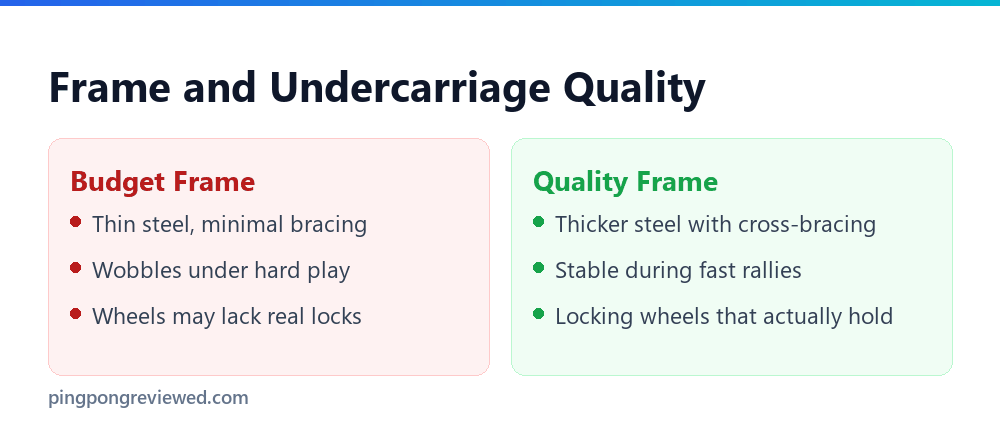
The frame matters more than casual buyers expect, since a wobbly undercarriage undermines even a good tabletop’s bounce consistency during fast, aggressive play. Look for genuine cross-bracing rather than a simple frame, thicker steel gauge specifications where listed, and wheels with real locks rather than decorative casters. A table that shifts slightly during hard rallies is a frame problem, not a tabletop problem, and no amount of tabletop quality fixes it.
Weight is a genuinely useful proxy for frame quality when you’re comparing listings that don’t clearly spec steel gauge or bracing details. Heavier tables, all else being roughly equal in category, generally use more substantial steel in the frame and undercarriage, since manufacturers don’t add weight for no reason at this price point. It’s not a perfect signal on its own, a heavy table with a genuinely poor tabletop is still a poor table, but comparing weight within the same thickness tier is a reasonable tiebreaker when two listings otherwise look similar on paper.
Step 4: Space and Practical Fit
Regulation tables measure 9 feet by 5 feet, and you need meaningful clearance beyond that footprint for actual gameplay, at least 5 feet behind each end for backing up during rallies and 3 feet on each side. If your available space is genuinely tight, a midsize table trades regulation dimensions for a smaller footprint rather than trading quality, a real, honest option covered in our main table guide rather than a compromise to avoid.
Folding and storage matter here too if space is shared or limited. Most tables fold into two halves, either for solo playback-mode practice or flat storage against a wall, but folded dimensions still vary enough between models that it’s worth checking a specific table’s folded footprint against your actual storage space rather than assuming any folding table fits any storage space equally.
Playback mode specifically, one half folded upright while the other stays flat, is worth checking for if you’ll often be practicing solo, since not every folding table supports it safely and some cheaper models only fold flat for storage without a stable playback configuration. If solo practice matters to you, confirm this feature explicitly on a specific listing rather than assuming every folding table includes it.
The Short Version
Decide indoor versus outdoor first, since that determines the material category you’re actually shopping within. Pick 18mm or thicker if you’ll play regularly, accept 15mm or even 13mm honestly for occasional casual use rather than overpaying for tournament-tier specs you won’t benefit from. Check the frame and wheels as carefully as the tabletop spec, and confirm your available clearance space matches the table’s actual footprint before ordering. Get these four decisions right and any specific table that fits your resulting category is a reasonable choice, whether it comes from our own verified picks or somewhere else entirely.
How We Fact-Checked This Page
Thickness tiers, frame construction terminology and clearance space recommendations on this page were checked against manufacturer specifications and multiple independent buying guides. Thickness claims in particular are worth verifying wherever you read them, since the figures quoted vary considerably between guides and are frequently given without a source.
We also cross-checked the thickness-tier boundaries specifically, since different sources draw the line between budget and mid-tier thickness slightly differently. The ranges given above reflect a genuine consensus across the manufacturer specifications and independent buying guides we reviewed, rather than a single source’s specific categorization, since we’d rather present a defensible general range than a falsely precise cutoff that doesn’t actually hold up across the broader market.
Frequently Asked Questions
Is a 13mm ping pong table good?
It’s the budget floor, not a genuinely bad table outright, but noticeably less bounce-consistent than 15mm and above, and more prone to warping over time with regular use. Fine for very occasional casual use, not genuinely recommended for anyone planning to play regularly.
How thick should a genuinely good ping pong table actually be?
18mm or thicker for regular play strikes a solid, defensible balance between bounce quality and price. 25mm+ is worth the extra cost specifically if you’re training seriously or competitively rather than just casually.
What’s more important, tabletop thickness or frame quality?
Both genuinely matter, but a weak frame undermines even a good tabletop during fast play, while a thin tabletop on a strong frame is still limited by the tabletop itself. Neither fully compensates for a real weakness in the other.
Do I need a tournament-tier table for casual home use?
No — 15 to 18mm covers casual and family play well. Tournament-tier 25mm+ tables mainly matter if you’re training seriously or want bounce that closely matches competitive play.
How much clearance space do I actually need around a table?
At least 5 feet behind each end and 3 feet on each side beyond the table’s own 9×5 foot footprint, for realistic backing-up room during actual rallies.
Should I buy an indoor table and just bring it outside occasionally?
For very occasional use with careful, immediate covering afterward, it’s a workable compromise, but sustained outdoor exposure will warp an indoor MDF table faster than most owners expect.
Does table weight actually indicate quality?
It’s a reasonable proxy within the same thickness tier, since heavier construction generally means more substantial steel in the frame, though it isn’t a perfect signal on its own and shouldn’t override checking actual tabletop thickness and frame bracing directly.
What’s the difference between playback mode and simple folding?
Simple folding is purely for flat storage; playback mode specifically means one half locks upright in a stable position for solo practice against your own returns. Not every folding table supports playback mode safely, so check this feature explicitly if solo practice matters to you.
Is a heavier table always more stable during play?
Generally yes within the same category, since more mass combined with genuine frame bracing resists shifting during hard rallies better than a lighter table does, though locking wheels matter just as much as raw weight for actual in-play stability.
As an Amazon Associate, we earn from qualifying purchases through links on this page.

Ping Pong Reviewed is an equipment review site covering table tennis and baseball gear. Specifications are checked against manufacturer listings, and prices against live retail pages, before publication.