Ping Pong Paddle Weight and Handle Types Explained
Ping pong paddle weight and handle types come down to maker figures and personal preference, not a rule. The ITTF Laws allow a racket of any size, shape or weight. STIGA lists its performance rackets at 140 to 177 g and its blade weight bands at 75 to 95 g, Butterfly calls handle choice strictly personal, and flared is the style it calls most popular. We haven’t tested any paddle, so this guide reports what the makers and the rules say.
Ask ten players how heavy a paddle should be and you’ll get ten answers, often with a confident number attached. The numbers rarely come with a source.
This guide does the reverse. It lists the weights and handle shapes that makers publish, explains the difference between a blade’s weight and a finished racket’s weight, maps the handle names used by different brands, and flags the claims we couldn’t source. We read the ITTF Laws and each maker’s own pages on October 1, 2026.
If you’re choosing a first paddle, our beginner paddle guide covers picks and prices. For how you hold the paddle, see our grips guide.
- →The ITTF Laws set no weight or size for a racket. They require a flat, rigid blade that is at least 85% natural wood.
- →Blade weight and racket weight are different numbers. STIGA’s blade bands run 75 to 95 g, and its performance rackets run 140 to 177 g.
- →Butterfly and STIGA both say handle choice is personal. Butterfly calls flared the most popular and anatomic the second.
- →Makers say blade weight varies with humidity and temperature, so a listed weight is approximate.
- →Popular numbers such as an ideal 150 to 200 g paddle and handle popularity percentages had no maker or federation source.
Table of Contents
Ping pong paddle weight and handle types: what the rules say
Less than most buyers expect. The ITTF Statutes 2026 say the racket may be of any size, shape or weight, but the blade must be flat and rigid. At least 85% of the blade by thickness must be natural wood. The Laws also say material suitable to shape a handle for holding the racket may be added on.
Table Tennis England says the same thing in plain words: 85% of the blade must be natural wood and can be of any size, shape or weight, provided the surface is flat and rigid. See its equipment guidance.
In practice that means every weight, head size and handle you see on a shelf is a maker’s choice. None of them is the official one.
Blade weight versus racket weight
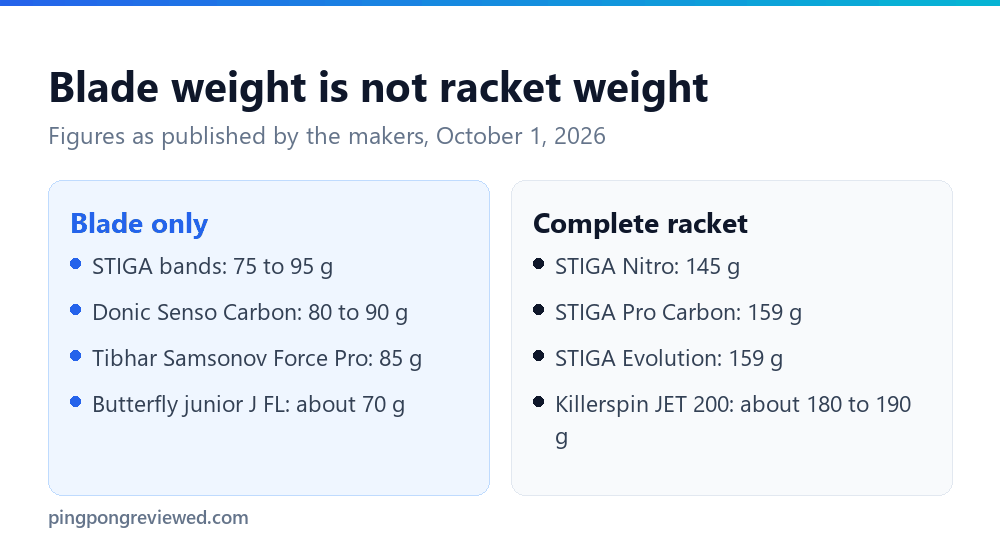
This is where most weight advice goes wrong. A blade is the wooden base. A racket is the blade plus two rubbers and the glue between them. Rubbers add a good deal of weight, so the two numbers can’t be compared.
STIGA’s blade guide groups blades by weight: low (75 to 85 g), mid (80 to 90 g) and high (85 to 95 g), with a footnote dated July 2022. Its performance rackets list 140 g and up. Here are the weights we found on the makers’ own pages.
A few cautions apply. STIGA says it can’t give specific weight information for each blade, and that blade weight can vary due to humidity and temperature. Butterfly says the same about conditions. And STIGA’s Allround Classic page says the product is specified for its weight and is not weighed individually for each order. So treat any listed figure as approximate.
Amazon’s weight fields can disagree with the maker. Amazon’s data for the Blue Pro Carbon variant we link works out to about 165 g, while STIGA’s page for the Red variant says 159 g, and we can’t tell whether the variants differ. We take weights from the maker.
What the makers say weight changes
Not much, and they say it carefully. STIGA’s blade guide suggests choosing a blade you can swing comfortably, says a heavier blade can produce more power when hit with the same swing speed, and says the ideal weight depends on your playing style and physical strength. STIGA’s US guide adds that there isn’t one ideal paddle weight or balance point for every player, that a heavier paddle can give stability and may help generate extra power but takes more effort, and that a lighter one is easier to maneuver. See STIGA’s blade guide and its paddle guide.
We found no maker or federation statement tying weight to a skill level, to wrist or elbow strain, or to a recommended range for beginners. STIGA’s US guide also answers the question of whether a heavier paddle makes you better with a plain no. Where an article states one, ask where it came from.
Ping pong paddle handle types and what the makers call them
Handle names vary between brands, which confuses buyers. The same shape can be flared at one maker and concave or master at another. This table maps the names as the makers use them.
Killerspin also lists SmartGrip and PowerGrip handle styles in its guide, and says most players use the shakehand grip. Donic and Tibhar blade pages list handle options as anatomic, concave and straight.
Butterfly says which handle is right for you is strictly a personal preference, and STIGA says neither handle style is universally better and the right choice comes down to personal preference. That is the closest thing to a consensus: pick the one that feels right in your hand.
⚠️ Watch out: Handle labels can disagree even on one maker’s site. On STIGA’s US site the Aspire page title mentions a concave Italian composite handle while its spec table says flared, and the Nitro page title says anatomic while its table says flared. We follow the spec tables.
Handle and head sizes: the numbers makers publish
Blade pages are where sizes are easiest to find, and Butterfly is the clearest example. For its Timo Boll ALC blade it lists a head size of 157 by 150 mm and handle sizes of 100 by 24 by 34 mm for flared and anatomic, and 100 by 22 by 27.5 mm for straight. See Butterfly Global’s Timo Boll ALC page.
The junior blades show how small the differences are. Butterfly’s two junior heads are 152 by 144 mm and 154 by 146 mm against 157 by 150 mm for the adult blade, a difference of 3 to 6 mm in each dimension, and the junior handles are 92 and 95 mm long against 100. JOOLA describes a reduced blade size and a thinner handle for its Team Junior racket. Whether that suits a particular child is something no federation we found gives guidance on. For more on children, see our beginner guide’s kids section.
Two examples with maker weights
Two STIGA rackets show how a maker’s weight and handle information looks in practice.
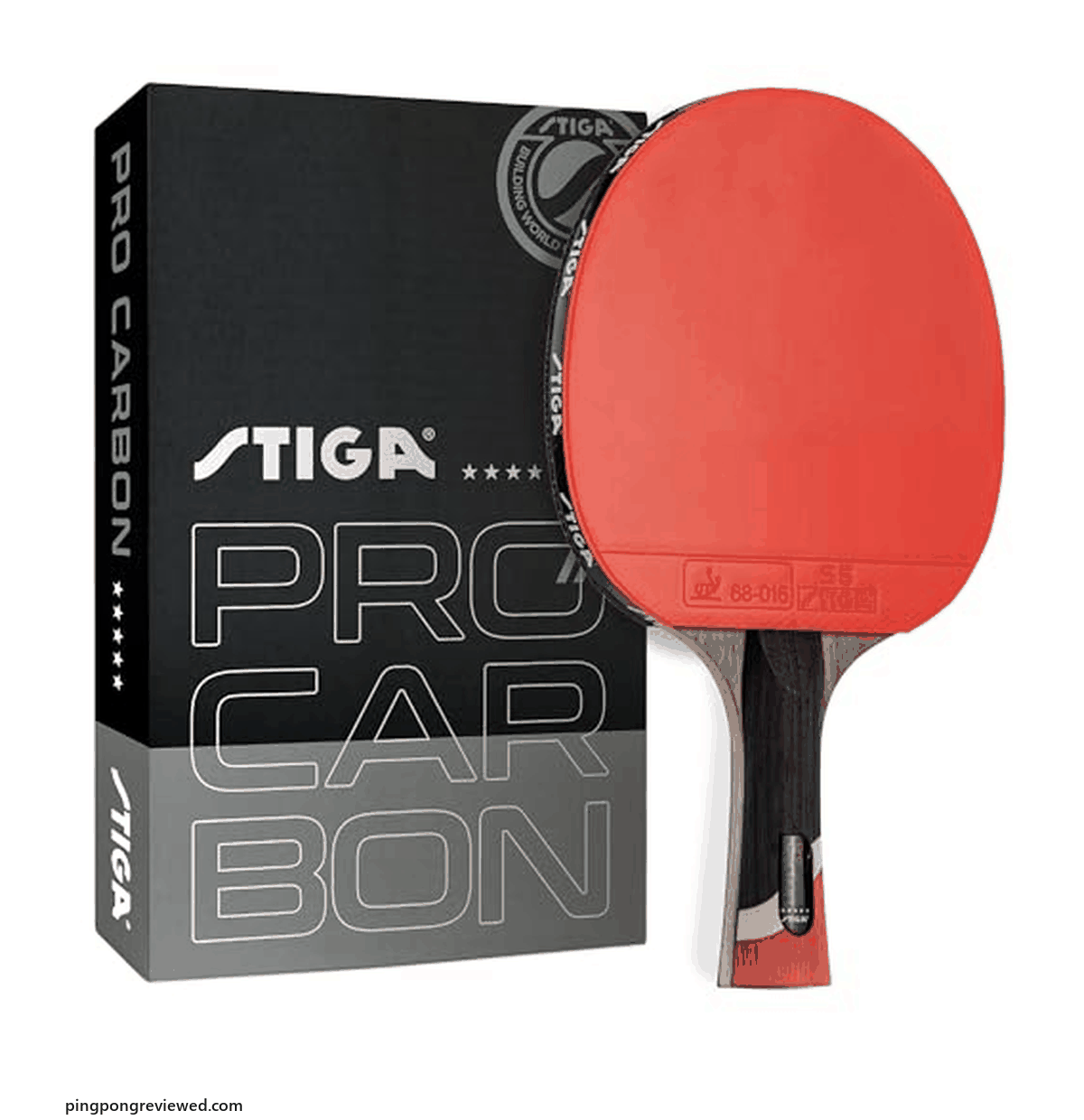
STIGA Pro Carbon is listed by STIGA at 159 g for the Red variant, with a flared handle in the spec table. It was $69.99 on Amazon on October 1, 2026, and STIGA’s US page lists $79.99. STIGA labels it a performance racket.
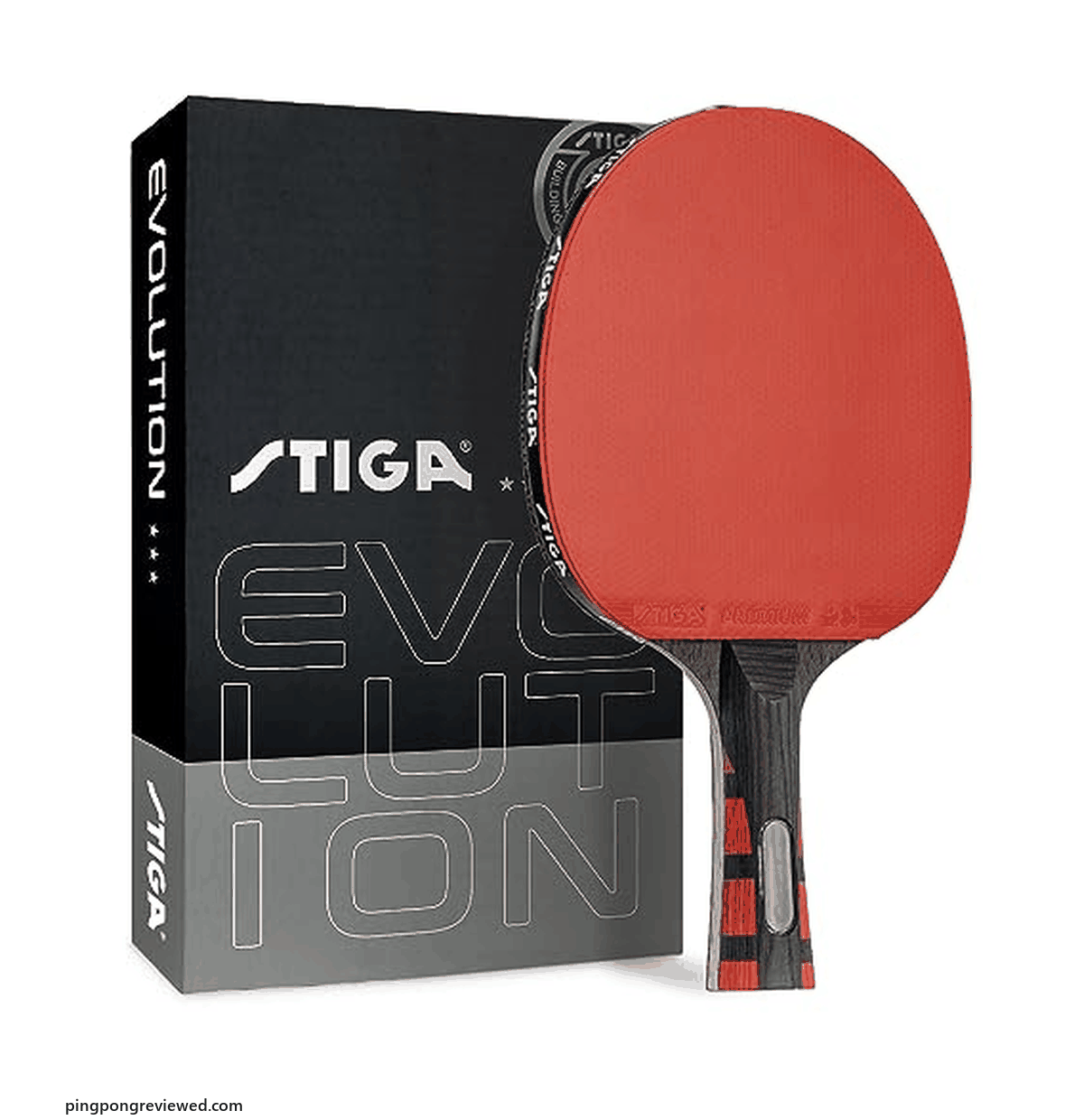
STIGA Evolution is also listed at 159 g by STIGA, with a flared handle. It was $59.99 on Amazon on October 1, 2026, with the listing describing a 6-ply light blade.
We include these because STIGA’s pages state their weights, which makes them easy to compare. Always check which variant a listing means.
Matching the handle to your grip
The handle you buy has to match how you hold the paddle. Shakehand paddles come with flared, anatomic or straight handles, and penhold paddles have their own short handles. Butterfly lists two penhold styles, Chinese and Japanese, and describes the Chinese penhold as similar to a cone-shaped shakehand blade with a shorter handle, and the Japanese as long and narrow. STIGA describes its penhold handle as conical, short and wide.
Killerspin says most players use the shakehand grip. If you’re not sure which grip you use, work that out first, because on a finished paddle the handle shape is fixed. Our paddle grip guide and grips guide cover both.
Weight and handle claims to treat with care
While researching we met a lot of confident statements. These either had no maker or federation source we could find, or a maker says something different.
How to choose, using only what the sources support
If you’re still deciding which paddle to buy, our main paddle guide compares eight paddles by skill level, and our paddle grip guide explains how to hold them.
How we checked this guide
We read the ITTF Statutes 2026 and each maker’s own product pages and guides on October 1, 2026, and the Amazon listings where we quote one. We searched for weight, size and handle statements from federations and found none beyond the Laws. We did not weigh or test any paddle, so every number here is one the maker or the rules published. Where a maker’s page wouldn’t open or gave no figure, we left it out.
Frequently asked questions
How heavy should a ping pong paddle be?
There is no official answer. The ITTF Laws allow a racket of any size, shape or weight. STIGA suggests choosing a blade you can swing comfortably, and says a heavier blade can produce more power at the same swing speed. We found no maker or federation weight target for beginners.
What is the difference between blade weight and racket weight?
Blade weight is the wooden base alone, and racket weight includes the two rubbers and the glue. STIGA’s blade bands run from 75 to 95 g, while STIGA lists its performance rackets at 140 to 177 g and Killerspin lists its JET 200 at 0.397 to 0.419 pounds. Don’t compare the two kinds of number.
Which handle is best for a beginner?
The makers say it is a personal choice. Butterfly calls handle selection strictly a personal preference and STIGA says neither handle style is universally better. Butterfly Global describes its anatomic handle as a comfortable shape for beginner players.
What is the difference between flared and straight handles?
Butterfly describes the flared handle as wide at the base and concave in the center, and the straight handle as uniform from neck to base. Butterfly Global says the straight handle makes changing grip easier and that the majority of choppers choose it, and says the flared handle moves the center of gravity closer to the handle.
Is a flared handle the most popular?
Butterfly calls flared the most popular style and anatomic the second most popular. That is Butterfly’s description of its own range and customers, not a survey of all players.
Does the ITTF limit paddle weight or size?
No. The Laws say the racket may be of any size, shape or weight, but the blade must be flat and rigid and at least 85% natural wood by thickness.
Do kids need a smaller paddle?
Some makers build smaller ones. Butterfly’s junior blades are 152 by 144 mm and 154 by 146 mm against 157 by 150 mm for an adult blade it lists, and JOOLA describes a reduced blade and thinner handle on its Team Junior racket. No federation sizing guidance turned up.
Are the weights on Amazon reliable?
Not always. Amazon’s data for the Blue Pro Carbon variant we link works out to about 165 g, while STIGA’s page for the Red variant says 159 g. We take weights from the maker’s page.
Does blade weight change over time?
Makers say it can vary. STIGA says blade weight can vary due to humidity and temperature, and Butterfly says the weight of blades differs according to humidity and temperature conditions.
Sources
The rules are in the ITTF Statutes 2026. Weights and handle descriptions come from STIGA’s blade guide, STIGA’s paddle guide, Butterfly’s equipment FAQ, Butterfly Global’s handle FAQ, Killerspin’s guide, Donic, Tibhar, JOOLA Germany and Table Tennis England.
As an Amazon Associate, we earn from qualifying purchases through links on this page.

Ping Pong Reviewed is an equipment review site covering table tennis and baseball gear. Specifications are checked against manufacturer listings, and prices against live retail pages, before publication.