The Table Tennis Clothing Color Rule, Explained (USATT 20.2.1)
This is one of the more surprising rules for players coming from other sports, where uniform color is purely a team-branding choice with zero functional purpose. In table tennis, what you wear can actually be illegal depending on what ball is being used.
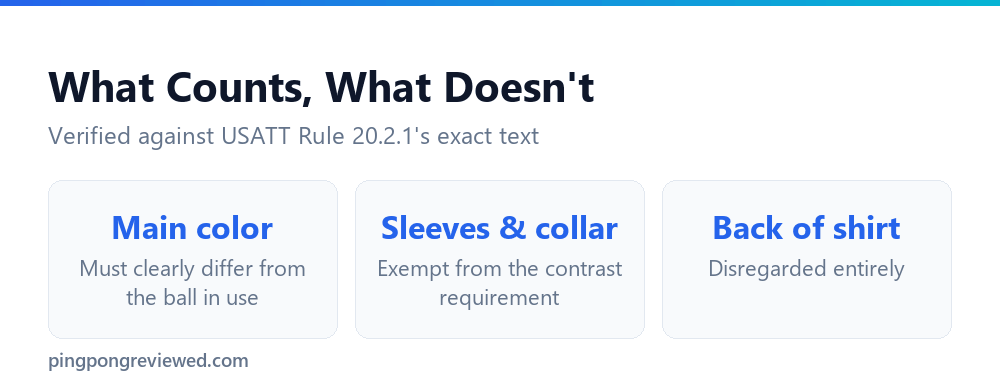
Short answer: The main color of your shirt, shorts, or skirt must be clearly different from the color of the ball in use. The ITTF Regulations exempt the sleeves and the collar of a shirt, and the ITTF Handbook for Match Officials says the color of the back of the shirt can be disregarded. In practice, an all-white outfit does not meet the rule against a white ball, and an all-orange outfit does not meet it against an orange ball.
Table of Contents
The Actual Rule Text
The current ITTF Statutes (2026 edition, Regulation 3.2.2.2) read: “The main colour of a shirt, skirt or shorts, other than sleeves and collar of a shirt shall be clearly different from that of the ball in use.” These Regulations for International Competitions apply to World, Olympic and Paralympic title competitions and to open tournaments (Regulation 3.1.2), so a local league or club may set its own clothing rules. Check the rules of the event you are entering.
Why the Rule Exists at All
The ITTF Handbook for Match Officials (16th edition, July 2019, section 8) says the purpose of the clause is to ensure visibility of the ball. A white ball against a white shirt is harder for the opponent to pick out against the clothing, and that is the problem the rule addresses. It is a visibility rule, not a style rule.
What Counts as “Main Color”: It’s Not About Area
One of the more counterintuitive details: according to the ITTF Handbook for Match Officials (16th edition, 2019, section 8), “main” color does not necessarily mean the color occupying the greatest area. A solid patch of color that covers only 40% of the front of a shirt may still be the dominant color, whereas a much larger percentage of the same color evenly dispersed could be relatively unnoticeable.
The same section says it is the apparent color of the clothing that matters, and that the referee has to decide whether it provides sufficient contrast with the color of the ball. It gives two examples: predominantly yellow clothing may be quite acceptable with an orange ball, and patterned clothing with a white background may be satisfactory with a white ball, provided the perceived colors of clothing and ball are clearly different.
⚠️ Watch out: Whether a garment complies is often a judgment call. The Handbook says it is often a matter of judgment whether clothing complies with the regulations, and that the referee’s decision is final on any question of legality.
What’s Exempt: Sleeves and Collar
The Regulation carves out the sleeves and the collar of a shirt from the main-color requirement. A shirt with a ball-matching color on its sleeves or collar can therefore still comply, as long as the shirt’s main color contrasts with the ball. Trim is handled by a separate provision: Regulation 3.2.2.7 says markings or trimming on the front or side of a playing garment shall not be so conspicuous or brightly reflecting as to unsight an opponent.
The Handbook adds that, because the purpose of the clause is ball visibility, the color of the back of the shirt can be disregarded for this requirement.
The Practical Consequence: Two Common Mistakes
Applied practically, an all-white uniform does not contrast with a white ball, and an all-orange uniform does not contrast with an orange ball. The Laws allow the ball to be white or orange (Law 2.3.3), and Regulation 3.2.1.2 says the entry form or prospectus for an open tournament shall specify the colours of the ball to be used. A player can therefore check which ball color an event will use before choosing match-day clothing.
💡 Pro tip: If you compete regularly and own multiple uniform colors, keep at least one option that clearly contrasts with both white and orange balls, so you’re never caught needing to change outfits last-minute based on which ball color a specific match or venue uses.
How This Connects to the Racket Color Rule
This clothing rule sits alongside a related, similarly visibility-driven rule this site has covered elsewhere: the requirement that one side of the racket covering is black and the other is a bright color clearly distinguishable from black and from the color of the ball (Laws, section 2.4). Both rules involve colors that have to contrast with the ball.
- ✓Check which ball color a match will use before choosing your competition clothing
- ✓Keep at least one uniform option that contrasts with both white and orange balls
- ✓Use sleeve and collar accents, which the Regulation exempts from the contrast requirement
- ✓Think about visual concentration of color, not just percentage of fabric covered
- ✕Assume an all-white outfit is universally safe regardless of ball color
- ✕Assume a small detail on an otherwise matching shirt settles the question; the referee judges the apparent color
- ✕Treat the back of the shirt as the deciding factor; the Handbook says its color can be disregarded for this requirement
- ✕Treat this as a stylistic suggestion rather than an enforceable standard
Which Ball Colors the Laws Allow
Law 2.3.3 says the ball shall be white or orange, and matt. The Laws do not give a reason for allowing both colors. What the Regulations do require is that the entry form or prospectus for an open tournament specifies the colours of the ball to be used (Regulation 3.2.1.2), so the ball color for an event can usually be checked in advance. Because either color may be in use, the clothing rule is written against whichever ball is in play rather than against a single fixed color.
The Short Version, Restated
Your main clothing color has to clearly contrast with whatever ball color is in play, the sleeves and collar are exempt, and the Handbook says the shirt’s back can be disregarded. It is a visibility rule, and it is tied to whichever ball color a given match actually uses.
A small thing to check before your next competitive match, but an enforceable one, worth confirming rather than assuming your usual outfit is automatically fine.
How Officials Actually Enforce This
The Handbook for Match Officials says the umpire usually has the first opportunity to consider whether players’ clothing complies. If the umpire is sure it is illegal, the umpire explains why to the player, and if the player changes to a legal garment no further action is needed. Where the umpire is uncertain or the player does not accept the decision, the referee is consulted, and the referee’s decision on legality is final. Under the Regulations, deciding the acceptability of clothing is among the referee’s duties (3.3.1.2.10).
Why This Rarely Comes Up at the Recreational Level
Casual and club play without an umpire or referee has nobody assigned to apply this rule, and local leagues and clubs may set their own clothing rules, so many recreational players may never run into it. That said, the underlying practical concern, ball visibility against your own clothing, doesn’t disappear just because nobody’s checking for compliance. A recreational player choosing an all-white outfit for a casual game with a white ball is still creating the same visibility challenge for their opponent that the rule was designed to prevent, even though no umpire is present to flag it.
This is worth keeping in mind even outside formal competition: choosing clothing that naturally contrasts with whatever ball color you’re using is simply good practice for a better, more visible game, independent of whether any rule is being formally enforced in that specific setting.
Uniform Design: a Real Consideration for Serious Players
For players competing regularly enough to invest in custom or club-branded uniforms, this rule is worth factoring into the actual design process rather than discovering a compliance problem after uniforms have already been ordered. A club or team commissioning matching uniforms in a specific brand color should confirm that color clearly contrasts with both white and orange balls before finalizing a design, since reordering an entire team’s uniforms after discovering a compliance issue is a considerably more expensive mistake than checking the rule upfront during the design phase.
Common Questions
Can I wear a white shirt in table tennis?
An all-white main clothing color does not contrast with a white ball, so it is not compliant against one. Against an orange ball, white contrasts with the ball. In a borderline case the referee decides.
What parts of my clothing are exempt from the color rule?
The Regulation exempts the sleeves and the collar of a shirt from the main-color requirement. Markings or trimming on the front or side fall under a separate rule against being so conspicuous or brightly reflecting as to unsight an opponent.
Does the back of my shirt need to contrast with the ball?
The ITTF Handbook for Match Officials says the color of the back of the shirt can be disregarded for this requirement.
Is “main color” just whichever color covers the most fabric?
Not necessarily, a concentrated patch covering less area can still be judged the dominant color if it’s visually prominent, while a larger but subtly spread color might not count.
Why does table tennis have a clothing color rule at all?
To keep the ball clearly visible against a player’s clothing during fast play, it’s a functional visibility rule, not an aesthetic uniform standard.
Is this rule enforced in casual, recreational play?
It takes an umpire or referee to apply it, so casual play without officials has nobody assigned to check it, and local leagues may set their own rules. The visibility concern still applies in practice.
Should a club check this rule before ordering team uniforms?
Yes, confirming a uniform color contrasts with both white and orange balls before finalizing a design avoids an expensive reorder later.
The Short Version
- →Main clothing color must clearly differ from the ball color in use.
- →Sleeves and collar are exempt from the requirement.
- →The back of the shirt can be disregarded (Handbook for Match Officials).
- →“Main color” is about visual dominance, not simply the largest area of fabric.
- →An all-white main color does not contrast with a white ball; all-orange does not contrast with an orange ball.
- →The rule exists purely for ball visibility, not aesthetic uniform standards.

Ping Pong Reviewed is an equipment review site covering table tennis and baseball gear. Specifications are checked against manufacturer listings, and prices against live retail pages, before publication.