
How to Disguise Serve Spin in Table Tennis (Real Mechanics)
A deceptive serve isn’t about hiding your arm behind your body or serving unusually fast, it’s about a specific mechanical principle that lets the exact same motion produce completely different spins, so an opponent reading your swing gets less reliable information.
This page breaks down the actual mechanics behind that principle, several concrete deception techniques built on top of it, and how to practice and measure the skill realistically.
Short answer: Use a semi-circular, curved racket path rather than a straight-line motion, and vary the exact contact point and timing within that same curve to produce different spins, backspin when you contact the downward part of the swing, sidespin on the sideways part, topspin on the upward part, or very little spin by contacting the ball where the racket is moving slowly. The disguise comes from one motion producing multiple outcomes, not a different motion for each spin.
Table of Contents
Why a Straight-Line Serve Gives Everything Away
One principle behind serve disguise: if your racket moves in a straight line, any opponent with reasonable eyesight and a bit of practice can read your contact point and predict the spin with real accuracy. A straight path makes the moment of contact visually obvious, since there’s only one trajectory the racket is following and the contact point sits somewhere along that single, predictable line.
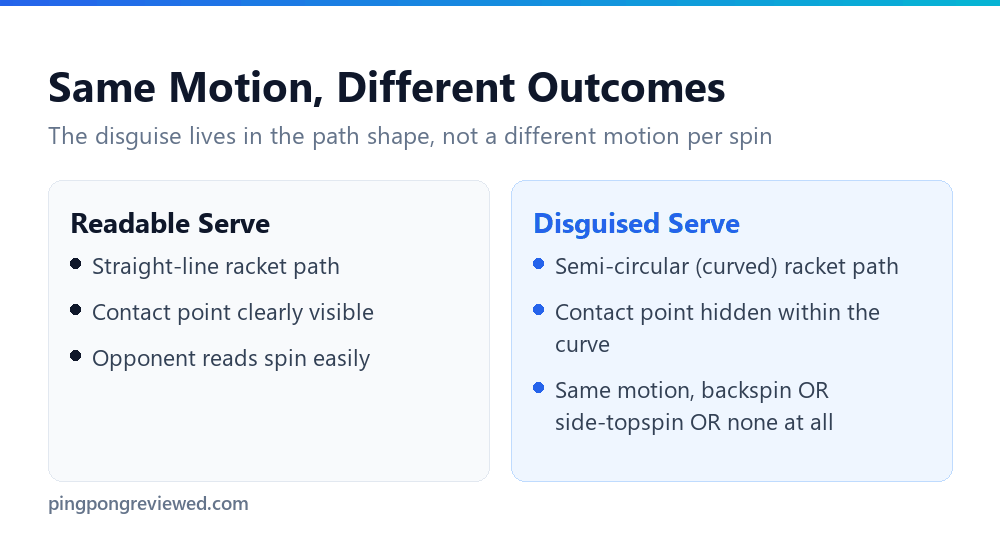
A semi-circular, curved racket path solves this by giving the racket many possible points along a curve where contact could plausibly happen, rather than one obvious point on a straight line. This is the foundation for the contact-point variation covered below.
Same Motion, Different Contact Point
Once you’re using a curved path, the specific spin you produce depends on exactly where within that curve you make contact. Contacting the ball on the downward part of the curve produces backspin, on the sideways part sidespin, and on the upward part topspin. The overall arm motion can look similar to an opponent watching from the other side of the table, since only the contact moment shifts along the same swing shape.
💡 Pro tip: Practice this specifically by serving the same overall arm motion repeatedly, deliberately shifting your contact timing earlier or later within the swing each time, rather than practicing completely different motions for different spins. The disguise only works if the motion looks the same from outside.
The Follow-Through Trick
A further layer of deception happens after contact, not during it: pulling the racket in the opposite direction from where the spin was actually generated, immediately after striking the ball. Since some players may read a serve’s spin partly from the follow-through motion rather than the harder-to-see exact contact point, a follow-through that visually contradicts the actual spin can mislead even a player who’s gotten reasonably good at reading contact points directly.
The Float Serve: Similar Motion, Little or No Spin
One deception does not disguise one spin as another at all, it disguises the complete absence of spin as a heavy backspin serve. A float serve uses a motion that is meant to look like a heavy backspin serve to the receiver, but carries little or no spin. A receiver who prepares for heavy backspin and meets a ball with little spin can pop the return up or hit it long, which can give the server an easy follow-up attack.
Backhand-Specific Deception: the Elbow Pull
For backhand serves specifically, a distinct deception technique involves a vigorous elbow pull immediately after contact on a backspin serve. This creates an exaggerated, larger follow-through motion that opponents often misread as sidespin or side-topspin, even though the actual spin imparted was backspin. This is a more specialized version of the general follow-through trick above, tailored to the specific biomechanics of a backhand serve motion.
Practicing Disguise Without a Partner
A serve does not require a receiving partner, so serve practice can be done solo. Serving repeatedly into a catch net while deliberately varying contact timing within the same overall motion lets you refine the mechanical consistency of the disguise itself, even without anyone there to actually be deceived by it.
A useful self-check during solo practice: record your serves on video and watch them back at reduced speed, specifically checking whether your own overall arm motion actually looks consistent across different spin types, or whether subtle differences are creeping in that would tip off a real opponent. It’s much easier to spot your own tells on video than to feel them in the moment.
Reading the Deception Back: What Good Receivers Do
Understanding these deception techniques from the receiving side is just as valuable as learning to execute them. A receiver facing a server who’s disguising contact point well can’t rely purely on watching the racket, a receiver can also pay attention to secondary cues: the sound of contact (a brushing contact for heavy spin sounds different than a flatter, more direct contact for a float serve), and the ball’s actual flight path immediately off the racket, which can reveal the spin sooner than the server’s motion does.
This is worth knowing even if your own priority is serving deceptively rather than receiving, understanding what a skilled receiver is actually listening and watching for helps you identify which of your own tells might still be giving information away despite a well-disguised arm motion.
Does This Work Against Experienced Players?
It might seem like these tricks would only fool beginners, but the underlying principle, reducing the reliable visual information available to an opponent, can still matter against experienced players, though the margin may be finer. An experienced player reads spin faster and more accurately than a beginner, but they’re still reading the same visual cues: contact point and follow-through motion. Reducing how much those cues actually reveal, rather than just serving faster or with more spin, is what separates deceptive serving from simply serving hard.
- ✓Practice one consistent semi-circular motion capable of producing multiple spins
- ✓Vary your exact contact timing within that motion rather than changing the whole swing
- ✓Mix in no-spin serves against opponents who over-read for spin
- ✓Practice the opposite follow-through deliberately, since it doesn’t come naturally
- ✕Use a visibly different arm motion for each spin type you want to produce
- ✕Serve with a straight-line racket path if disguise is the goal
- ✕Rely on serve speed alone as a substitute for spin deception
- ✕Assume these tricks only work against beginners, they can matter against skilled opponents too
The Short Version, Restated
Serve deception comes from one curved motion producing different outcomes, backspin, sidespin, topspin, or very little spin, depending on the contact point, not from a visibly different swing for every spin type. Layer in an opposite follow-through and the specific backhand elbow-pull trick, and you’re giving an opponent unreliable visual information to read from.
Practice it deliberately and pair it with placement variation. None of this requires new equipment, just a curved motion, a catch net, and enough repetition to make it feel natural.
How Much Disguise Is Actually Achievable
It’s worth setting realistic expectations rather than treating serve disguise as a skill with a clean finish line. The aim is to make the spin harder to read, not impossible to read. The coaching site tabletenniscoaching.com notes that world-class players do this so quickly, with such a short motion around contact, that it is almost impossible to pick up except in slow motion.
This matters for how you should measure your own progress practicing this skill: success looks like an opponent’s return quality dropping noticeably and inconsistently, not a guarantee that every disguised serve produces an outright winning return.
Combining Disguise With Placement
Spin disguise works best as one layer of a broader serve strategy rather than the entire strategy on its own. Combining a well-disguised spin with varied placement, short to the middle, long to the wide forehand, alternated unpredictably, compounds the difficulty for a receiver considerably more than either element alone. A receiver who’s uncertain about spin AND uncertain about where the ball is going has to split their attention and preparation across two different problems simultaneously, which is meaningfully harder than solving either one in isolation.
Common Questions
How do you disguise spin on a table tennis serve?
Use a semi-circular racket path and vary your exact contact point and timing within that same motion, backspin on the downward part, sidespin on the sideways part, topspin on the upward part, rather than using a different motion for each spin.
Why is a curved racket path better than a straight one for deception?
A straight-line path makes the contact point visually obvious. A curved path gives many plausible contact points, making the actual one much harder to read.
What is a float serve?
A serve that looks identical to a heavy backspin serve but carries essentially no spin, for example by contacting the ball where the racket is moving slowly.
How does the opposite follow-through trick work?
Pulling the racket in the opposite direction from the actual spin immediately after contact misleads opponents who read spin partly from the follow-through rather than the contact point. It adds a second layer of deception on top of the contact-point variation itself.
Does serve disguise still work against experienced players?
It can. Experienced players read the same visual cues (contact point, follow-through) as beginners, just faster and more accurately, so reducing what those cues reveal can still matter.
Can I practice serve disguise without a partner?
Yes, serving into a catch net and reviewing video of your own motion is one way to practise disguise consistency on your own.
Should I combine spin disguise with placement variation?
Yes, combining uncertain spin with unpredictable placement compounds the difficulty for a receiver far more than either element alone.
The Short Version
One curved motion, several possible outcomes, the disguise lives in the ambiguity, not in hiding the swing itself.
- →Use a semi-circular racket path, not a straight-line motion.
- →Vary the contact point within one motion: downward part for backspin, sideways part for sidespin, upward part for topspin.
- →Pull the racket opposite to the actual spin direction after contact to mislead the follow-through read.
- →A float serve mimics heavy backspin’s motion while carrying near-zero actual spin.
- →A backhand elbow pull creates a follow-through often misread as sidespin.
- →These techniques can matter against experienced opponents, not only beginners.

Ping Pong Reviewed is an equipment review site covering table tennis and baseball gear. Specifications are checked against manufacturer listings, and prices against live retail pages, before publication.