Palio Master 2.0 Review: The Real Step Up From Expert 2
Palio Master 2.0 sits a tier above the Expert 2 already reviewed on this site, aimed at intermediate players who’ve outgrown an entry-level paddle but aren’t ready for a bare blade-and-rubber custom build. This page checks the real specs and pricing behind that positioning.
What follows is independently corroborated specifications and current pricing, not a claimed hands-on verdict.
📊 Note: What this review is. We have not logged hours with this paddle, and we’re not going to describe a feel we haven’t felt. What follows is verified pricing, consistently reported specification numbers, and the buying decisions that follow from them.
Table of Contents
What Palio Master 2.0 Costs Right Now
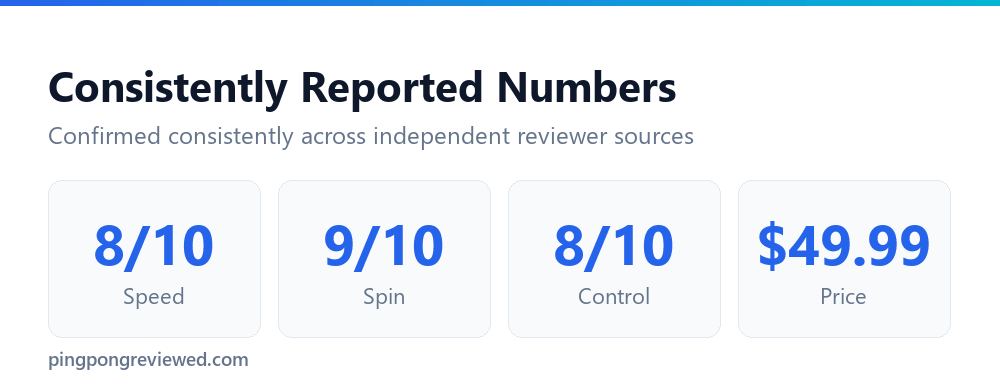
Multiple independent sources consistently price Palio Master 2.0 at $49.99 in the US. It’s a complete, pre-assembled paddle, Palio’s own CJ8000 rubber, 2.0mm, mounted on both sides at the factory, not a bare blade requiring separate rubber selection.
Master 2.0 is listed on Amazon with its included case, alongside other established table tennis retailers.
The Official Specifications
The CJ8000 rubber is worth understanding specifically, since it’s the actual source of this paddle’s spin-forward character. Independent sources describe it as a tacky-topsheet rubber over a softer sponge, a similar general category to DHS Hurricane 3’s construction already covered on this site, engineered to let players generate real spin variety (topspin, backspin, sidespin) without needing a hard-hitting, fully committed swing to access it.
How It Compares to Palio’s Own Expert 2
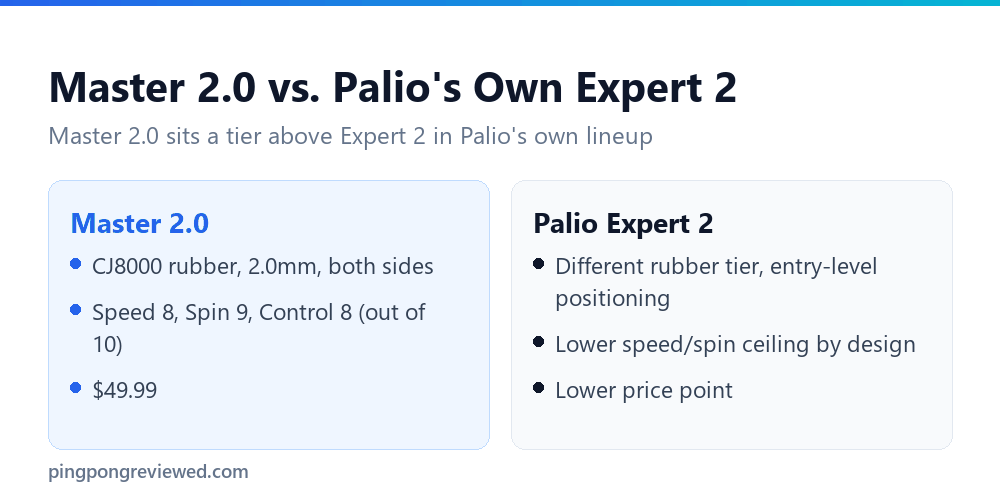
This site has already reviewed Palio’s Expert 2, and Master 2.0 is consistently positioned by independent reviewers as the step up from it within Palio’s own pre-assembled lineup, a higher spin ceiling and a more capable rubber, aimed at a player who’s outgrown Expert 2’s more entry-level positioning.
Who Palio Master 2.0 Is Actually For
- ✓You’ve outgrown a true entry-level paddle and want more spin
- ✓You want a tacky, spin-forward rubber without a custom blade build
- ✓You’re comparing Palio’s own pre-assembled tiers against each other
- ✓You want ITTF-approved rubber for casual tournament eligibility
- ✕You’re a complete beginner just starting the sport
- ✕You want to eventually customize blade and rubber separately
- ✕You need the absolute fastest, most aggressive paddle available
- ✕You already play at an advanced level requiring a custom setup
💡 Pro tip: If you’re not sure whether you’re ready for Master 2.0’s spin ceiling, this site’s Palio Expert 2 review covers the more entry-level option in the same lineup, a reasonable comparison point before spending the extra money here.
The ITTF Approval, and What It Actually Means
Independent sources confirm Master 2.0’s rubber carries ITTF approval, which this site’s own rules content covers in more depth elsewhere: approval matters specifically for sanctioned tournament play, where a referee can check equipment against the official approved list. For casual, club, or recreational play, approval status has no practical effect on how the paddle performs or whether it’s fine to use.
That’s worth knowing directly rather than treating “ITTF approved” as a vague quality signal on its own, it’s a specific, checkable status that matters in one specific competitive context and is otherwise a nice-to-have rather than a meaningful differentiator for most buyers.
Thickness and Grip Options
Independent sources describe Master 2.0’s CJ8000 rubber mounted consistently at 2.0mm on both sides, without the multiple thickness options this site’s bare-rubber reviews typically cover. That’s a normal, expected trade-off for a pre-assembled paddle, the manufacturer picks one thickness that suits the paddle’s overall intended player and doesn’t offer per-side customization the way a buyer selecting rubber separately would have. The flared handle shape is likewise fixed rather than offered in alternate grip styles on this specific model.
Why Pre-Assembled Paddles Serve a Different Buyer
Most of the rubber reviews on this site cover bare sheets meant to be mounted onto a separately chosen blade, the path serious and advanced players take once they know specifically what combination of blade stiffness and rubber character suits their game. Palio Master 2.0 serves a different buyer: someone who wants a complete, ready-to-play paddle without researching blade construction, sponge hardness, and gluing technique separately.
That’s not a lesser path, just a different one, and it’s worth stating directly since a reader coming from this site’s rubber reviews might expect the same level of granular customization discussion. A pre-assembled paddle’s whole value proposition is removing that granular decision-making, trading some ability to fine-tune for a much simpler buying and playing experience.
What CJ8000 Rubber Actually Prioritizes
Independent sources consistently describe CJ8000 as a tacky topsheet paired with a softer sponge, a combination that prioritizes accessible spin generation over raw speed or power. That’s a meaningfully different design goal than a hard, high-output rubber like this site’s Donic Baracuda or Tibhar Hybrid K3 reviews cover, CJ8000 is built to let an intermediate player feel real spin variety without needing the fast, committed swing those harder rubbers demand.
This context helps explain why Master 2.0’s spin rating (9/10) outpaces its speed rating (8/10) specifically, and why independent reviewers position it as an intermediate rather than advanced-attacking paddle. The rubber is doing exactly what a softer, tackier sponge is generally built to do: making spin more accessible at a cost of some maximum output ceiling compared to harder, more demanding rubbers.
The Included Case
Independent listings consistently note Master 2.0 ships with a carrying case, a detail worth mentioning since it’s a real, if modest, value-add compared to a bare-blade purchase where a case is typically an unbundled extra cost. For a buyer new to assembling their own equipment ecosystem, having a case included by default removes one more small decision from the purchase.
Comparing Weight to Other Paddles on This Site
At approximately 259 grams, Master 2.0 sits at a moderate weight within the range this site has covered for pre-assembled and custom setups alike. Weight affects swing feel directly, a heavier paddle generally provides more built-in power at the cost of maneuverability and reaction time, while a lighter setup favors quicker hands over raw pop. Independent sources don’t flag Master 2.0’s weight as unusual in either direction, consistent with its positioning as a balanced, all-round intermediate option rather than a specialist tool built around an extreme weight choice.
Buying It as a Gift or for a Developing Player
Master 2.0’s positioning, a genuine step up from a true beginner paddle, but still a complete, no-assembly-required purchase, makes it a reasonable gift consideration for a player who’s shown real interest and improvement in the sport but hasn’t yet reached the point of wanting to research custom blade and rubber combinations themselves. It sidesteps the risk of either underestimating a developing player with too basic an entry paddle, or overwhelming them with a fully custom setup they’re not ready to evaluate or maintain themselves.
That’s an useful middle position to occupy in a gift-giving context specifically, where the giver often doesn’t have enough information about the recipient’s exact skill level and preferences to make a confident custom-build decision on their behalf.
Care and Maintenance
Like any inverted rubber, CJ8000’s tacky topsheet benefits from the same general care principles covered across this site’s rubber reviews: wiping the surface down after sessions and storing the paddle in its included case rather than leaving it exposed helps preserve tack and grip meaningfully longer than neglecting basic care. Since this is a pre-assembled paddle rather than a rubber sheet a buyer glues on themselves, there’s no gluing process to manage, maintenance here is limited to cleaning and storage rather than mounting.
A Worked Example
Picture a player who started with a basic entry paddle a year ago, has developed a consistent forehand drive, and is starting to feel frustrated that their opponents’ shots carry more spin than they can generate or handle. That’s close to the exact profile independent reviewers describe Master 2.0 as built for, a real, if moderate, jump in spin capability that meets a developing player where their game actually is, without requiring them to learn blade and rubber selection from scratch.
Compare that to a complete beginner picking up a paddle for the first time. That player likely benefits more from a simpler, more forgiving entry paddle, possibly Palio’s own Expert 2, since Master 2.0’s spin-forward rubber assumes a baseline stroke consistency a first-time player hasn’t built yet.
That’s the actual decision this review is trying to help with: not whether Master 2.0 is a good paddle in the abstract, but whether your own game has reached the specific point where its particular trade-offs, more spin, a genuine but not extreme price, no customization required, actually line up with what you need next.
Common Questions
How much does Palio Master 2.0 cost?
Multiple independent sources consistently price it at $49.99 in the US, including its case.
What rubber does Palio Master 2.0 use?
Palio’s own CJ8000 rubber, 2.0mm, mounted on both sides, an ITTF-approved tacky-topsheet rubber built for spin.
Is Palio Master 2.0 better than Palio Expert 2?
For an intermediate player ready to use more spin, yes. A genuine beginner is often better served starting with Expert 2’s more forgiving entry-level rubber.
Is Palio Master 2.0 good for beginners?
It’s positioned for intermediate players specifically, not complete beginners, its spin-forward rubber rewards a stroke already in development.
Does ITTF approval matter for casual play?
No. Approval only matters for sanctioned tournament play, where a referee checks equipment. Casual and club play has no equivalent check.
Match the paddle to the stage, not the other way around, and this becomes an easy purchase to feel good about regardless of which direction you land on.
The Verdict
The short version: Palio Master 2.0 is a genuine intermediate step-up paddle within Palio’s own pre-assembled lineup, built around a tacky, spin-forward CJ8000 rubber, priced at $49.99 with consistent Speed 8/Spin 9/Control 8 ratings across independent sources. It suits a player who’s outgrown a true beginner paddle, not a first-time buyer. Verified across multiple independent sources on 6 September 2026.
- →Consistently reported: Speed 8/10, Spin 9/10, Control 8/10 at $49.99.
- →Uses Palio’s own CJ8000 rubber, 2.0mm, ITTF-approved, on both sides.
- →Positioned as the step up from Palio’s own Expert 2 paddle.
- →Spin-forward design rewards an already-developing stroke.
- →ITTF approval matters for tournaments, not casual or club play.
- →Ships with a carrying case included, a real if modest added value.
So the closing question is about stage, not just budget: has your own game reached the point where more spin ceiling actually helps, or would a more forgiving entry-level paddle still serve you better right now?
A complete, no-assembly paddle with a real, specific role in a developing player’s progression is worth more than its modest price tag might suggest.
As an Amazon Associate, we earn from qualifying purchases through links on this page.

Ping Pong Reviewed is an equipment review site covering table tennis and baseball gear. Specifications are checked against manufacturer listings, and prices against live retail pages, before publication.