How to Choose a Ping Pong Paddle Blade and Rubber That Actually Match
Choosing a ping pong paddle blade and rubber that work as one setup, rather than as two separate purchases, is the gap most guides on this topic leave open. They treat the blade and the rubber as independent decisions and stop there, which misses the problem players actually hit: a good blade and a good rubber can still make a bad paddle together if their speed and control characteristics pull against each other. Our blade and rubber guides cover picking each piece individually. This page is about pairing them so the finished setup does not fight itself.
Table of Contents
Why Pairing Matters More Than Picking Each Alone
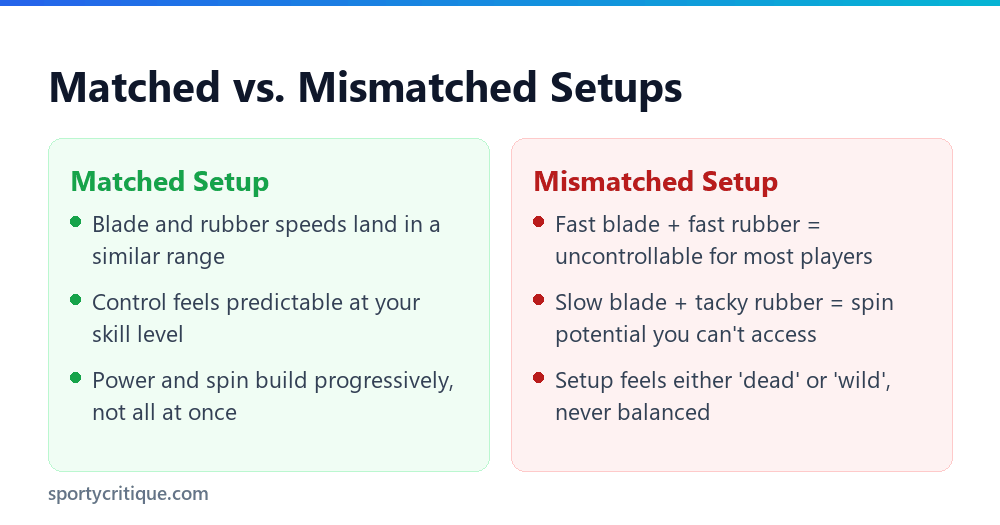
Every blade carries a speed rating, roughly categorized as defensive, all-round, or offensive. Every rubber sheet carries its own combination of speed, spin, and control ratings. The mistake most new buyers make is picking the highest-rated “best” option in each category independently — an offensive carbon blade paired with the tackiest, fastest rubber available. On paper that sounds like the strongest possible setup; in practice, two maximum-speed components combined usually produces a paddle so fast and hard to control that even advanced players struggle to keep shots on the table.
How to Actually Match Them
Start From Your Skill Level, Not the Spec Sheet
A beginner or early-intermediate player is almost always better served by an all-round blade paired with a control-oriented or moderate rubber, even if a faster combination is available. Speed and spin potential you can’t yet control don’t help your game — they just make every shot less predictable while you’re still building consistency.
Balance the Total Speed, Not Just Peak Speed
Think of blade speed and rubber speed as adding together rather than each existing independently. An offensive blade with a control-leaning rubber often lands in a similar overall “total speed” zone as an all-round blade with a faster rubber — two different paths to a similar balanced result. Understanding this lets you swap one component for a faster or slower option and compensate with the other, rather than treating each choice in isolation.
Match Rubber to Blade Flex, Not Just Blade Speed
A stiffer blade transmits more of the rubber’s own characteristics directly, while a more flexible blade dampens some of the rubber’s speed and spin. A very tacky, high-spin rubber on a stiff offensive blade can feel genuinely uncontrollable; the same rubber on a more flexible all-round blade often plays noticeably calmer.
Consider Different Rubber on Each Side
Many intermediate and advanced players deliberately run different rubber on their forehand and backhand — often a faster, spin-oriented sheet on the forehand paired with a softer, control-oriented sheet on the backhand. This isn’t cheating on setup consistency; it’s a genuinely common way to get power where you need it and control where you need that instead.
Three Reasonable Starting Combinations
- Beginner-safe: all-round blade + control-oriented, moderate-speed rubber on both sides. Prioritizes consistency and forgiveness over raw power.
- Balanced intermediate: all-round or light-offensive blade + one moderate rubber (forehand) and one control rubber (backhand). Adds selective power without sacrificing overall control.
- Advanced offensive: offensive carbon or ALC blade + tacky, high-spin rubber on the forehand, softer control rubber on the backhand. Only recommended once a full, consistent loop stroke is already in place.
These are starting points, not rigid prescriptions — personal playing style, hand size, and preference all shift the right answer. But starting from one of these three combinations avoids the most common mismatch mistake of maxing out speed on both components at once.
Don’t Forget the Handle
Blade shape and handle style are easy to overlook when the focus is on speed and spin ratings, but they directly affect how well you can actually execute the pairing you’ve chosen. Shakehand blades commonly come in flared (wider at the base, easier grip stability for beginners), straight (more uniform width, favored by some intermediate and advanced players for grip flexibility), and anatomic (contoured to the hand, less common but preferred by some players for a locked-in feel) handle shapes. Penhold blades use a different handle style entirely, generally shorter and rounder, built around the penhold grip’s different hand mechanics.
A mismatched handle doesn’t ruin a good blade-and-rubber pairing, but it can subtly undercut it — a grip that feels unstable in your hand makes it harder to execute the consistent, repeatable stroke that a carefully matched setup is supposed to reward. Test a few handle shapes in person if possible before committing to a blade, especially if you’re unsure which shape suits your hand size and grip style.
Allocating a Limited Budget
If you can’t afford a premium blade and premium rubber at the same time, rubber is generally the better place to spend more. Rubber has a bigger direct impact on spin, speed, and feel for most playing styles than the blade underneath it, and rubber wears out and needs replacing every few months regardless — a budget blade paired with a quality rubber sheet is a reasonable, common way to get most of the performance benefit without the full cost of a premium setup.
The reverse strategy — an expensive blade with cheap, worn-out, or mismatched rubber — tends to waste more of the blade’s actual potential, since the rubber is doing most of the work in generating spin and shot character in the first place. If budget forces a tradeoff, put the extra money into the rubber sheets, not the blade underneath them.
Frequently Asked Questions
What factors should I consider when choosing a ping pong blade?
Blade speed rating (defensive/all-round/offensive), material (pure wood vs. carbon-reinforced), and flex, matched to your current skill level rather than the fastest option available. See our dedicated blade guide for a full breakdown of blade types.
How does rubber affect paddle performance?
Rubber determines most of a paddle’s spin and a large share of its speed and control feel — arguably more than the blade itself for most playing styles. A tacky, high-tension rubber generates more spin; a harder, less tacky rubber generally offers more predictable control.
Should beginners use a specific type of paddle setup?
Yes — an all-round blade with control-oriented, moderate-speed rubber on both sides is the safest starting point for nearly every beginner, prioritizing consistency over the power and spin ceiling a faster setup offers.
How often should I replace my paddle rubber?
Every 3-6 months for regular club play, sooner if you notice reduced grip on serves — see our full rubber replacement kit guide for the complete process and required tools.
Can I mix a cheap blade with expensive rubber, or vice versa?
Yes, and it’s a common budget strategy — rubber typically has a bigger performance impact than blade for most playing styles, so investing more in rubber while starting with a budget blade is a reasonable way to allocate a limited budget.
How do I know if my blade and rubber are mismatched?
The clearest sign is a paddle that feels either uncontrollably fast — shots consistently flying long even on moderate swings — or oddly dead, where you can’t generate expected spin or pace even on a full swing. Both are signs the combined speed of blade and rubber doesn’t suit your current technique level.
Should I buy blade and rubber from the same brand?
Not necessarily — brand matching is a marketing convenience, not a technical requirement. Mixing brands is completely normal and common at every level of play; what matters is matching speed and control characteristics, not the logo on each component.
Does blade wood type matter as much as rubber choice?
Less, for most players. Wood type and ply count affect feel and vibration dampening, but rubber choice has a larger measurable impact on spin, speed, and control than blade wood composition does for the vast majority of playing styles below elite competition level.
How long does a properly paired setup last before needing changes?
The blade itself can last years with normal care, but rubber wears out every 3-6 months of regular play. When you replace rubber, it’s worth reconsidering whether the same speed rating still suits your current skill level, since players who are actively improving often outgrow their original rubber pairing well before the blade needs replacing.

Ping Pong Reviewed is an equipment review site covering table tennis and baseball gear. Specifications are checked against manufacturer listings, and prices against live retail pages, before publication.