How to Choose a Ping Pong Paddle: 4-Step Framework (2026)

If you’re trying to figure out how to choose a ping pong paddle, this page answers a different question than our main best ping pong paddle guide does. That guide tells you which specific paddles to buy, tiered by skill level. This page teaches the decision framework itself, so you can evaluate any paddle you come across, not just the ones we’ve picked. If you already know your play style and grip, skip ahead to our main guide for actual product picks. If you’re not sure where to even start, this is that starting point.
What follows is a single ordered four-step framework rather than a list of considerations, because paddle decisions compound: your grip constrains your handle, your handle constrains your blade, and your blade constrains which rubbers make sense. Taken in the wrong order, you end up re-deciding the same things repeatedly.
Table of Contents
Step 1: Figure Out Your Play Style
Before anything else, decide whether you play more defensively or offensively, since this shapes every choice that follows. Defensive play leans on the block, the push, the chop, and the lob to absorb an opponent’s attack and wait for their mistake. Offensive play leans on loops, drives, and aggressive serves to create the mistake yourself. Most players land somewhere in between as an all-round style, which is genuinely the right starting point if you’re still new enough that you don’t have a strong opinion either way.
This matters for paddle choice specifically because control-oriented paddles favor defensive and all-round play, while speed- and spin-rated paddles favor offensive play. Buying a high-speed offensive paddle before you have the technique to control it is one of the most common beginner mistakes, covered in more depth in our main paddle guide’s style-matching section.
A practical way to figure out which category you actually fall into, if you haven’t played enough to have a strong sense yet, is to pay attention to what you instinctively do when a fast shot comes at you during a casual rally. If your first instinct is to block it back safely and keep the point alive, you’re leaning defensive. If your first instinct is to try to end the point immediately with an aggressive return, you’re leaning offensive. Neither instinct is wrong, and most players shift somewhat between the two as they improve, but your current instinct is a genuinely useful starting signal for equipment choice today rather than equipment choice for the player you might become in a year.
Step 2: Choose Your Grip
Shakehand Grip
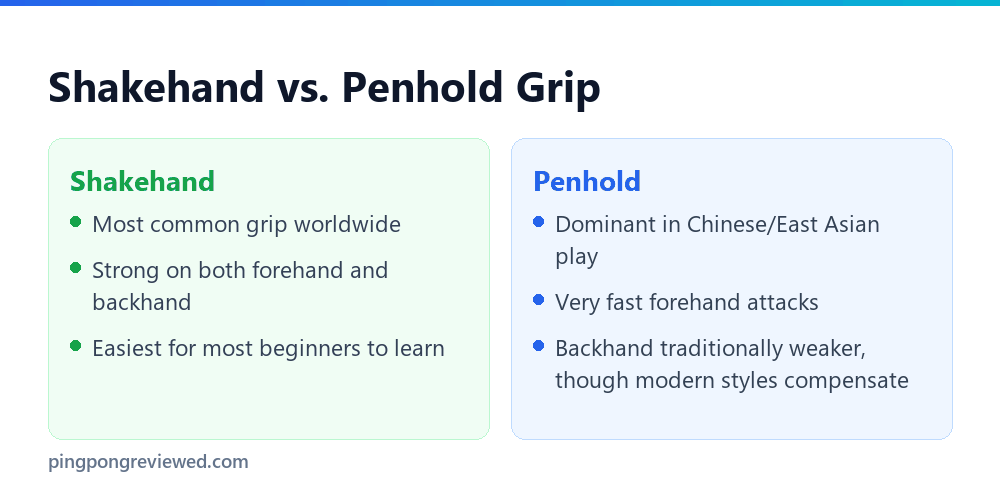
You hold the handle the way you’d shake someone’s hand, roughly. It’s the most common grip worldwide and generally the easiest for new players to pick up, since it gives you a genuinely strong forehand and backhand from the same natural wrist position. A shallow shakehand grip (index finger higher up the blade) favors more control and spin; a deeper grip (hand further down the handle) favors more raw power on forehand shots.
Penhold Grip
You hold the handle the way you’d hold a pen, with the blade extending from your fist. Chinese penhold style wraps the index and middle finger behind the blade for backhand support, while traditional Japanese/Korean penhold style keeps the back of the hand mostly flat against the blade. Penhold rewards an extremely fast, aggressive forehand and remains dominant in Chinese competitive play, but the backhand side is genuinely more limited unless you’ve put in real time developing it.
There’s no universally “better” grip — it comes down to which one your hand adapts to and which play style you’re building toward. If you’re a first-time player with no existing habit either way, shakehand is the more common recommendation simply because it’s easier to find coaching and training resources built around it.
Two less common grips worth knowing about, even though we wouldn’t recommend either as a starting point, are the Seemiller grip, a shakehand variation where the paddle is rotated to favor one side heavily and is mostly seen among players who developed it independently before formal coaching caught on, and the V-grip, a genuinely unconventional hold that trades significant backhand mobility for an unusually strong forehand attack. Both are legitimate at a competitive level in the hands of someone who developed real skill with them, but neither is a sensible choice to deliberately learn from scratch given how much harder it is to find coaching built around them compared to shakehand or penhold.
Step 3: Understand What You’re Actually Buying
Handle Shape
- Flared — widens toward the base, the most common shape, generally comfortable for shakehand grips of any hand size.
- Straight — no widening, popular for penhold play and among players who prefer a more neutral, adjustable grip position.
- Anatomic — molded with a contoured shape for a specific hand position, more polarizing since it locks you into one grip more than flared or straight handles do.
Blade and Ply Count
The blade is the wooden (or wood-plus-carbon) base the rubber mounts to, and its ply count — the number of layers glued together — affects how the paddle feels on contact. Our main paddle guide covers ply count and carbon-reinforced construction in more depth, including why more plies isn’t automatically better for every play style.
Rubber and Sponge
Rubber is what actually contacts the ball, and its sponge thickness underneath controls how much of your swing energy converts into ball speed versus control. Thinner sponge (under 1.8mm) favors control and is standard on beginner paddles; thicker sponge (2.0mm+) favors speed and spin but demands more consistent technique to control.
Most paddles you’ll encounter use inverted rubber, the smooth-surfaced type that grips the ball for spin. A smaller category uses pips-out rubber, which has small raised bumps on the surface and produces a flatter, less spin-heavy return that some defensive-style players use specifically to disrupt an opponent’s rhythm. Unless you already know you want that disruptive playing style, inverted rubber is the sensible default and is what every complete paddle recommended in our main guide uses.
Step 4: Complete Paddle or Custom Build?
A complete, pre-assembled paddle is the right choice for anyone still developing their play style, since custom-building forces you to commit to a specific blade-and-rubber pairing before you actually know what you need from it. Once you’ve played consistently for a while and have opinions about what your current paddle lacks, like wanting more spin without losing control, that’s the point where building a custom paddle by pairing a separate blade with separate rubber starts to make sense. Our main paddle guide’s picks are almost all complete paddles for exactly this reason — it’s the right starting point for the overwhelming majority of buyers.
Custom building also introduces a real cost consideration beginners often don’t anticipate: you’re now buying a blade, two rubber sheets, and glue as separate purchases, and gluing rubber to a blade yourself carries a real risk of a bad first attempt if you haven’t done it before. Some players find that genuinely satisfying once they know what they’re doing, but it’s an added skill on top of the sport itself, not a prerequisite for playing well. Plenty of intermediate and even advanced players stick with quality complete paddles indefinitely rather than ever moving to a custom build, and there’s no competitive disadvantage in doing so as long as the complete paddle you’ve chosen actually matches your play style and grip.
How We Fact-Checked This Page
Grip mechanics, handle-shape terminology and sponge-thickness guidance on this page were checked against multiple independent table tennis coaching sources rather than a single one, since terminology in this area varies between manufacturers and coaching traditions.
Frequently Asked Questions
What’s the best grip for a beginner?
Shakehand, in most cases — it’s the most common grip worldwide, works well for both forehand and backhand from the same hand position, and has the most coaching resources built around it if you want structured lessons later.
Do I need a different paddle for offense vs. defense?
Not strictly a different paddle, but a different rubber-and-sponge combination. Offensive players generally want thicker sponge for more spin and speed; defensive players generally want thinner sponge for more control.
Is a more expensive paddle automatically better?
No — a paddle that’s more advanced than your current technique can actually make your game noticeably worse by amplifying small errors into bigger ones. Match the paddle to your current skill level, not simply your available budget ceiling.
Can I switch grips later after learning one?
You can, but it takes real retraining time, similar to switching your dominant hand at a task you’ve already built muscle memory for. Most players who switch do it fairly early on, before years of ingrained habit make the transition significantly harder.
What handle shape should I pick?
Flared is generally the safest default for a shakehand grip and the most common shape sold. Try it before assuming you need anatomic or straight, since those two shapes suit more specific existing habits and hand sizes.
Should I build a custom paddle as a beginner?
Generally no — a complete, pre-assembled paddle is the right starting point until you’ve played enough to have specific opinions about what you’d want to change about your current setup, since gluing your own rubber to a separate blade adds a real skill and cost on top of the sport itself.
As an Amazon Associate, we earn from qualifying purchases through links on this page.

Ping Pong Reviewed is an equipment review site covering table tennis and baseball gear. Specifications are checked against manufacturer listings, and prices against live retail pages, before publication.