How to Get Better at Ping Pong Once You Know the Basics

If you want to know how to get better at ping pong past a plateau, this guide is for a specific situation: you already know how to play — grip, serve, basic rally — but you’ve stopped improving. You beat the same players you always beat and lose to the same players you always lose to. If you’re brand new to the sport, our basic skills guide and quick tips list are better starting points. This one is about what actually moves the needle once the fundamentals are already there.
Table of Contents
Why You’ve Stopped Improving
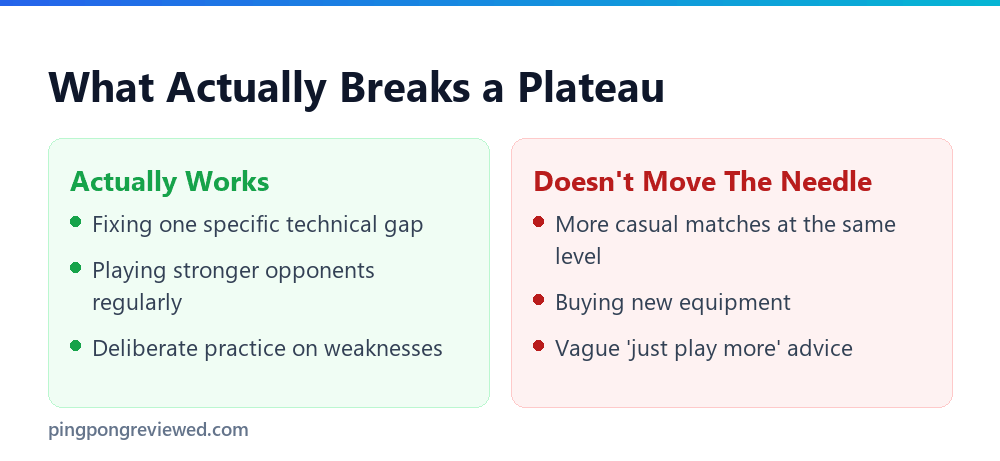
A plateau almost always means one of two things: you’re only playing opponents at your own level, which reinforces existing habits instead of exposing gaps, or you’re practicing broadly instead of on the one or two specific weaknesses actually capping your results. More casual play rarely fixes either problem — it just repeats the same patterns at the same pace, session after session, without introducing anything genuinely new for your game to adapt to or improve against.
What Actually Moves You Forward
1. Find a Partner Who Beats You
Playing people at or below your level feels good but teaches you almost nothing new. A partner who consistently beats you exposes exactly which shot or situation you can’t yet handle — that gap is your actual practice priority, not a guess.
2. Learn to Read Spin Before Contact
Watch your opponent’s racket angle and swing path at the moment of contact, not just the ball’s flight afterward. Topspin, backspin, and sidespin all look different in the racket motion that produces them — reading it early gives you time to adjust your own angle instead of reacting after the ball has already surprised you.
3. Compensate Your Racket Angle for Incoming Spin
Once you can read the spin, the technical fix is straightforward: open your racket face against heavy backspin, close it against heavy topspin. Most intermediate players know this in theory but haven’t drilled it enough to do it automatically under match pace.
4. Use Your Whole Body on the Forehand
An arm-only forehand caps your power and consistency both. Hip and shoulder rotation should generate most of the force, with your arm mostly guiding direction — see our forehand loop guide for the full mechanics if this is a genuine technical gap rather than just a reminder.
5. Develop a Second and Third Serve
If you only have one reliable serve, opponents adjust to it after a few points and neutralize your advantage. Adding a genuine sidespin serve alongside your primary one keeps opponents guessing longer into a match.
6. Keep Your Returns Low, Not Just In
A return that clears the net by a wide margin gives your opponent an easy attacking ball regardless of how well-placed it is. Prioritizing a low trajectory over a safe-feeling high one is one of the fastest ways to stop handing out free attacking opportunities.
7. Take Real Rest Between Points and Games
Fatigue quietly erodes technique before it’s consciously noticeable — a tired stroke breaks down well before a tired mind admits it. Use the allowed time between points and the break between games deliberately, not just as an automatic pause.
8. Track What Actually Beats You
After matches against stronger players, note specifically what shot or situation caused the point loss — a particular serve, a specific corner, a spin you couldn’t read. Casual after-the-fact impressions (“I just lost”) don’t give you anything to actually practice; a specific pattern does.
Diagnose Your Specific Plateau First
“Get better at ping pong” means something different depending on where you’re actually stuck, and the eight items above work best when you know which one applies to you rather than trying all of them evenly. A few common patterns:
- You lose mostly to spin you can’t read: prioritize items 2 and 3 — spin reading and racket-angle compensation — over everything else on this list.
- You win rallies but lose on unforced errors: the problem is usually consistency under pressure, not raw shot quality — items 6 and 7 (low returns, real rest between points) matter more here than adding new shots.
- You have good shots but get outlasted in longer matches: item 7 on fatigue management and item 5 on serve variety both address a game plan that holds up over a full match, not just a strong start.
- You plateau specifically against players who out-serve you: item 5, developing a genuine second and third serve, is the direct fix — a single reliable serve becomes predictable fast at this level.
If none of these patterns obviously fits, item 8 — tracking what actually beats you across several matches — is the most useful starting point. A pattern usually becomes obvious after three or four losses once you’re deliberately looking for one, even if it wasn’t clear from a single match alone. Write it down if you have to; relying on memory alone tends to blur several different losses into one vague, unhelpful impression of “I just need to be better overall,” which isn’t specific enough to actually practice against.
Why Improvement Stalls, and What Actually Restarts It
Most players improve quickly for a period and then flatten, and the flattening is rarely about talent or effort. It is usually about practising in a way that no longer challenges anything.
Playing games is the most common culprit. Games feel like practice and are enjoyable, but they let you use your existing strengths repeatedly and avoid your weaknesses entirely. A player who only plays games gets better at deploying what they already have and does not acquire anything new.
The restart is uncomfortable by definition: deliberately practising what you are bad at, in conditions where you will fail often. That means drilling the stroke you avoid in matches, playing opponents whose style you dislike, and accepting a period of worse results while a new skill becomes usable.
- Identify one specific weakness, ideally from match evidence rather than guesswork.
- Drill it in isolation until it is merely unreliable rather than absent.
- Force it into practice games, even at the cost of losing them.
- Only then judge whether it works, since a shot abandoned before this stage was never given a chance.
This is also why coaching accelerates improvement so much: the hardest part is accurately identifying what to work on, and that is precisely what an experienced observer supplies in minutes and a player can spend months failing to see alone.
Getting the Practice You Need From Other People
Improvement is much easier with the right practice, and most recreational players are limited less by ability than by only ever playing casual games with the same person.
Joining a club is the single biggest step available, and it is consistently underrated by people who assume clubs are for serious competitors. Most contain a wide range of standards, provide opponents who vary in style, and offer coaching or informal advice that is difficult to obtain any other way. Our ping pong club guide covers what to expect on a first visit.
If a club is not practical, the next best thing is deliberately varying who you play. Different styles expose different weaknesses, and a player who only ever faces one opponent develops a game shaped entirely around beating that specific person.
It is also worth asking a stronger player for a practice session rather than a game. Many are happy to feed balls or play structured rallies, and most people never ask because it feels like an imposition. A twenty-minute drilling session with someone better than you is worth several casual games.
Things That Feel Like Improvement But Are Not
Some activities feel productive and change very little, which makes them worth naming so time can be redirected.
Buying equipment is the clearest example. A new bat produces a real sensation of change and almost no change in results, and the adaptation period frequently makes things temporarily worse. Equipment is worth upgrading when you can name what you want it to do, not when progress has stalled.
Playing many games against much weaker opponents is the second. It produces wins and no pressure, and pressure is where most improvement happens. It is enjoyable, and it is not practice.
Watching large amounts of professional play without a specific focus is the third. Watching helps, but only when you are deliberately observing one thing, otherwise it is entertainment that feels like study.
Structuring Improvement Around a Real Schedule
Most improvement advice assumes more available time than people have. The useful question is not what an ideal training week looks like but how to get the most from the time that genuinely exists.
If you have one session a week, spend most of it on games and spend ten minutes at the start on one specific technical thing. Trying to run a full drilling programme on one weekly session produces neither technical progress nor enjoyment.
If you have two or three, dedicate one primarily to drilling and the others to play. That ratio gives technique somewhere to be tested while still producing change.
If you have more, the limiting factor stops being time and starts being direction, which is the point at which coaching or structured feedback returns more than additional hours would.
Whatever the volume, consistency beats intensity. Two hours a week every week produces more than six hours once a month, because motor learning consolidates between sessions and long gaps undo part of what was built.
Knowing Whether You Are Actually Improving
Improvement in table tennis is genuinely hard to perceive from inside, because your opponents improve too and match results are noisy. Without some form of measurement, players routinely conclude they have plateaued when they have not, and vice versa.
- Count something repeatable. Consecutive returns in a controlled rally, or serves landing in a target area out of thirty. These are insensitive to who you happen to be playing.
- Track results against specific opponents, not overall. A steady win rate against the club generally can hide clear improvement against one particular player.
- Record occasionally. Footage from six months ago makes technical change obvious in a way that memory does not.
- Note what beats you. If the thing that loses you points has changed, that is improvement even if the results haven’t yet.
That last point is the most useful and the least intuitive. Moving from losing to basic inconsistency, to losing to a specific tactical weakness, is real progress even when the scoreline looks identical, and recognising it is what keeps players working through the periods where results lag behind ability.
The Part That Is Not Technical
Beyond a certain level, matches are lost to decision-making and composure rather than to stroke quality, and this is the least practised area in recreational table tennis.
The most common failure is playing faster when losing. Under pressure players rush serves, rush returns, and attack balls that do not warrant it, which accelerates exactly the outcome they are trying to avoid. The counter is deliberate and simple: slow down between points, particularly when behind.
The second is failing to change a losing pattern. If a tactic has not worked for six points, it is unlikely to start working, and continuing it is a decision even when it feels like persistence. Noticing the pattern and trying something different is a skill that improves with deliberate attention.
Neither of these requires physical practice. They require noticing, which is why reviewing your own matches, even from memory immediately afterwards, tends to produce faster tactical improvement than additional table time does.
A Realistic Timeline
Expectations cause a surprising amount of avoidable frustration, so it is worth stating roughly how improvement actually unfolds.
The first few months produce rapid, obvious gains, because almost everything is new and basic consistency improves quickly. That phase ends, and its ending is not a sign of a ceiling, it is simply the point at which further progress requires deliberate work rather than exposure.
After that, meaningful change tends to arrive in steps rather than smoothly. A technique worked on for weeks often seems to do nothing and then suddenly becomes usable, which is normal for motor learning and is why abandoning something after a fortnight is usually premature.
Over a longer horizon, the players who improve most are rarely the most talented ones. They are the ones who practise deliberately, seek out stronger opposition, and keep working on weaknesses after the enjoyable phase of rapid early gains has passed.
The Short Version
Everything on this page reduces to one uncomfortable idea: the practice that produces improvement is not the practice that feels most enjoyable, and choosing the former deliberately is what separates players who keep getting better from players who stay where they are for years on end.
Improvement past the beginner stage comes from deliberately practising what you are bad at, which is uncomfortable and is why most players stop doing it and plateau while continuing to play regularly, often for years. Enjoyment and improvement are not the same activity, and the gap between them widens the longer you play only in the way that feels good.
Identify one weakness from match evidence, drill it in isolation, force it into practice games while it is still unreliable, and only judge it after that, once it has actually been tested. Play a much wider range of opponents than you currently do, ask stronger players for structured practice sessions rather than for games, since most are willing and almost nobody thinks to ask, and prefer consistent weekly sessions over occasional long ones, since motor learning consolidates between sessions and long gaps undo part of what the previous one built.
Measure something repeatable so you can tell progress from noise, and remember that a change in what beats you is real improvement even before the results move. Progress in this sport is genuinely hard to see from the inside, and players who measure something keep working through the periods where it feels absent, while players relying on impressions alone tend to conclude they have stopped improving and quietly reduce their effort accordingly, which then makes the perception true. Measuring something, almost anything, is what breaks that loop before it costs you the months of practice that would have carried you through to the next visible step.
Frequently Asked Questions
Can you practice ping pong alone?
Yes — wall rallies build ball control and reaction speed, and shadow-swinging without a ball helps groove a whole-body forehand motion. Neither replaces live match play against real opponents, but both are useful supplements when a partner isn’t available, especially for grooving the mechanical parts of a stroke that don’t require live spin or pace to practice effectively.
How do you win at ping pong every time?
You don’t — even elite players lose regularly to other elite players at the top level. The realistic goal is winning more consistently against your current level and gradually beating players who used to beat you, not chasing an unbeaten record that no serious competitive player actually has.
How do you hit a good ping pong shot?
Consistency and placement beat raw power for most players at every level below elite competition. A well-placed shot to a corner or the opponent’s elbow, hit with moderate pace and topspin, wins more points over a full match than an occasional hard-hit winner surrounded by unforced errors.
Can a player hit the ball before it bounces in table tennis?
No — the ball must bounce exactly once on your side of the table before you return it. Hitting it out of the air (a volley) is an illegal shot and an automatic point for your opponent, with one narrow exception for balls that have already crossed the end line of the table.
How long does it take to get good at table tennis?
Reaching a solid intermediate level with consistent fundamentals typically takes 6 months to a year of regular play. Breaking through the specific plateau this guide addresses — going from intermediate to genuinely strong — often takes another year or more of the deliberate, targeted practice described above, not just additional casual play.
Is it normal to plateau more than once?
Yes — most players hit several distinct plateaus on the way to advanced play, not just one. Each plateau usually has its own specific cause, which is exactly why the diagnose-first approach in this guide works better than repeating the same broad practice routine indefinitely and hoping it eventually breaks through.
Does joining a club help more than practicing alone?
For most players past the beginner stage, yes. A club gives access to a wider range of opponents and skill levels than most people can find casually, which directly supports the ‘play someone who beats you’ strategy at the very center of this guide — it’s hard to consistently find stronger opponents outside a club or a regular organized practice group.
What’s a realistic timeline for breaking a specific plateau?
With focused practice on a correctly diagnosed weakness, most players notice real movement within about 4 to 8 weeks of consistent, deliberate effort. Vague, unfocused practice on the same underlying plateau can drag on for months or longer without any noticeable change, which is the core argument for diagnosing the specific gap before choosing what to drill.

Ping Pong Reviewed is an equipment review site covering table tennis and baseball gear. Specifications are checked against manufacturer listings, and prices against live retail pages, before publication.