Can the Ball Bounce Twice on Your Own Side? Table Tennis Rules
This question often comes from newer players, usually phrased as some version of “what if I’m too slow and it bounces again before I hit it”, and the answer is short.
This page covers the rule and why it applies to both serves and rally shots.
Short answer: No, the ball cannot bounce more than once on your own side of the table before you strike it. If it bounces twice, the point goes immediately to your opponent. This applies identically whether it happens during a serve or during a general rally, it’s not a serve-specific rule.
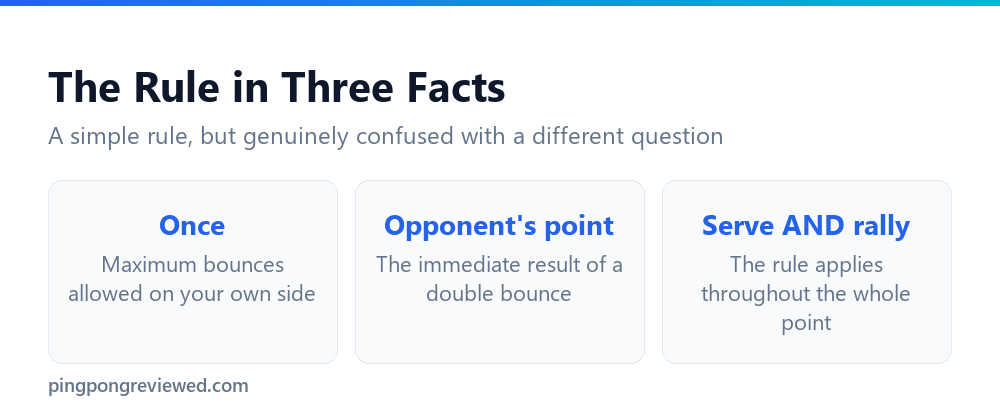
Table of Contents
One Bounce, Full Stop
The rule itself is simple: the ball may not bounce more than once on either side of the table, your own side or your opponent’s, at any point during play. If the ball bounces twice on your own side specifically before you manage to strike it, the point is immediately awarded to your opponent. There is no partial credit for how close the second bounce was to your paddle: two bounces is two bounces. The one related special case in the Laws is service to a receiver in a wheelchair (due to a physical disability), where a served ball that comes to rest on the receiver’s court, returns toward the net after touching it, or leaves it over a sideline is a let (ITTF Statutes 2026, Law 2.9.2).
This Applies to Serves and Rally Shots Equally
It’s worth being explicit that this isn’t a serve-specific rule, even though it comes up in serve-related discussions often. The same one-bounce limit applies identically whether the double bounce happens on a serve attempt or during any other shot in an ongoing rally. A player who’s been pulled out of position by a wide shot and simply can’t reach the ball before it bounces a second time on their own side loses the point the same way a server would for the same mistake, the rule doesn’t distinguish between these two moments in a point at all.
⚠️ Watch out: There’s no exception for a double bounce caused by an unreturnable shot, difficult footwork situation, or bad luck. If the ball bounces twice on your side before contact, the point goes to your opponent regardless of why you couldn’t get there in time.
The Different Question This Rule Gets Confused With
It’s worth directly distinguishing this rule from a different question that sounds similar: how many times can the ball bounce on the OPPONENT’s side after you’ve already hit a legal shot there? That’s not a double-bounce violation question at all, once a legal shot crosses the net and bounces on the opponent’s side, the opponent simply has to return it before it bounces a SECOND time on their own side, which loops back into this exact same one-bounce-per-side rule, just from the other player’s perspective. It’s the same underlying rule applied symmetrically to both sides of the table, not two separate rules.
Why There Is Little to Interpret
A double bounce is a plain physical event: either the ball touched the same court twice before it was struck, or it did not. That leaves less to interpret than an edge-ball call or a disputed serve toss height. At high speed it can still be hard to see, so in officiated matches the umpire makes the call; the ITTF Handbook for Match Officials lists “double bounce” as the recommended explanatory term for a ball that touched the same court twice (section 18.4.2).
How This Connects to Footwork and Recovery
This rule is a large part of why footwork and recovery, both topics this site has covered in detail elsewhere, matter as much as they do competitively. A double bounce is, in practice, almost always the direct result of a player simply not reaching the ball in time, which means the actual skill that prevents this specific rule violation isn’t a technical understanding of the rule itself (which is simple), it’s the footwork and positioning skill that gets a player to the ball before that second bounce happens at all. Understanding the rule is trivial; avoiding triggering it is an athletic skill.
💡 Pro tip: If you find yourself double-bouncing regularly against faster opponents, the actual fix almost never involves rules knowledge, it’s a footwork and anticipation issue. Review this site’s coverage of shuffle steps, crossover steps, and reading racket angle for anticipation, since those are the skills that actually prevent this specific outcome.
Why This Question Comes Up So Often for Beginners
It’s worth understanding why this specific question is so common among newer players learning the sport, since the confusion has an understandable source. Beginners frequently mishit or mistime a shot, and in the moments right after a missed swing, it’s natural to wonder whether there’s some grace period or second chance before the point is actually lost, especially coming from other sports or games where a missed attempt doesn’t always end things immediately. Table tennis’s answer here is simply more absolute and immediate than what some players expect coming in: the moment that second bounce happens, the point is over, with no ambiguity about whether recovery was still possible.
A Note on Doubles
In doubles play, the same one-bounce-per-side rule applies identically, with the practical complication that either partner on a team might be the one attempting to reach the ball before a second bounce. The rule doesn’t distinguish based on which specific partner is closer or more responsible for covering that part of the table, if the ball bounces twice on the team’s own side before either partner makes contact, the point goes to the opposing team, the same as it would in singles.
- ✓Understand this as a symmetric rule applying to both sides throughout the whole point
- ✓Recognize a double bounce as objectively verifiable, with no judgment call involved
- ✓Address chronic double-bouncing as a footwork and anticipation issue, not a rules question
- ✓Apply the identical rule in doubles regardless of which partner was closer
- ✕Assume this rule only applies to serves specifically
- ✕Expect any exception for a difficult, hard-to-reach shot
- ✕Confuse this with the separate question of bounces on the opponent’s side after a legal shot
- ✕Treat a double bounce as anything other than an immediate point for the opponent
The Short Version, Restated
One bounce per side, with no exception for how hard the shot was to reach, applying identically to serves and rally shots for both players throughout the entire point. The rule itself is about as simple as any in the sport, the actual challenge is the footwork and anticipation skill that keeps you from ever triggering it in the first place.
Learn the rule once, then spend your actual practice time on the footwork that makes it irrelevant for the rest of your playing career.
Common Questions
Can the ball bounce twice on my own side before I hit it?
No, if it bounces twice on your side before you strike it, the point goes immediately to your opponent.
Does this rule only apply during a serve?
No, it applies identically during a serve attempt and during any general rally shot, throughout the entire point.
Is there an exception if the shot was unreturnable?
No, a double bounce is an objectively verifiable event with no exception for how difficult the shot was to reach.
What’s the difference between this and how many times the ball can bounce on my opponent’s side?
It’s the same underlying rule applied symmetrically, one bounce per side. After a legal shot bounces once on the opponent’s side, they simply need to return it before a second bounce there.
Does this rule work differently in doubles?
No, the same one-bounce-per-side rule applies identically, regardless of which partner on a team is closer to the ball.
The Short Version
Simple rule, immediate consequence, and the real skill lies entirely in the footwork that prevents it.
- →The ball may bounce at most once on either side of the table.
- →A double bounce on your own side immediately gives the point to your opponent.
- →This applies identically to serves and general rally shots.
- →There’s no exception for a difficult or unreturnable shot.
- →The rule applies symmetrically to both players throughout the entire point.
- →Chronic double-bouncing is a footwork issue, not a rules misunderstanding.

Ping Pong Reviewed is an equipment review site covering table tennis and baseball gear. Specifications are checked against manufacturer listings, and prices against live retail pages, before publication.