Does Ping Pong Keep You Fit? What Regular Play Actually Does (2026)

Does ping pong keep you fit? Yes, with a real condition attached: consistency, not any single session, is what actually determines whether it does. This page focuses specifically on that time dimension, what happens to your fitness over weeks and months of regular play, rather than whether a single game counts as exercise, which our companion page on ping pong’s exercise intensity already covers in detail. If you want the full breadth of health benefits, cardio, brain, balance, social, our main health benefits guide is the place for that.
This is worth separating out as its own question because “is it exercise” and “does it actually keep you fit over time” are genuinely different things to ask. Plenty of activities count as real exercise in the moment without necessarily being something people stick with consistently enough to see lasting fitness benefit from, and the honest answer to this question depends much more on your own consistency than on any property specific to the sport itself.
Table of Contents
What “Keeping Fit” From Ping Pong Actually Looks Like
Realistically, regular table tennis play maintains and gradually builds cardiovascular endurance, lower-body muscular endurance, and reaction time, the three things consistent play trains most directly. It won’t build significant muscle mass or raw strength the way resistance training does, and it won’t match dedicated distance training for pure cardiovascular capacity at a serious athletic level. Within that realistic scope, though, regular players do maintain genuinely better cardiovascular fitness, coordination, and reaction time than sedentary peers, consistent with the general exercise-science principle that any regular moderate-intensity activity maintains fitness better than no activity at all.
It’s worth being specific about the reaction-time piece since it’s genuinely distinct from the cardio benefit and often gets folded into a vague “good for fitness” summary without being called out on its own. Reaction time and hand-eye coordination are trainable qualities, not just something you either have or don’t, and open-skill sports like table tennis specifically drill that quality through constant, unpredictable stimulus in a way that steady, predictable cardio genuinely doesn’t. That’s a real fitness dimension distinct from cardiovascular endurance, and regular play maintains and builds it specifically, not as a side effect of the cardio benefit but as its own trained quality.
Why Consistency Matters More Than Intensity
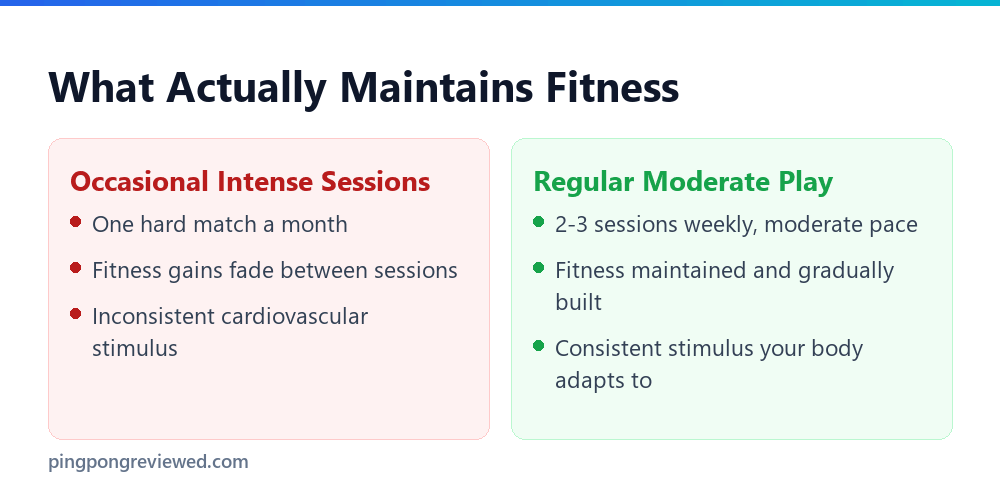
Cardiovascular fitness gains genuinely fade without regular stimulus, generally within a couple of weeks of significantly reduced activity, which is why one intense session followed by three weeks of nothing doesn’t meaningfully keep you fit even though that single session felt like real exercise in the moment. Two to three moderate sessions weekly maintains fitness far more reliably than one occasional hard match, the same principle that applies to essentially any form of regular exercise, not something specific to table tennis.
This matters practically because a lot of people set an ambitious playing schedule in their first excited week, then quietly drop to nothing once that initial motivation fades, which produces roughly the same net fitness outcome as never having started a regular schedule at all. A realistic, modest, genuinely sustainable pace, even just twice a week, beats an ambitious schedule you abandon within a month, every time, for the simple reason that the fitness benefit comes from the sustained pattern, not any single burst of enthusiasm.
A Realistic Timeline
- First few sessions: mostly learning movement patterns and grip; don’t expect much fitness change yet, just adaptation to the sport itself. This early phase is genuinely more about neuromuscular learning, your body figuring out efficient movement patterns, than about cardiovascular training, which is worth knowing so you don’t get discouraged by feeling clumsy before any real fitness effect has had time to show up.
- 2 to 4 weeks of regular play: noticeably less fatigue during rallies, footwork starts to feel more automatic rather than deliberate.
- 1 to 3 months: measurable cardiovascular and reaction-time improvement for most previously sedentary players, consistent with general moderate-exercise adaptation timelines. This is usually when the fitness improvement becomes noticeable outside of play too, less breathlessness on stairs, easier recovery from other physical activity, rather than only during table tennis sessions themselves.
- Ongoing regular play: fitness maintenance rather than continued rapid improvement, the same plateau pattern any regular exercise eventually reaches.
That plateau is worth understanding rather than treating as a discouraging sign, since it’s a genuinely normal part of any exercise adaptation curve, not evidence that table tennis has stopped working for you. Once your body has adapted to a given level of regular activity, continued improvement generally requires either more volume, more sessions or longer ones, or more intensity, faster-paced or more competitive play, the same principle that governs progression in essentially any exercise routine once the initial adaptation phase is behind you.
Is It Enough on Its Own, or Do You Need More?
For general fitness maintenance, moderate cardiovascular health, and coordination, regular table tennis alone is genuinely enough for a lot of people, particularly those not training for a specific separate athletic goal. If you’re specifically after significant strength gains, add resistance training separately, since table tennis builds muscular endurance rather than strength. If you’re training for serious distance-running or cycling goals, table tennis works better as cross-training variety than as your primary cardiovascular program.
A reasonable way to think about the gap: table tennis trains reaction time, coordination, and moderate cardio endurance genuinely well, but leaves raw strength and pure sustained cardiovascular capacity comparatively undertrained relative to sports built specifically around those qualities. Pairing it with even modest resistance training, twice weekly bodyweight or light weight work, covers that gap without requiring a completely separate cardio program on top of it, since the table tennis itself is already supplying real cardio value within the range described earlier on this page.
How We Sourced This
The fitness-adaptation timelines and the consistency-over-intensity principle described here reflect general, well-established exercise-science consensus rather than a claim specific to table tennis alone. We’re applying that general principle honestly to this specific sport rather than inventing sport-specific numbers we can’t actually verify.
The flat “yes” that this question usually receives is worth resisting. Without the consistency caveat it invites the assumption that any amount of occasional play counts equally, which is not how fitness adaptation works for this or any other activity. Frequency and duration decide whether ping pong keeps you fit; the sport itself only decides how enjoyable the frequency is to sustain.
The Short Version
Regular play, roughly two to three moderate sessions a week, genuinely and reliably keeps you fit in the specific ways table tennis actually trains: cardiovascular endurance, reaction time, coordination, and lower-body muscular endurance. It won’t build significant strength on its own, and occasional intense sessions without regular follow-through won’t maintain much of anything over time, the same way that’s true of essentially every other form of exercise. Treat it as a genuine, sustainable fitness habit rather than an occasional intense workout, and the honest, evidence-based answer to whether it genuinely keeps you fit is a real yes.
Frequently Asked Questions
Does ping pong actually keep you fit?
Yes, with regular play — 2 to 3 moderate sessions weekly genuinely maintains cardiovascular fitness, coordination, and reaction time, though not muscle mass or raw strength the way resistance training does.
Can you get fit playing ping pong from a sedentary starting point?
Yes — most previously sedentary players see genuinely measurable cardiovascular and reaction-time improvement within roughly 1 to 3 months of consistent regular play, broadly consistent with general moderate-exercise adaptation timelines documented across exercise science more widely.
Does table tennis need a baseline level of fitness to start?
No — intensity naturally scales with your own pace and your opponent’s skill level, which makes it genuinely approachable for beginners rather than requiring existing fitness first. Starting slow and building up gradually is a completely normal and reasonable approach.
What does table tennis actually do to your body over time?
With regular play: better cardiovascular endurance, faster reaction time, improved lower-body coordination and balance, and better sustained grip and forearm endurance.
How often do you need to play to actually stay fit?
Roughly 2 to 3 sessions weekly at a genuinely moderate pace is a reasonable target, consistent with general activity guidelines rather than a table-tennis-specific number.
Will playing ping pong once a week keep you fit on its own?
It contributes, but a single weekly session alone is generally less effective for maintaining fitness than 2 to 3 shorter, more frequent sessions covering similar total time.
How quickly do fitness gains fade if you stop playing?
Cardiovascular adaptations generally begin fading within a couple of weeks of significantly reduced activity, which is exactly why consistency, not occasional intense bursts of play, is what actually maintains real fitness over time.
Does playing ping pong get easier the more you play?
Yes, in two distinct ways — your cardiovascular endurance improves so rallies feel less taxing, and your movement patterns become more automatic and efficient over time, which genuinely reduces wasted physical effort during actual play compared to when you first started out.
As an Amazon Associate, we earn from qualifying purchases through links on this page.

Ping Pong Reviewed is an equipment review site covering table tennis and baseball gear. Specifications are checked against manufacturer listings, and prices against live retail pages, before publication.