
Best Ping Pong Net for Any Table: 3 Verified Picks (2026)

If you are searching for the best ping pong net for any table, there is a labelling problem in this category worth knowing about before you shop: a large share of the products that rank for “ping pong net” are complete paddle-and-ball sets that happen to include a net — the FBSPORT Ping Pong Paddle Set and the Nibiru Sport Professional Ping Pong Paddle Set among them. If you already own paddles and just need a net, those mean paying for equipment twice. Below are three genuinely standalone nets, covering the two attachment styles you will actually choose between.
This mislabeling pattern, where a search for one product type surfaces mostly bundled sets built around a different product, is common enough in this equipment category that it’s worth watching for on other sites too, not just correcting here. A bundled set isn’t inherently a bad purchase if you genuinely need paddles and balls too, but it shouldn’t be presented as if it’s primarily a net recommendation when the net itself is a minor included accessory rather than the actual focus of the product.
Table of Contents
The Two Attachment Styles
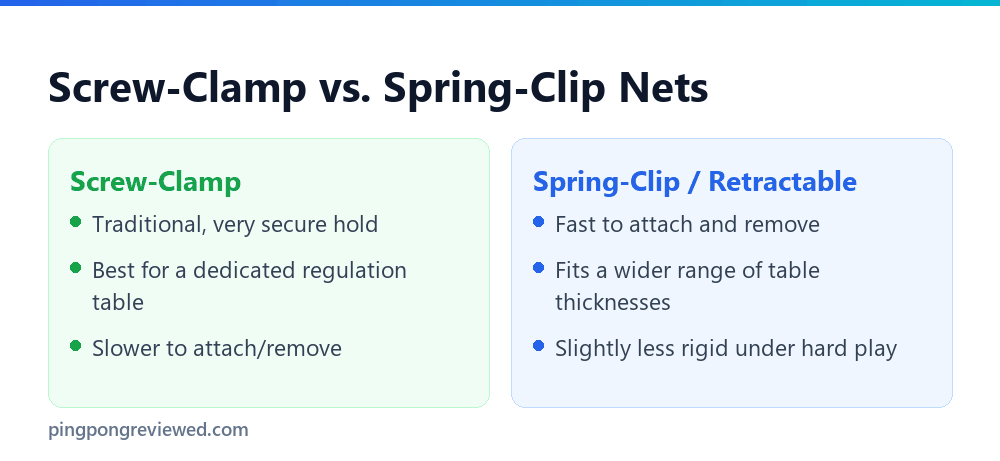
Nearly every net on the market uses one of two attachment systems, and knowing which one you want before shopping narrows the decision considerably. Screw-clamp posts thread directly onto the table edge and hold with real mechanical force, the traditional choice for a table that stays set up most of the time. Spring-clip or retractable systems clamp on with tension rather than a screw thread, trading a little rigidity for the ability to attach and remove the net in seconds, which matters more if you’re setting up and breaking down regularly on a shared or multi-purpose table.
Net material is a smaller but still real factor beyond the attachment mechanism. Nylon and polyester blends hold their shape and tension more consistently over repeated use than cotton blends, which can stretch or sag slightly over time, especially with humidity exposure. This matters more for regular players who set up the same net dozens of times a month than for someone who plays a few times a year, where the difference is unlikely to be noticeable within any reasonable ownership period.
3 Verified Picks
1. STIGA Premium Clipper — Best Spring-Clip for Varying Thickness
STIGA Premium Clipper Table Tennis Net and Post Set, $39.99, uses spring-activated clips with padded rubber grips built to accommodate a wider range of table edge thicknesses than a fixed screw-clamp typically handles. It’s the pick to reach for if you’re not certain your table’s edge matches a standard clamp width.
2. JOOLA Premium Inside Net and Post Set — Best Screw-Clamp for a Dedicated Table
JOOLA Premium Inside Table Tennis Net and Post Set, $27.45, is a traditional 72-inch regulation-size screw-clamp set, the more secure and stable option if your table stays set up most of the time and you’re not breaking the net down between sessions.
3. PRO-SPIN Retractable Net — Best Budget/Portable Pick
PRO-SPIN Retractable Ping Pong Net with Clamps, $17.09, is the cheapest of the three and genuinely built around the “fits any table” promise in this page’s own title, with a compact retractable design that stores easily and attaches quickly to tables of varying thickness.
If your primary concern is genuinely fitting an unusual or non-standard table rather than budget or setup speed, the STIGA pick’s wider clip tolerance is the one most worth trying first, followed by the PRO-SPIN as a cheaper backup if the STIGA doesn’t fit. The JOOLA screw-clamp set is the outlier of the three in this specific sense — it’s the most secure once installed but also the least forgiving of an unusual table edge, so it’s best reserved for a table you’ve already confirmed fits standard clamp dimensions.
Checking Your Table’s Edge Thickness First
Before buying any net, measure your table’s edge thickness rather than assuming a “universal fit” claim covers your specific table. Most nets accommodate roughly 1 to 1.5 inches of edge thickness, but tables vary meaningfully outside that range, especially budget folding tables with thinner MDF edges and older or oversized tables with thicker framing. A spring-clip net generally tolerates more variation than a screw-clamp, which is the main practical reason to choose one style over the other beyond simple preference.
A quick way to check without hunting for a manual: measure the thickness of the table’s edge with a tape measure or ruler at the exact point the net post will clamp on, not just anywhere along the rim, since table edges sometimes taper or have a routed lip that measures differently than the flat surface a few inches in. Comparing that measurement against the compatible-thickness range printed on each net’s listing before buying avoids the single most common return reason for this product category.
How We Verified These Picks
Each of the three picks above was checked against its own live Amazon listing individually to confirm it is a genuine standalone net rather than a paddle-and-ball set with a net included as a minor component. Current price and rating were verified individually as well.
We also compared each pick’s specific attachment-mechanism claims against its actual customer photos and question-and-answer section where available, rather than taking the listing’s marketing copy alone at face value. This matters specifically for thickness-range claims, since a listing’s stated compatible range is sometimes more optimistic than what buyers report actually working well in practice, particularly at the outer edges of the claimed range.
Getting the Most Out of Your Net
- Store it loosely, not tightly coiled, if you take it down between sessions — repeated tight coiling stresses the mesh fibers and post joints faster than flat or loose storage.
- Wipe down clamps periodically, especially spring-clip mechanisms, since dust and grip residue buildup can reduce clamping tension over time.
- Re-tension before serious play rather than assuming last session’s tension still holds — most nets loosen slightly with repeated setup and breakdown cycles.
- Replace rather than repair a torn net — a sagging or torn net changes ball trajectory in ways that make practice genuinely less useful, and replacement nets for most post systems are inexpensive on their own.
The Regulation Specs Your Net Should Match
Before comparing attachment styles, it’s worth knowing the numbers a net is supposed to hit, because plenty of budget nets don’t, and a net at the wrong height quietly changes how every rally plays.
- Height: 15.25cm (6 inches) measured from the table surface to the top of the net, and it should be that height consistently across the full width, not just at the centre.
- Full assembly width: 183cm (6 feet). That’s the 152.5cm table width plus 15.25cm of overhang past each edge, so the net and posts extend beyond the table on both sides rather than stopping flush with it.
- Tension: roughly 6–20 N. Taut enough not to sag in the middle, slack enough that a ball clipping the top still behaves like a net-cord rather than bouncing off a drum.
The height figure is the one worth actually checking on a net you already own. A net set even a centimetre high makes low pushes and short serves harder than they should be, and one set low makes them easier, either way you’re practising against a target that won’t match a properly set table elsewhere. A ruler takes ten seconds and settles it.
The overhang matters less for casual play but does affect wide angles: without the full 183cm assembly, a ball played sharply across the corner can pass beside the net where it should have been blocked, which changes what angles are legitimately available.
Why the Net Is the Most Overlooked Piece of Equipment
Players who will happily spend an hour comparing rubber sheets often buy whatever net is cheapest, which is backwards relative to how much each affects a game. Rubber changes what you can do with the ball; the net defines what counts as a legal shot at all, and it does so on every single point.
A net that’s too high penalises exactly the shots the sport rewards developing: short serves that barely clear, low pushes, and flat drives played close to the tape. Practise for months against a net set high and you’ll systematically over-lift those shots, then find your margins wrong the first time you play on a correctly set table. A net that’s too low creates the opposite habit and is arguably worse, because it flatters shots that would fail elsewhere.
A sagging net is its own distinct problem, since the effective height then varies across the width of the table, lower in the middle, correct at the posts. That means the same stroke played down the middle and down the line meets different clearance requirements, which quietly teaches inconsistent margins without the player ever identifying the cause.
None of this requires an expensive net. It requires a net that holds the right height consistently, which is a much lower bar than premium pricing and is mostly a function of the tensioner and clamp quality discussed above. Spending twenty minutes getting a modest net set correctly beats spending three times as much and leaving it sagging.
The Full Range of Net Types
Beyond the two attachment styles covered above, it’s worth knowing the whole category, because “which net” often turns out to be “which kind of net” once you know what exists.
- Screw-clamp nets: a threaded clamp tightens onto the table edge. The most secure and the most adjustable for tension, and the standard for club and competition use. Slowest to put up and take down.
- Spring-clip nets: a sprung clip grips the edge without threading. Far faster to attach, less secure under a hard ball, and the tension is whatever the spring gives you.
- Retractable nets: the net pulls out of a housing like a tape measure and retracts for storage. Genuinely convenient for shared or multi-use tables; usually the least adjustable.
- Full replacement post-and-net sets: what you buy when the original net that shipped with a table fails, matched to that table rather than universal.
If the table is shared with other uses, a dining table, a garage workbench, retractable or spring-clip wins on the practical grounds that a net you can put up in fifteen seconds is a net you’ll actually use. If the table is dedicated to table tennis and stays set up, a screw-clamp net is the better long-term choice for its tension control and stability.
Setting a Net Up Properly
Most net complaints, sagging, drifting sideways, uneven height, come from setup rather than the product. The sequence that avoids them:
- Attach both posts before tensioning either side, so the net is hanging loose and square across the table rather than being pulled crooked as you go.
- Centre the net on the table before tightening, checking that the overhang looks equal on both sides.
- Tension gradually and alternate between sides rather than fully tightening one end first, which is what pulls a net off-centre.
- Measure the height at the centre and at both ends. Centre sag is the most common fault and the easiest to correct while the clamps are still accessible.
For teardown, release tension before unclamping. Unclipping a net still under full tension is how post threads get stripped and spring clips get bent, and it’s the single most common way a net that should last years fails inside a season.
What Nets Are Actually Made Of
Net quality comes down to two components that are described vaguely in most listings: the mesh and the post hardware. They fail in different ways and on different timescales.
Mesh is typically cotton, nylon, or polyester. Cotton has the most traditional feel and the softest response to a net-cord ball, but absorbs moisture, stretches over time, and sags permanently once stretched. Nylon and polyester hold tension far longer and shrug off humidity, which is why they dominate at the budget end and in anything sold for outdoor use. For a table that stays set up in a garage or basement where humidity swings, synthetic mesh is the more practical choice regardless of price tier.
Post hardware is where cheap nets are usually cheap. Plastic clamp bodies flex under tension and gradually lose grip on the table edge; metal clamp mechanisms hold tension consistently for years. If you’re comparing two nets at similar prices, the one with metal rather than plastic at the clamp and tensioner is generally the better long-term buy even if the mesh looks identical.
The tensioning mechanism deserves a specific look too. A net with a proper adjustable tensioner lets you correct sag as the mesh settles in; a net with fixed tension gives you whatever it gives you, and once the mesh stretches there’s no way to take up the slack. That single feature does more for a net’s usable life than any difference in mesh material.
Common Net Problems and What They Mean
- Centre sag: almost always insufficient tension rather than a defective net. Re-tension alternating between sides. If it recurs within a session, the tensioner isn’t holding and that’s a hardware fault.
- Net drifts sideways during play: the clamps aren’t tight enough on the edge, or the table edge is thicker than the clamp is rated for and it’s only gripping partially.
- Uneven height end to end: one post is seated lower on the table edge than the other, usually because an undercarriage bar is holding one clamp off the surface.
- Balls passing under the net: the net’s bottom edge should sit against the table surface along its whole length. A gap means the posts are set too high or the mesh has shrunk.
Worth knowing when a net is simply finished rather than misadjusted: permanently stretched mesh that won’t hold height even at full tension, and clamp threads that spin without gripping, are both end-of-life signals. Nets are inexpensive enough that replacing one is usually more sensible than improvising a repair, and a sagging net quietly degrades every practice session it’s used for.
Replacing the Net a Table Came With
A large share of net purchases are replacements for the net that shipped with a table, and that’s a slightly different problem from buying a net for a bare table. Bundled nets are usually the component manufacturers economise on hardest, because the table’s price is set by its top and frame, and the net is what’s left in the budget.
Two things are worth checking before assuming you need a full replacement. First, whether the existing net is genuinely worn or just badly tensioned, the sag that makes a bundled net feel cheap is often adjustable. Second, whether the posts or the mesh are the failing part: some manufacturers sell replacement mesh for their post systems, which is cheaper than a whole assembly and keeps the clamp geometry that already fits your table.
If you are replacing the whole assembly, a universal clamp net is usually the more flexible choice over a manufacturer-specific replacement, since it moves with you to a future table instead of being tied to the one you own now. The exception is tables with unusual edge profiles or integrated post sockets, where the matched replacement is the only thing that will seat properly.
If the Table Lives Outdoors
A net for an outdoor table is a genuinely different purchase. Standard indoor nets use cotton or untreated synthetic mesh and steel post hardware, both of which degrade quickly outdoors, mesh sags and rots when repeatedly wetted, and untreated hardware rusts at the clamp threads where it matters most.
Weatherproof nets use synthetic mesh that doesn’t absorb water and corrosion-resistant post hardware, usually aluminium or coated steel. They generally cost more than an equivalent indoor net, and the premium is real rather than marketing, though even a weatherproof net lasts considerably longer if you bring it in over winter rather than leaving it out year-round. Our outdoor net guide covers verified weatherproof options specifically.
Wind is the factor outdoor players underestimate. A net presents a surprisingly large flat surface to a crosswind, and a clamp tension that holds perfectly indoors can let the whole assembly shift on a gusty day. If your table is somewhere exposed, prioritise clamp strength over mesh quality, a slightly coarser net that stays put beats a nicer one that needs re-centring between games.
One last practical note for outdoor setups: take the net off when the table is not in use, even if both are rated for weather. Ratings describe survival, not indefinite preservation, and the net is both the cheapest component to remove and the fastest to degrade. Thirty seconds of teardown reliably adds seasons to a net that would otherwise be replaced annually.
If taking it down every time is unrealistic for how you actually use the table, a simple cover over the net and posts is a reasonable middle ground. It won’t match removing the net entirely, but it keeps direct sun and standing rain off the two components that suffer most, and a habit you’ll actually keep beats an ideal routine you abandon after a fortnight. Whichever route you take, check the clamp threads for corrosion every few months, since that is where an outdoor net almost always fails first, and it is very easy to catch early if you simply remember to look.
Frequently Asked Questions
What is the best portable ping pong net?
The PRO-SPIN Retractable Net is the most travel-friendly of our 3 picks, storing compactly and attaching quickly without any tools. For a deeper comparison of retractable-specific options, see our dedicated retractable net guide.
Can I use these nets on any table?
Within a reasonable edge-thickness range, yes, but always check your specific table’s edge thickness against the listing’s stated compatibility rather than assuming a “fits any table” claim covers every table without exception.
What’s the difference between screw-clamp and spring-clip nets?
Screw-clamp posts thread on with real mechanical force for a more rigid, stable hold, best for a table that stays permanently set up. Spring-clip nets clamp with tension instead, trading some rigidity for much faster attach-and-remove convenience.
Can these nets be used outdoors?
Check the specific listing’s material first — nylon and polyester mesh nets generally tolerate occasional outdoor use better than cotton-blend nets, which absorb moisture and can mildew if left outside repeatedly without being dried.
Are more expensive nets actually better?
Generally yes for stability and net tension consistency over the long run, though the gap matters more for serious or frequent play than casual use. Our budget pick above is a genuinely reasonable choice for occasional players who don’t need that extra durability margin.
How tight should a ping pong net be set?
Tight enough that it doesn’t sag in the middle but not so tight that it distorts the post angle — most nets include a tension adjustment specifically for finding this balance, and it’s worth adjusting rather than leaving at the factory default.
What’s the regulation height for a ping pong net?
6 inches (15.25 cm) at the center, which is the standard nearly every commercial net, screw-clamp or spring-clip, is built to meet by default. It’s still worth double-checking after setup rather than assuming, since a worn or stretched net can settle slightly lower over time.
Do I need to buy paddles and balls separately from the net?
Yes, all three picks on this page are standalone nets. If you need paddles and balls too, our other equipment guides cover verified picks for both separately, which generally gives you better individual quality than a bundled set built around minimizing total package cost.
As an Amazon Associate, we earn from qualifying purchases through links on this page.

Ping Pong Reviewed is an equipment review site covering table tennis and baseball gear. Specifications are checked against manufacturer listings, and prices against live retail pages, before publication.